
Hearts and Flowers – Draw Freely with Me!
This week we will grab colored pencils and draw freely in full color. Follow me step by step!
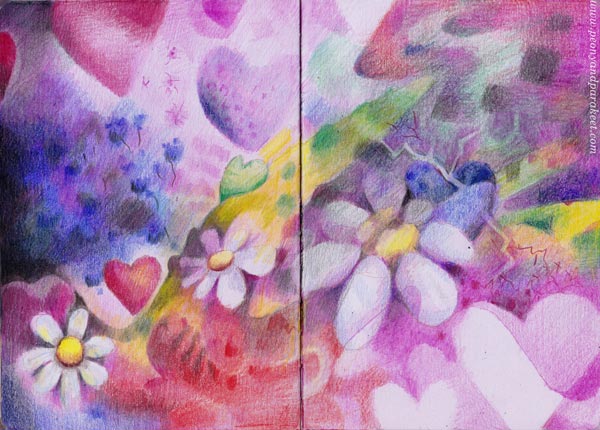
This exercise is set so that we start simple and then get more creative. If you are a beginner, you can stop earlier, and if you have more skills and patience, you can go to the very end. You only need paper and colored pencils. I drew the picture in my colored pencil journal.
Step 1 – Draw a Flower and a Heart
Pick a brown or blue colored pencil and draw a flower and a heart.
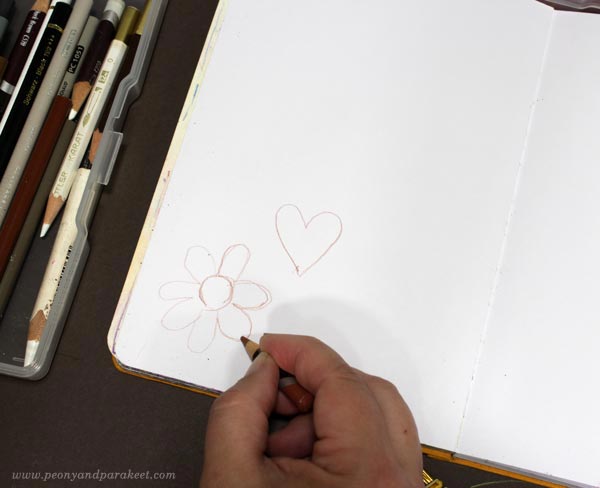
There’s nothing creative here, these are just the basic symbols of a flower and a heart. Place these on the corner of the page so that they are like a starting point for the rest of the image.
Step 2 – Draw a Tilted Flower and a Heart
Now draw a flower and a heart so that they look tilted. Having variation makes the image!
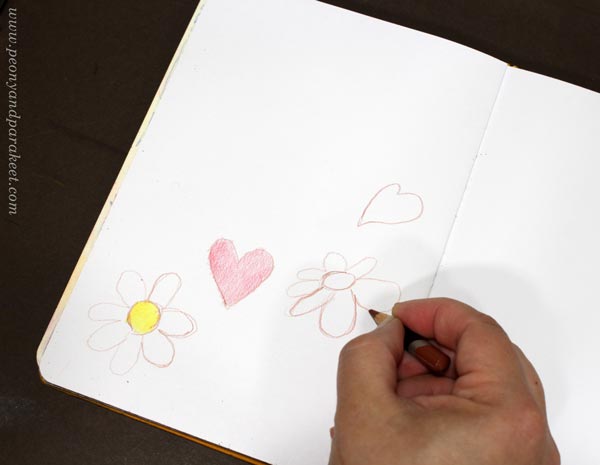
Instead of a circle, draw an oval for the center of the flower. Change the length of the petals gradually. Draw the other side of the heart smaller so that it’s not symmetrical anymore.
I like to add some color right away – not much, just a light layer as a warmup.
Step 3 – Draw a Big Flower and Then a Heart Behind It
I bet your flowers and hearts are pretty similar in size and placed separately – like mine are! Let’s add variation by drawing a big flower and by placing a heart behind it. So here, the heart is only partly visible.
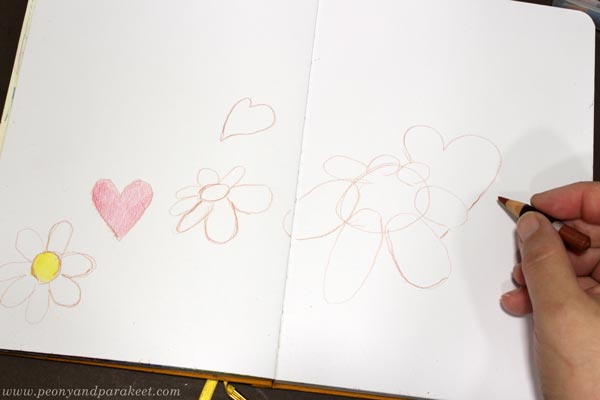
Again, I drew the flower a little differently than before. I made the petals go on the top of the center. Now when the flowers and hearts are all a bit different, they look more lively too.
Step 4 – Color the Hearts and Flowers and the Background Around Them
Now pick a wider selection of pencils and color the hearts and flowers. Also, choose a background color and add some of it to the background.
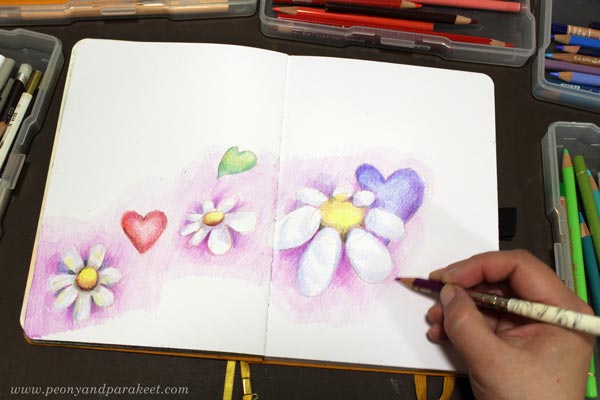
You can adjust the outlines if needed with the background color. Color lightly and leave most of the background blank.
Now you have a cute little drawing, but let’s draw more freely next!
Step 5 – Color Flowers on the Background
We now have stereotypes of flowers, but let’s go further and question them. When a flower wants to be free, it becomes less defined, and the center disappears. Make the background more lively by coloring three big blurry flowers freely.
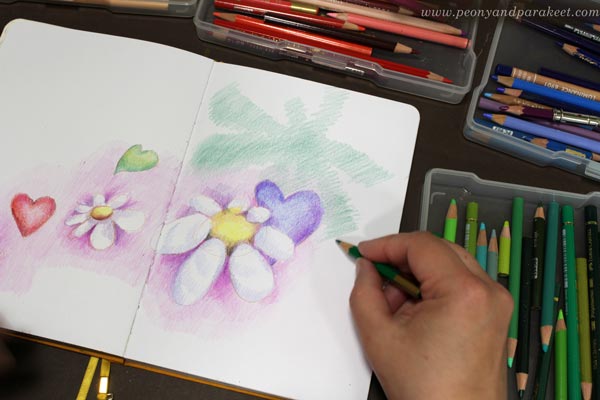
Without thinking about typical flowers, color stripes that go in different directions. They can have different lengths, be straight or curvy, and the result can look pretty odd!
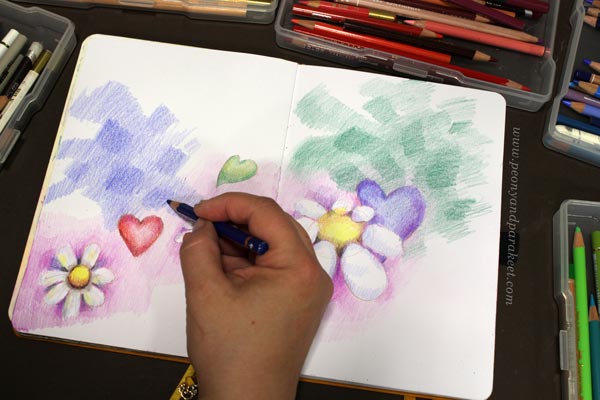
Then color rectangles on the top. Make three blurry flowers total – sets of stripes and rectangles, that is!
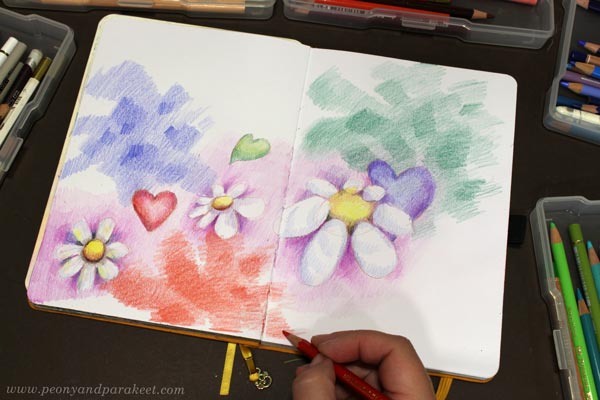
Connect the elements so that the new ones go a little behind the old ones. When you want to create an emotional connection, create a visual connection!
Step 6 – Color Hearts on the Background
Without outlining, color a set of hearts with the background color, and then make a second set of white hearts by coloring the background.
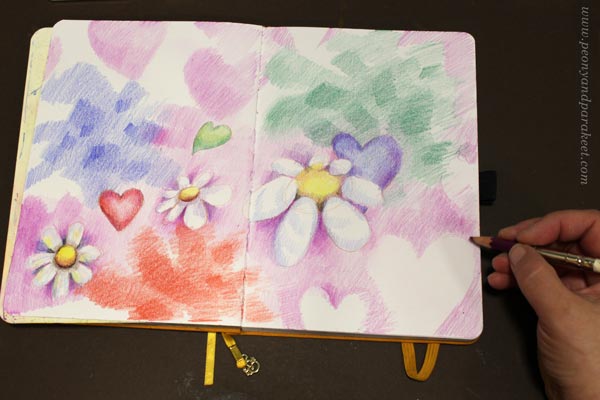
Color around the heart, not the actual heart! The hearts can have various sizes. Place a part of the hearts near the edges so that they are only partly visible.
Then add more background color so that it goes partly over the background elements and makes the image a little darker and calmer.
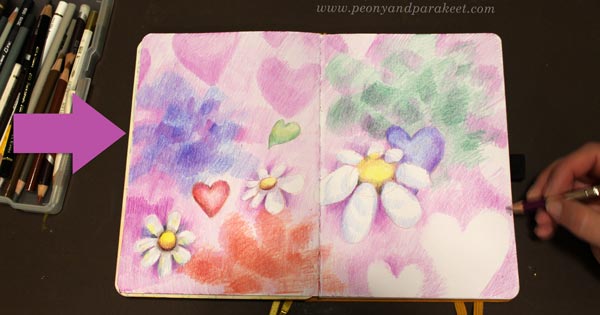
Now you have some free expression, but next, let’s go further and add more drama!
Step 7 – Color a Dark Path
Light always shines more brightly when there are also dark colors. Pick black and other dark pencils and plan a path that goes across your image from one corner to the opposite side of the center.
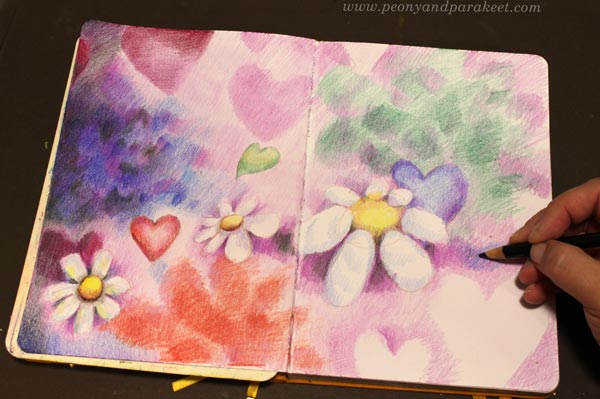
First, color the chosen corner and the nearest edge. Then move towards the center. There, add shorter stripes and spots that mark the path and highlight the best parts of the image.
Now you have set the basic lighting. But in nature, light often travels less straight and makes the overall impression less stiff.
Next, we will get creative and free up the light!
Step 8 – Draw a Freeform Line and Color Its Sides Differently
Take a deep breath, and practice first. Stand up, and move a pencil in the air so that it creates curves. Then sit down and draw a curvy and continuous line that goes across the page.
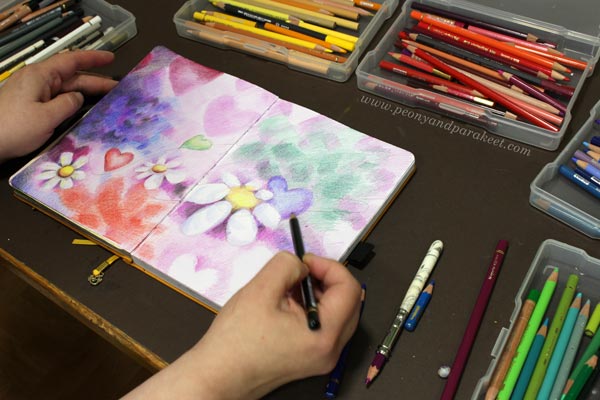
Draw freely and lightly!
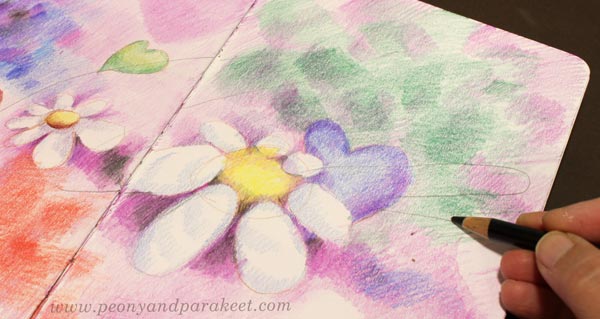
Then color around the line so that light and shadows alternate there. When darkening an area, notice that you can also color smaller shapes and patterns instead of using a solid color.
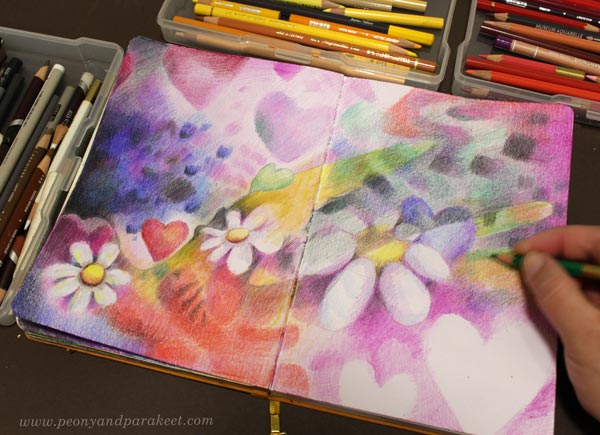
Hearts and flowers can also interact with the division so that they add more little curves to it.
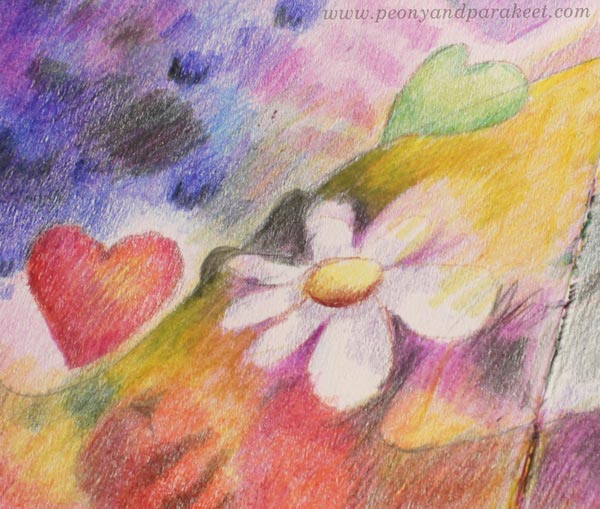
Here, the petals push the line away, creating small bumps.
If you want to add more interest to any other area, you can do the same: draw a line and then color the sides differently.
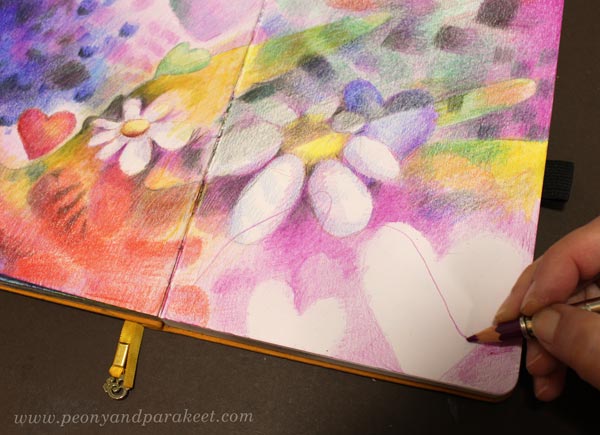
Now you have an atmospheric image, but does it have a message?
Next, let’s ponder what to express and color a little more!
Step 9 – Finishing with a Message
Ask yourself: what element do you like the best? My favorite thing was this blurry heart.
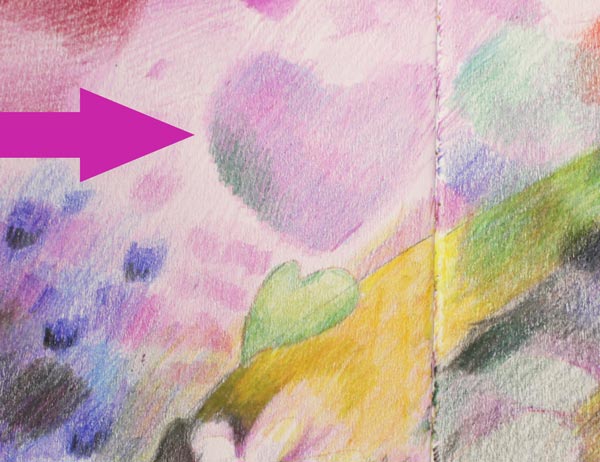
Even if it’s not a centerpiece like the big white flower, it felt like a force that affects the scenery the most. I often discover this kind of “background force” in my drawings and paintings. It seems to be the most strongly connected with the overall message that I want to tell.
The pink heart is like a lady who makes everybody fall in love with her. I want the overall scenery to look feminine but also have elements that include agony and the more desperate side of romantic feelings. I like the tension that I gave with some sharp lines and dramatic curves.
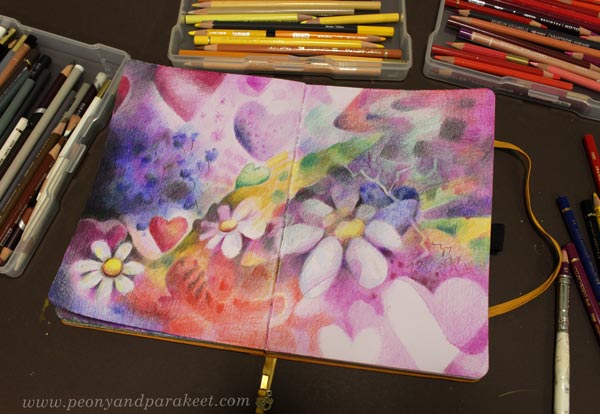
Because everything has two sides, often finishing with the message means adding more tension. It makes the image feel more real and more relatable.
I hope this inspired you to draw freely!
Let’s Get Inspired by Tassels!
This week, we dive deep into the soul of tassels and get the most out of our creativity.
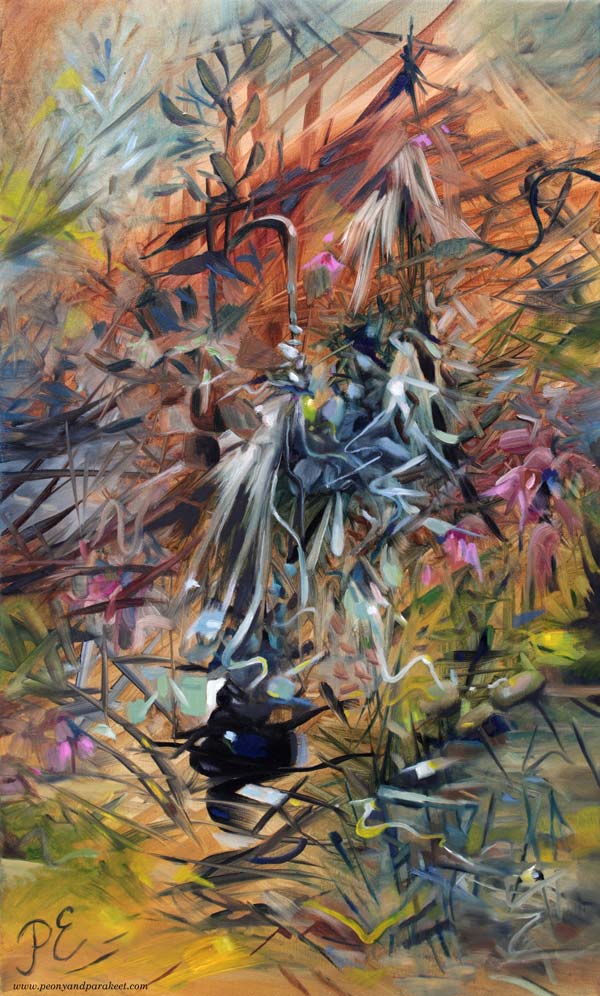
Here’s one of my newest paintings called Church of Saturn. This oil painting is a part of my series Linnunrata – Milky Way, where I explore planets and outer space. (See previous work: Jupiter here, Uranus here, the Moon here, Mercury here, Neptune here, Pluto here, the Earth here, Venus here, and the Sun here!) When I painted it, I thought about the rings of Saturn, the god of agriculture, branches and twigs, an old wooden church from my childhood, wabi-sabi, and the beauty of – tassels!
Tassel Dolls
When I was living in Eastern Karelia in the 1970s, the simplest doll we could make was a tassel doll. I painted it in watercolors so that you can check if it’s something that you had too!
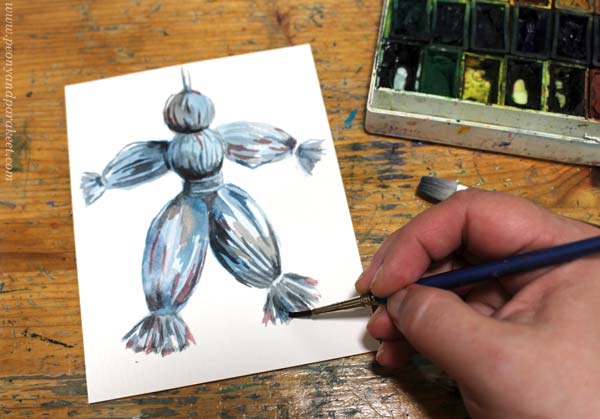
The doll was made of wool yarn and so simple that even a 5-year-old could make it. It’s a good example of a thing that is not valued by our adult self, but that brings up our inner child: “Hey, Miss Tassel, where do you want to go?”
Tassels as Extra Decorations
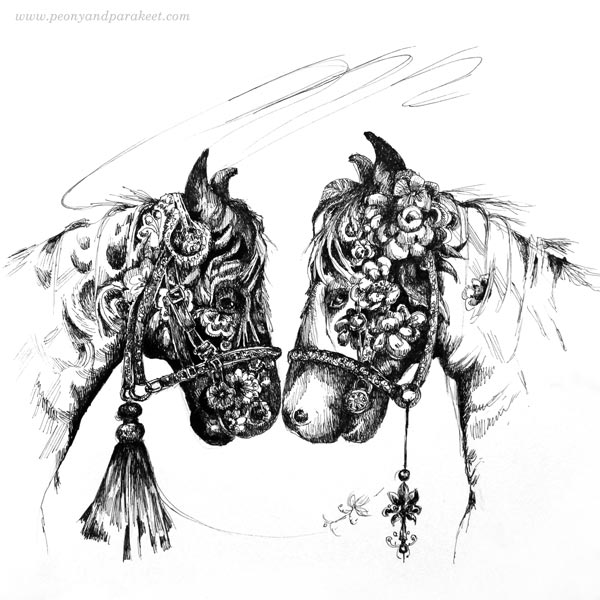
I rediscovered my love for tassels in 2018 when I participated in the Inktober challenge. Back then, I thought of tassels being a fun accessory and I have enjoyed using them as extra decorations in my drawings.
This week, I drew a new tassel for my boxes of joy and had a lot of fun making it.
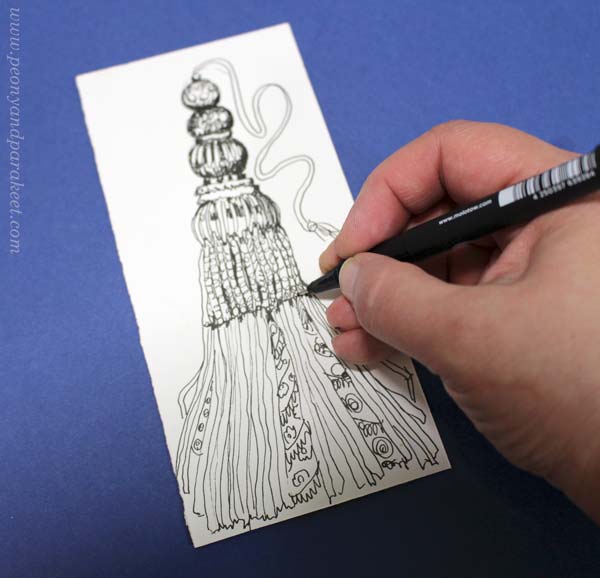
First I drew some circles and lines with a black drawing pen, then added textures and shadows in the style I each in the classes Animal Inkdom and Magical Inkdom.
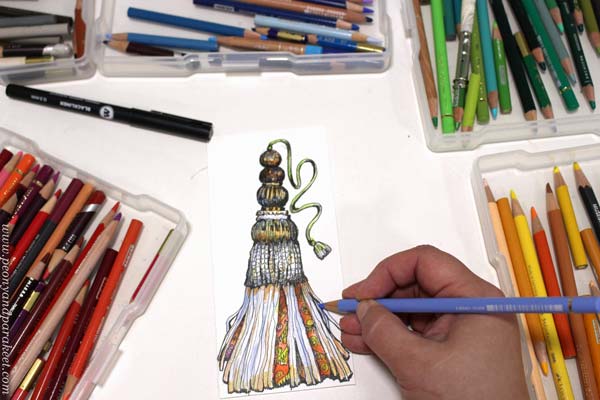
After colored pencils, I picked some other hand-drawn pieces from my boxes and admired the luxurious collection.
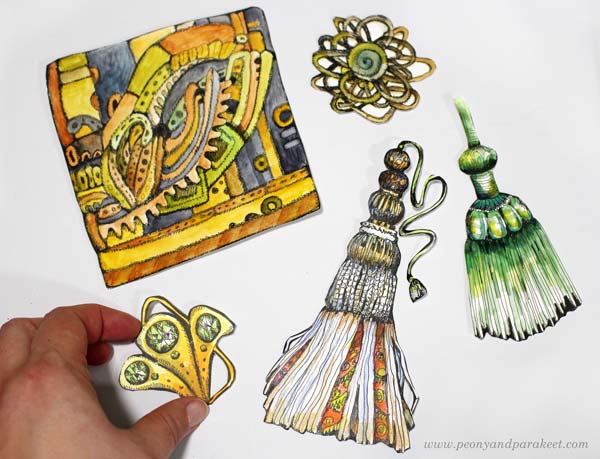
Who needs shopping when you can have your own personal store and draw all the good stuff for it!
Blowing Life to a Tassel
A tassel drawing can be more than a decoration only. You can have more fun by playing with it so that it will get a personality. Imagine a tassel as a person or an animal – a living thing. Here I see two tassel ladies on a stroll!
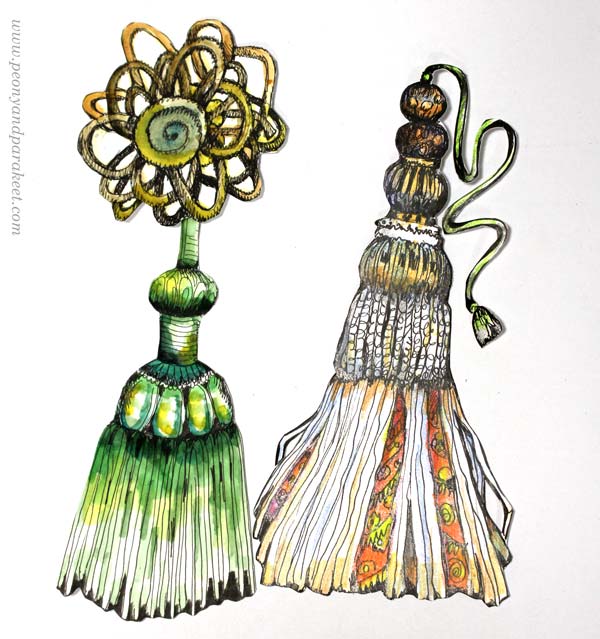
Now, the tassel has a mind of its own. An artist can see any simple object as an element of expression.
In the painting “Church of Saturn,” the tassels have a spirit that makes them an integral part of nature.
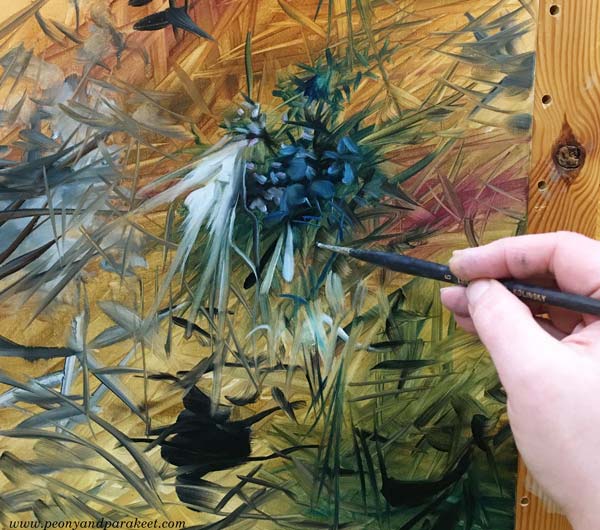
These tassels are organic, and the style is abstract rather than illustrative.
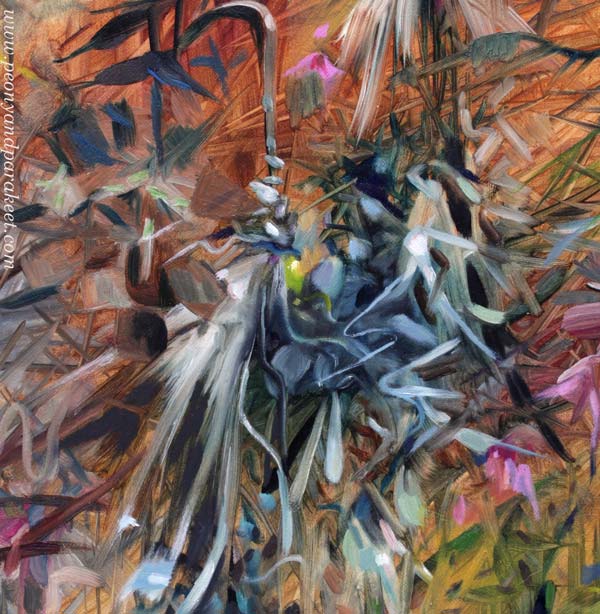
As artists we need to do this – go beyond what’s expected and commonly seen.
Ornamental Figure with Tassels
In the class Magical Inkdom, I draw a funny bunny with a tassel on her head and now I got the idea of making an ornamental figure so that the tassels form the body.
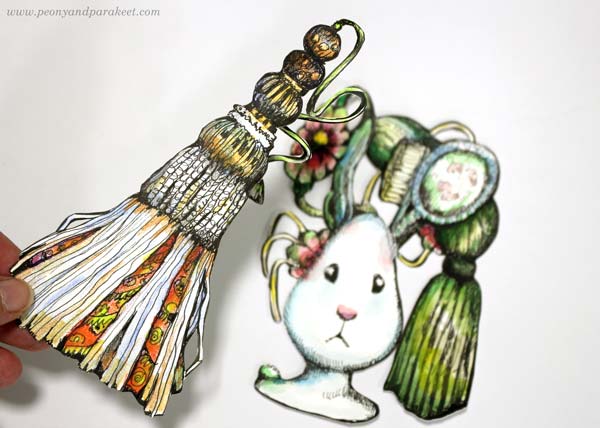
To make a symmetrical ornament, I traced the tassel three times on the right side marker paper. Marker paper is thin so it’s easy to see through it.
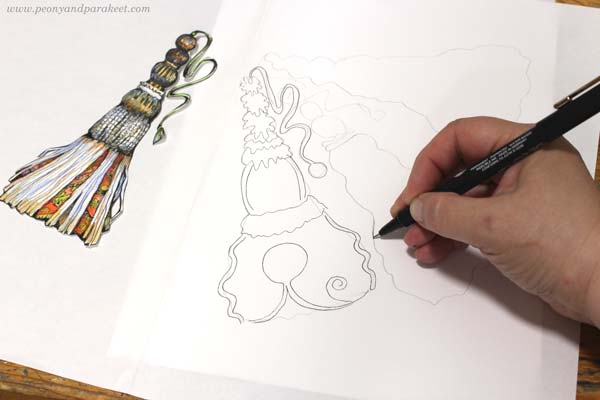
Then I taped the paper to the window and traced the three tassels on the left side of the paper. I added additional elements to the center and some facial features too. My tassel doll!
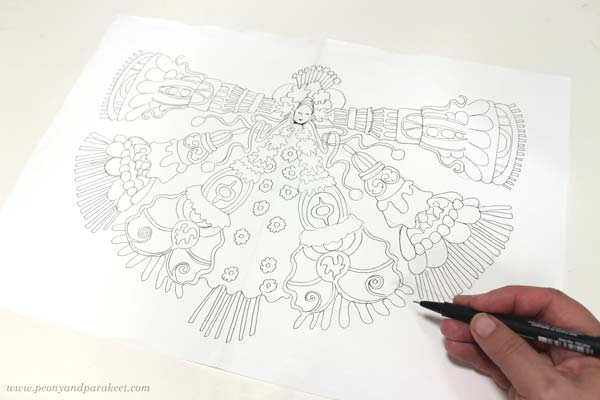
But when I continued the drawing, I got a crazy idea of a knitting hamster. Tens of years ago, I was a hamster breeder, attending shows and everything. I know those little animals well! Knitting is one of my favorite hobbies and the thought of a hamster collecting all the yarn and trying to knit it made me smile.
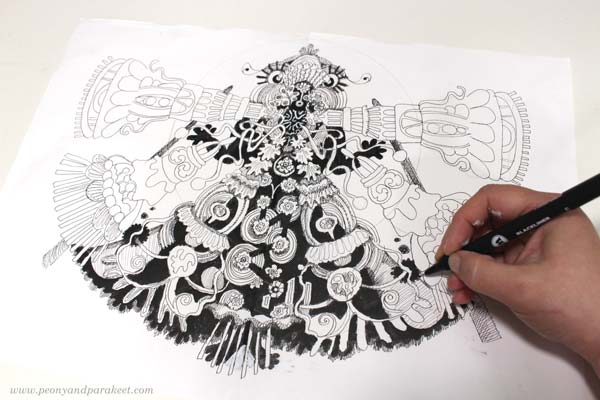
Then the word “Knitwork Orange” came to my mind, and I included the orange as well!
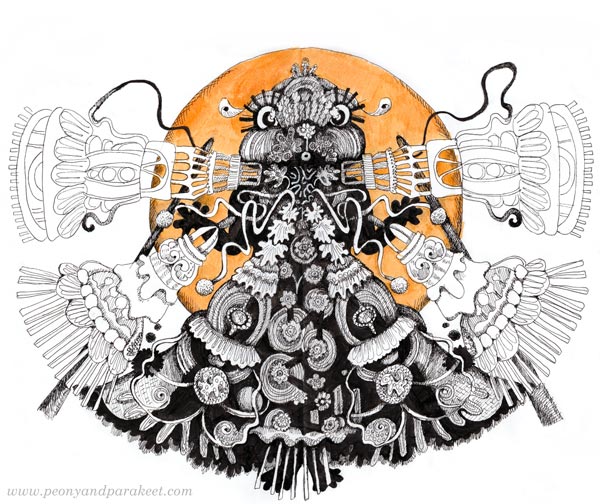
Here’s me, in the middle of the night, knitting away!
Tassel Dolls on Mars
Last spring, I had a small canvas that was first just a mess. I like to start my paintings in this intuitive way and without a plan. I had some leftover paint so nothing was wasted.
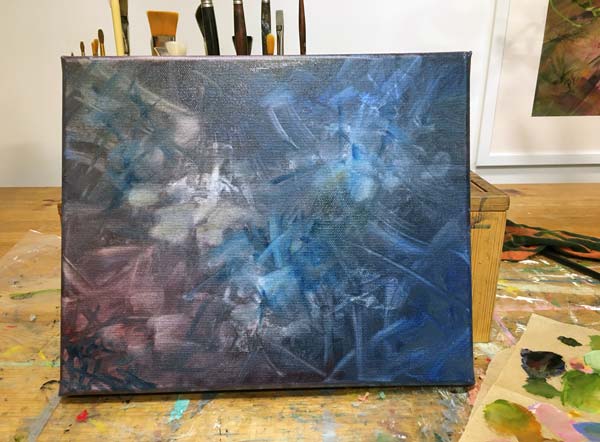
The first ideas are terribly traditional and mine was to make a vase with flowers.
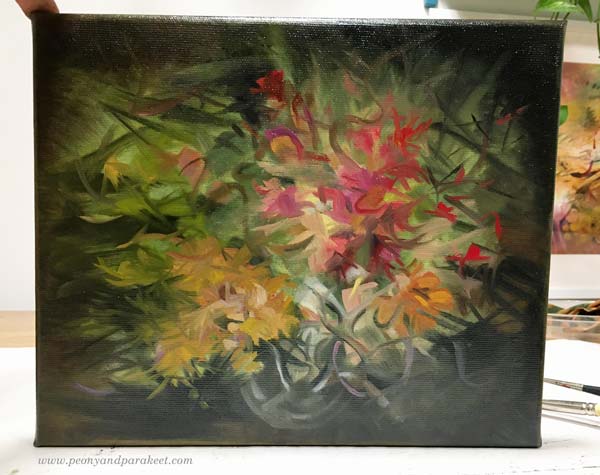
But after this, I was taken to another planet, to Mars! There, tassel dolls met art deco, and I had a lot of fun finishing the painting with all the decorative details.
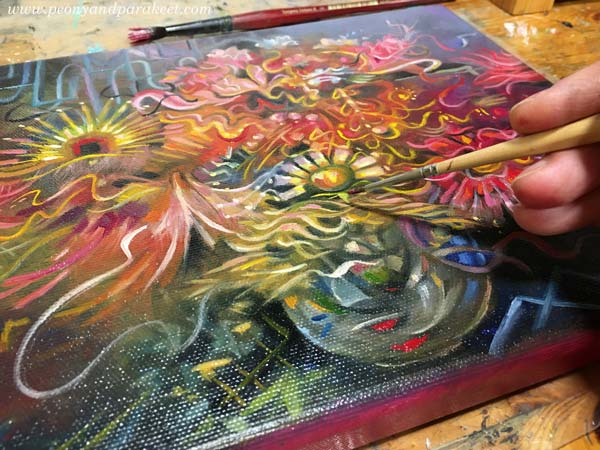
I love the Great Gatsby movie from 2013. It has the best party scenes and good music. I had a lot of fun creating a tassel doll party that took place on another planet.
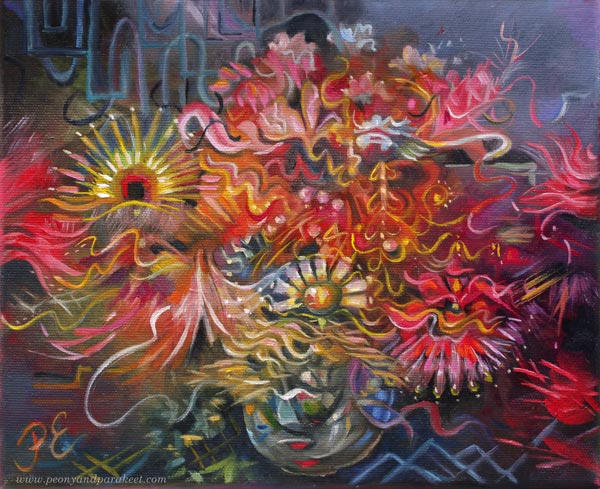
This small piece ends the Milky Way series – 11 oil paintings from March to May. I have taken a break from creating art, but feel like I am recovering now. Thanks to making the tassel drawings for this post! I hope they work for you too!
Painting and Drawing Fruits
This week, I share my love for fruits and give inspiration for fruit-themed paintings and drawings.
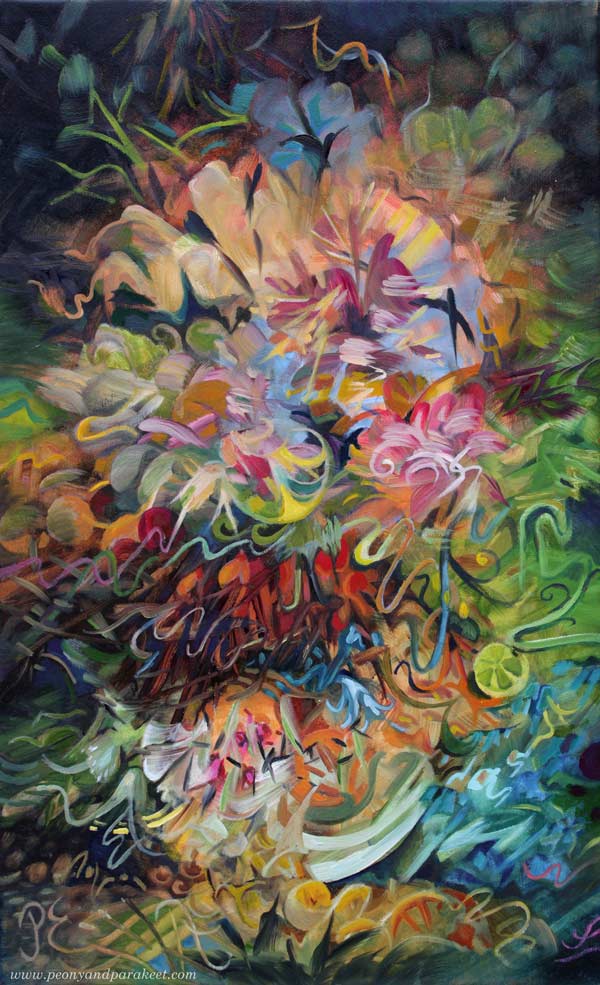
Here’s one of my newest paintings called Jupiter’s Bowl. This oil painting is a part of my series Linnunrata – Milky Way, where I explore planets and outer space. (See previous work: Uranus here, the Moon here, Mercury here, Neptune here, Pluto here, the Earth here, Venus here, and the Sun here!)
Fruit Storm in a Magical Bowl
The idea for this painting started from the orange storm that the planet Jupiter has. But then I thought about the Finnish saying “myrsky vesilasissa” which is “storm in the water glass” in English and similar to the saying “storm in a teacup.” It felt playful and funny to compare the planet to a small bowl and make a still life that doesn’t look still at all.
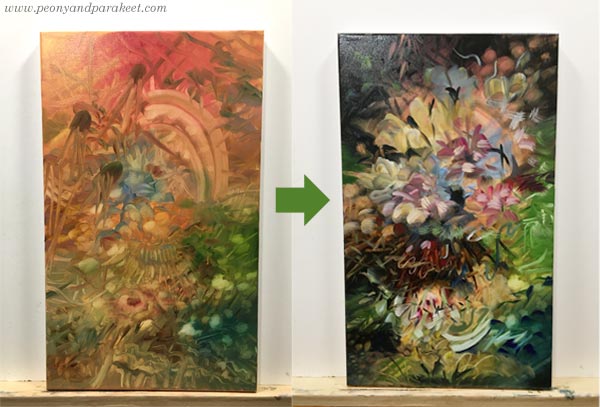
The first layers were very different from each other, and it felt like there was still more to come. The final version has brighter colors and juicy fruits that burst everywhere. Here’s a closeup of some:
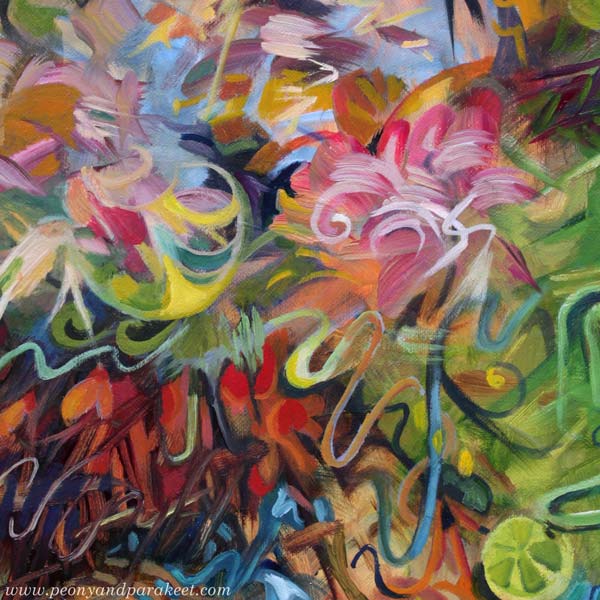
I love lemons and oranges. I think they are one of the most attractive things in the world. Their smell, taste, and look captivate me. And they are not difficult to paint or draw either!
Decorative Slices in Black and White Drawing
Here’s a line drawing from 2018 when I participated in Inktober for the first time. The slices were fun to draw, especially because I treated them like Faberge eggs: filled with jewelry and other decorative elements.
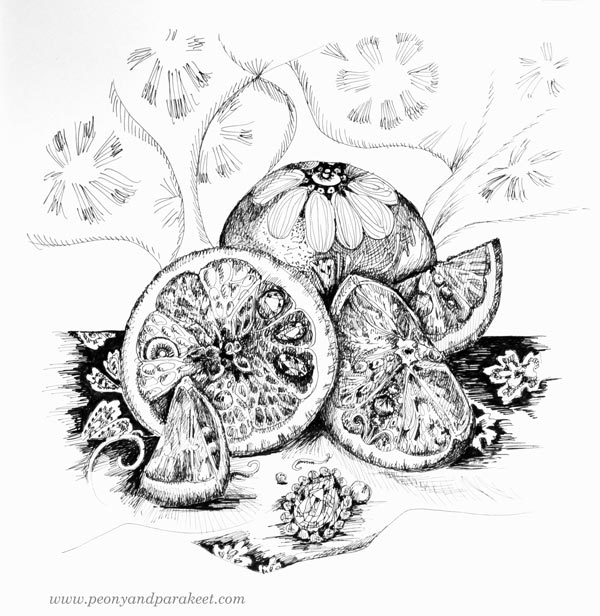
Back then, I was finding out things that I really like and bringing them together in my drawings.
Intuitive Fruit Painting in Gouache
In 2019, I made a gouache painting (see the video!) that reminds me of Jupiter’s Bowl. It has fruity and fresh colors and some stormy vibe too.
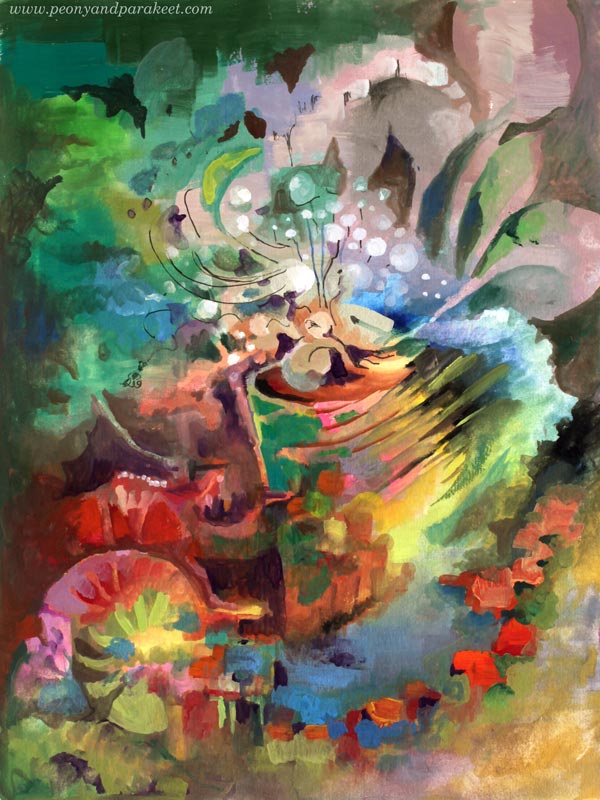
I was a bit clumsier painter back then, but the idea of refreshing fruity burst is evident.
Fantasy Fruits in Colored Pencils
This year started by making a new class called Fun Botanicum. The second lesson of the class is about fruits and berries. Here’s my example from the class, made with colored pencils.

I wanted the spread to look juicy with my own fantasy fruits. Practically, you can draw a circle, add shadows and decorations, and it will look like a fruit!
Juiciness vs. Fruits
When I took pictures of Jupiter’s Bowl, it was late May and grass and tulips were in full bloom. There’s a lot of juiciness in summer colors.
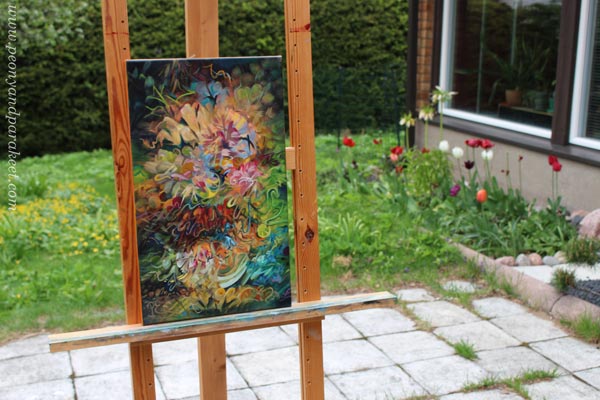
My suggestion is to focus on the juiciness when drawing or painting fruits. If you think about how the fruits look in reality, the result gets stiff more easily. If you let go and focus on the juicy part, creating is much more fun and the result more expressive. Anything can have the spirit of the fruit, and art can be juicy without presenting the actual lemons and oranges.
Tell me, which are your favorite fruits? Do they appear in your art too?
Expressing Moonlight Magic
This week is about the moon and expressing the magic!
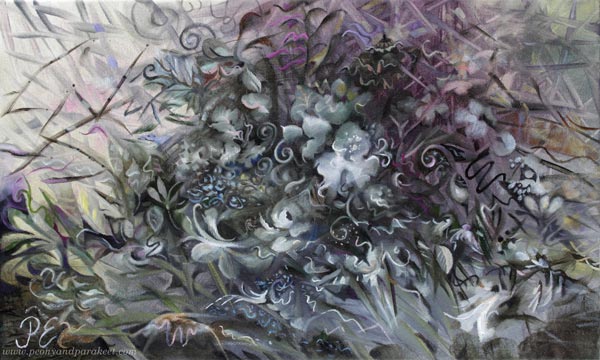
Here’s one of my newest paintings called Kuutamon Taika – Moonlight Magic. This oil painting is a part of my series Linnunrata – Milky Way, where I explore planets and outer space. (See previous work: Mercury here, Neptune here, Pluto here, the Earth here, Venus here, and the Sun here!)
Experiencing Moonlight Magic
One night in April, after a long workday, my spirit was low, and I felt tired. But after stepping outside to take the dogs out one more time, I saw a beautiful moonlight. I even took a picture but just with my phone camera, and the photo doesn’t do justice to the sight.
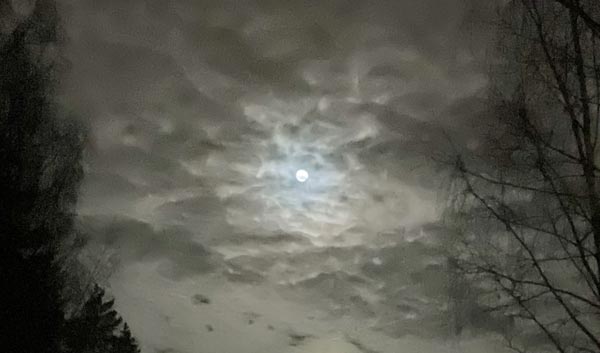
Everything looked black and white at first, but after a while, my eye saw a subtle variety of tones. It was like a message from the moon: “Paint me next! Let me be a part of your galaxy!”
Fantasy Art Connects Imagination and Past
This was not the first time expressing the moonlight magic. A few years ago, I started to feel that my art needed more fantasy. I had begun to follow many fantasy artists, for example, Jasmine Beckett-Griffith and Annie Stegg. Imaginative realism – as the genre is called – felt inviting. In 2018, I participated first time in the Inktober challenge, and in 2019 I made a class called Magical Inkdom.
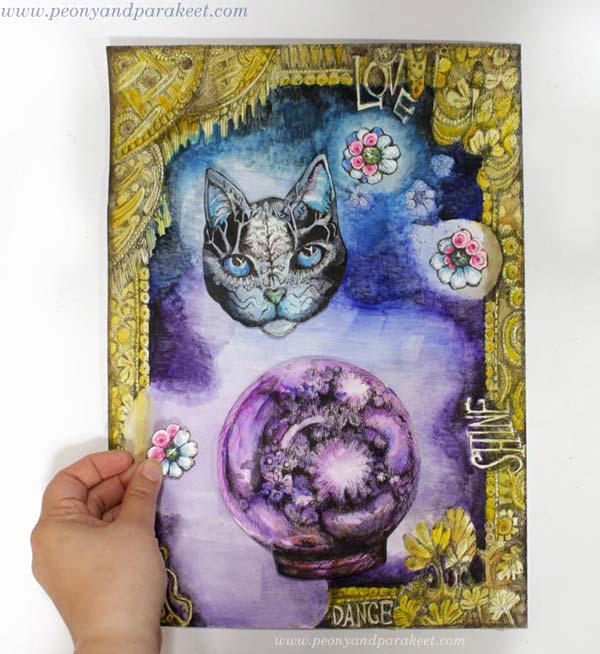
The world of Magical Inkdom is playful and colorful, but so that some elements look historical, just like in imaginative realism, where the story often happens in the past.
I wanted fantasy art to be present in my upcoming show too. So I wanted to make a painting with a similar historical yet fantasy-oriented look. My goal was to create a traditional floral but still include something that would tickle the imagination and feel magical.
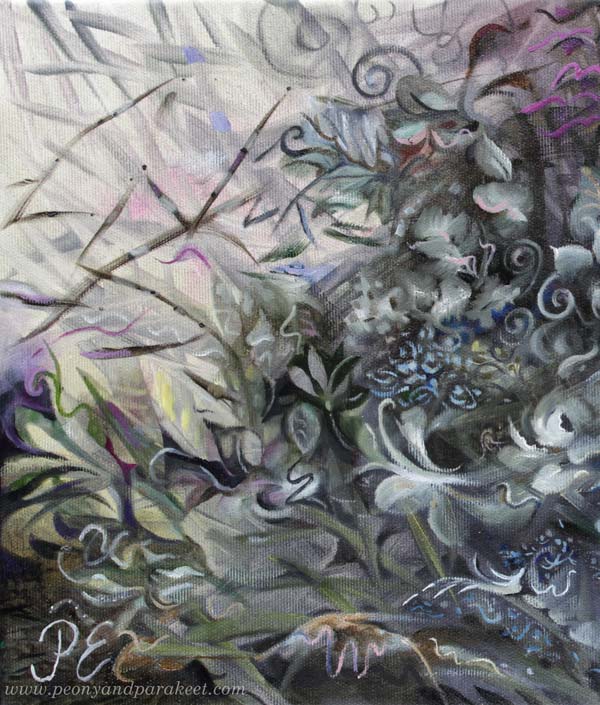
A slightly extraordinary composition and a combination of both decorative and more abstract elements make this painting stand out.
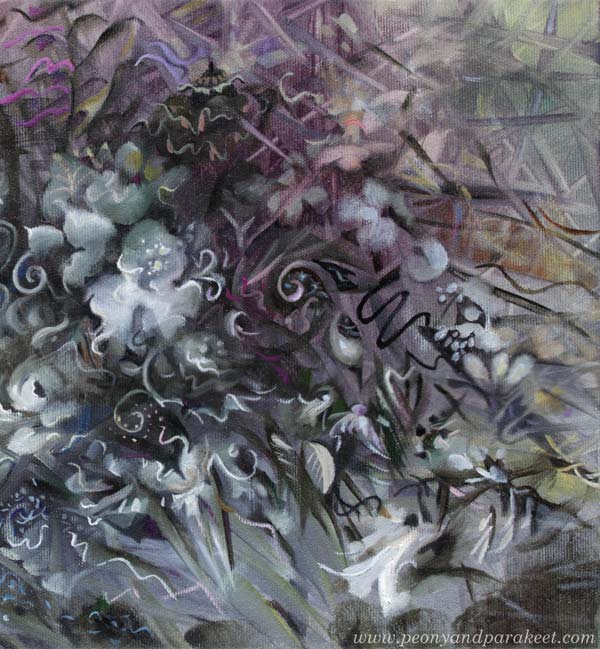
I am also surprisingly fond of the color scheme and it was much more fun to paint than I expected.
Expressing Magic and the Ability to Disappear
A part of the magic is that something almost disappears and then appears again, just like the moon in a cloudy sky. There are lots of blurry elements in this painting, even if you might not notice them right away. A sharp line and some dots on a blurry spot make the flower.
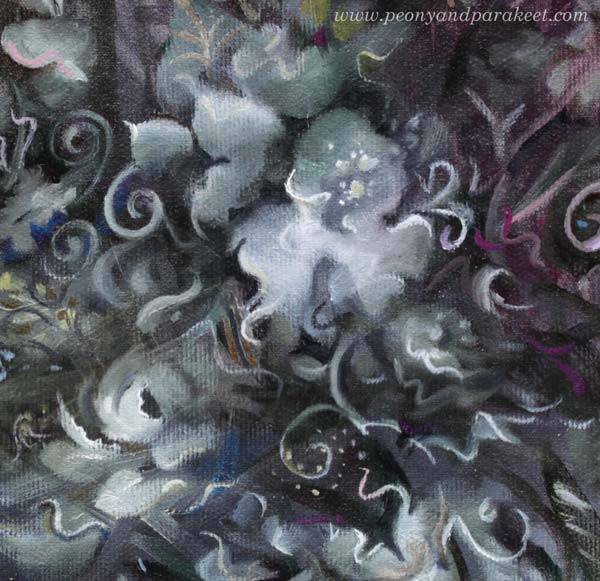
Old master painters of the 16th to 18th centuries used this technique a lot.
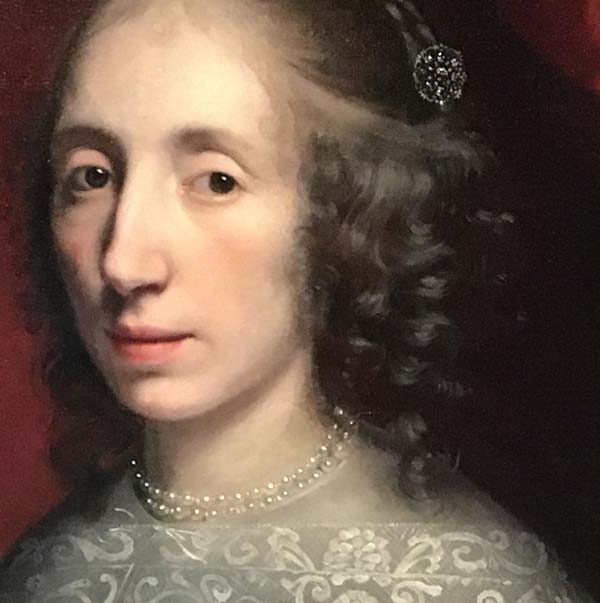
For example, look at the hair and the pearls in this portrait. Just blurry spots that have been sharpened with lighter and sharper strokes and dots. Don’t they look magical!
Preparing for the Show
This painting is small, 30 x 50 cm. Here’s a quick snapshot where you can see the size better.
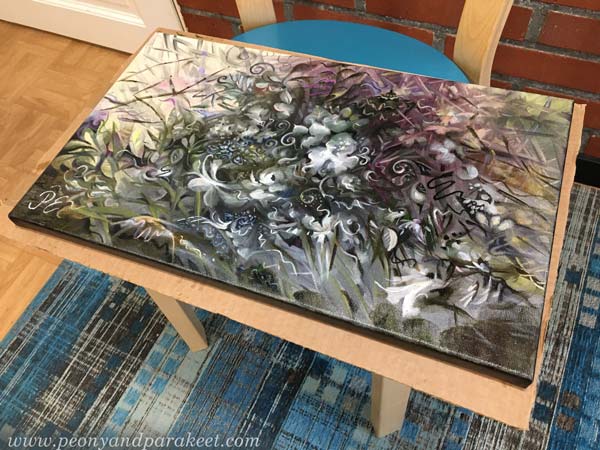
I am currently varnishing paintings for my upcoming solo show in June. All the tabletops are full and the not-so-pleasant odor is in the air. I hope to have photos of the show next week.
P.S. Magical Inkdom is for sale until June 16th! >> Buy here!