
Half-Empty Art Journals I Should Fill Up
Last month, I went through my art supplies and wrote a post about the supplies I shouldn’t use anymore. After the post, I gave most of those useless-to-me supplies away. Now I have reviewed my art journals and have come to the conclusion that I have too many half-empty ones. I should fill these up and at the same time, end one era in my artistic journey.
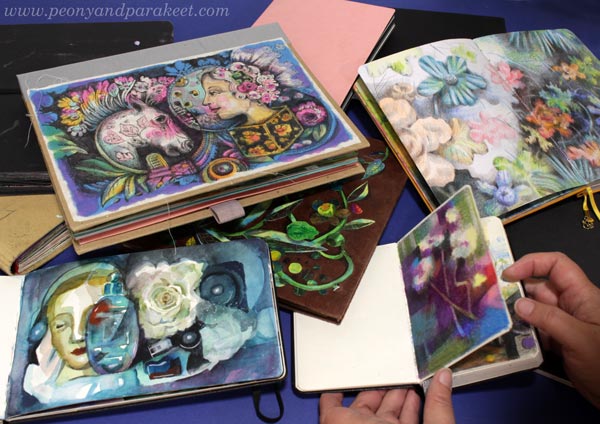
I don’t mean I shouldn’t have any art journals or sketchbooks anymore, but I think I could do well with only one or two. I have grown my skills by drawing a lot, but now I feel I am more of a painter. Most of my creative energy nowadays goes into painting, and I mostly make either watercolor or canvas paintings. So, the books don’t serve me as much as they have in the early years.
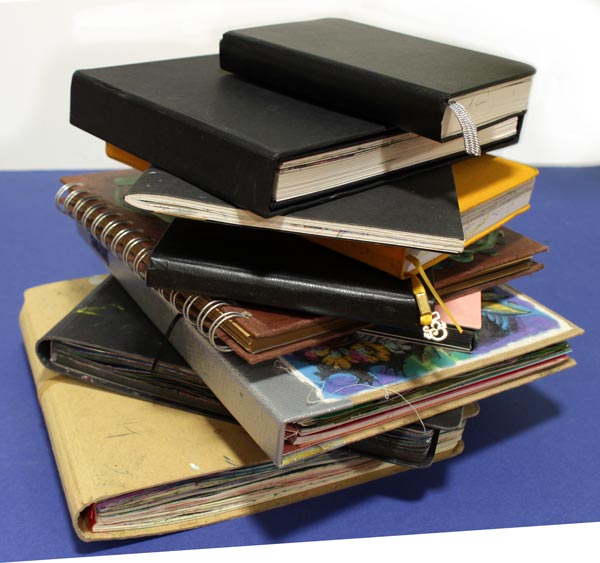
Ten of my art journals are half-empty. I don’t think it’s realistic to fill them in a short time. On the other hand, I have small pieces and hand-drawn motifs that I could attach to the pages and make collage art. Anyway, I wanted to share my inventory. Time will tell how quickly these will be filled!
Art Journal #1 – Smash Book
Who remembers the Smash Books by K&Company? I have several, but only one of them is unfinished. This one has the best cover as I have attached my fabric drawing to it.

This journal has all kinds of pages, but I want to show you the spread that has slow stitching. I have just glued the hand-embroidered fabrics on the pages.
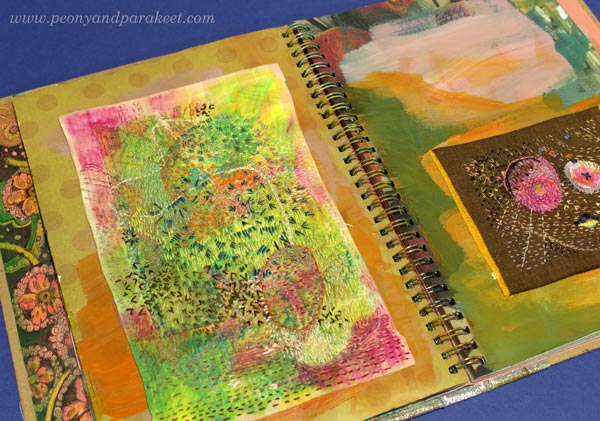
Maybe I could continue this journal with the fabric theme and search for other hand-embroidered pieces from my needlework stash?
Art Journal #2 – Accordion Book
This art journal is really fancy. It’s an accordion book with a separate casing. The paper holds watercolor well but it’s smooth enough for drawing and coloring too. I have got this as a gift from a student of my courses.
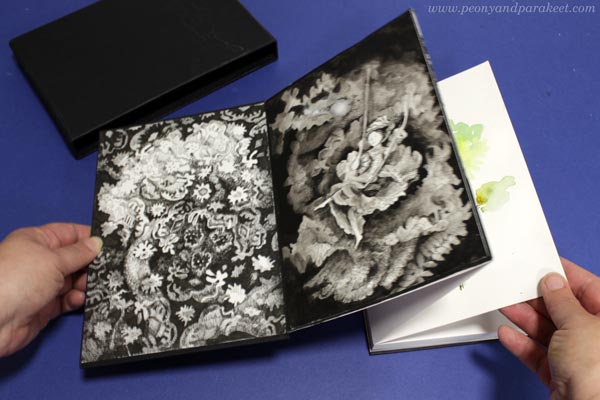
This journal has quite a many filled pages, but as it’s an accordion book, I could fill the rest of the pages with a watercolor painting that would continue from one page to another.
Art Journal #3 – Spiral Bound Sketchbook
I shared the process of making the collage cover in this blog post from 2020.

When I start making a new course, I often buy a new sketchbook, and that’s what happened here too. This book has mostly portrait drawings. They were drawn when practicing and gathering ideas for the course Innovative Portraits. Some portraits are very abstract like the one below.
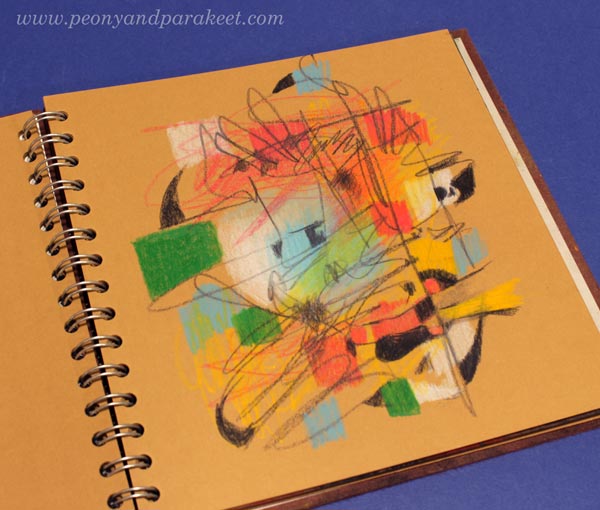
This book has still many empty pages. Here, I could gather other face drawings that I have made over the years. I think that at some point, every artist wants to draw faces.
Art Journal #4 – Small Sketchbook
Most of my art journals are filled with colorful art and contain fairly little writing or black-and-white sketches. This little sketchbook has some interesting ideas and it’s more like a notebook about art-making.
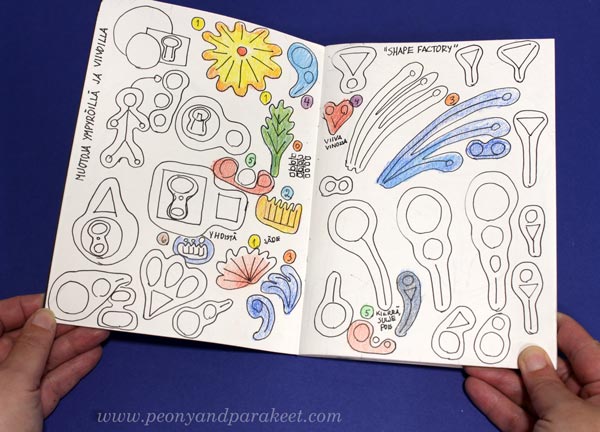
This sketchbook is almost full, and could be filled very quickly with the ideas for the upcoming paintings and courses.
Art Journal #5 – Colored Pencil Diary
This journal is an Archer & Olive Notebook that I call my colored pencil diary. I have filled many pages already. For example, see the blog post about coloring without limits!
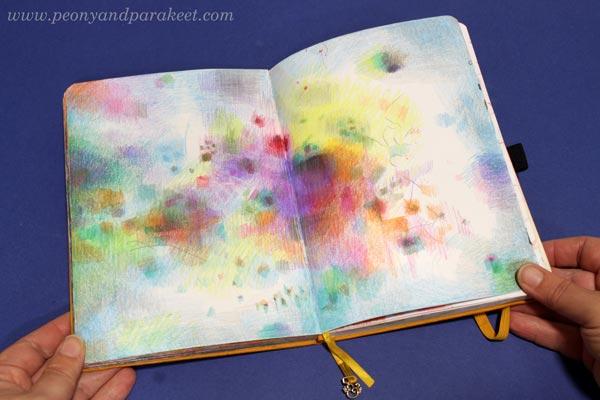
My favorite part of the book is the chapter that has fun plant-themed pages. I made them for the course Fun Botanicum.
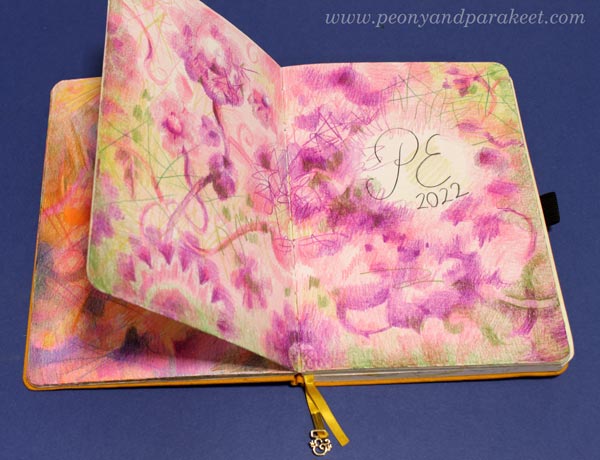
Even if this journal has many filled pages, it still has a lot of blank pages. However, I feel the journal is ready to be called finished. Should I remove the blank pages? What do you suggest?
Art Journal #6 – Bullet Journal
I love bullet journals but don’t usually draw in them. However, in 2018-2019 I bought a dot-grid journal just for small drawings. These became inspiration pieces for the course Animal Inkdom.
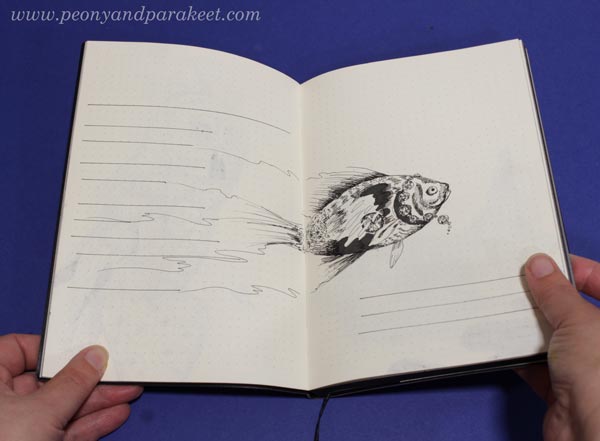
The drawings leave room for writing, and there are many empty pages left. I think I should remove this journal from my art journal shelf and use it for bullet journaling once my current bullet journal gets full.
Art Journal # 7 – Tiny Sketchbook
My smallest art journal is still quite empty. It has some lovely drawings, though!
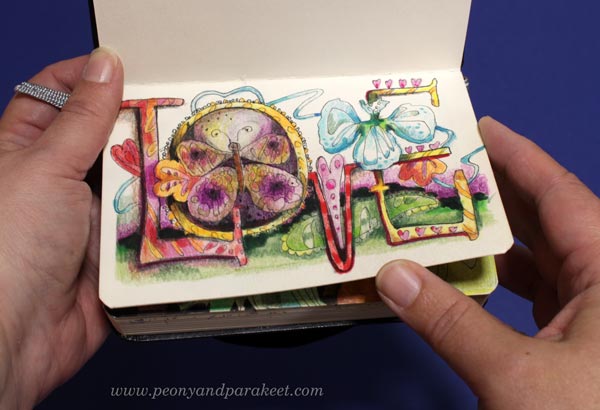
Should I continue this, or just take out the pages and glue them on another art journal? When I carry a journal with me, I prefer a bigger one.
Art Journal #8 – Dylusions Creative Journal Square with Black Pages
Dylusions Creative Journals are sturdy and their paper is quite thick. I like to practice painting by filling their page. Black is a nice background, especially when I use leftover paints from the palette.
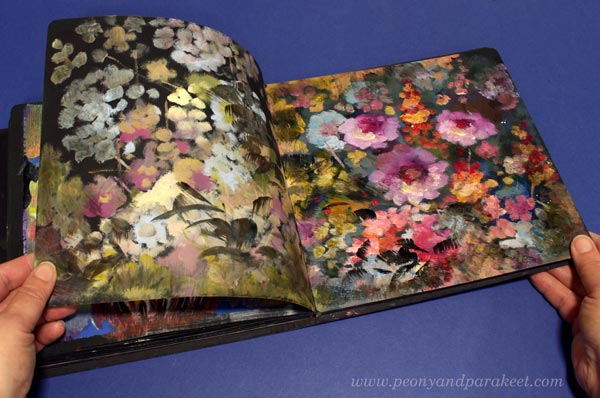
This is the kind of journal I still want and need. It will get filled over the years and there’s no pressure to do it right away.
Art Journal #9 – Moleskine Watercolor Notebook
Moleskine watercolor notebook is a small journal, but it has lovely panorama spreads and nice paper. See this blog post for more inspiration!
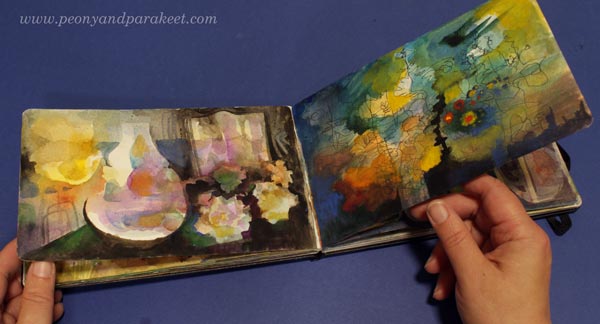
I am going to continue this one, for sure!
Art Journal #10 – Dylusions Creative Journal Square with Cream Pages
Dylusions Creative Journal with cream-colored pages is my favorite art journal. This journal works well with colored pencils, for example, see this drawing tutorial of Vermeer Girl!
The inside cover is colored freely with felt-tipped pens. I used thin marker paper for the drawing and then glued the paper on the cover.
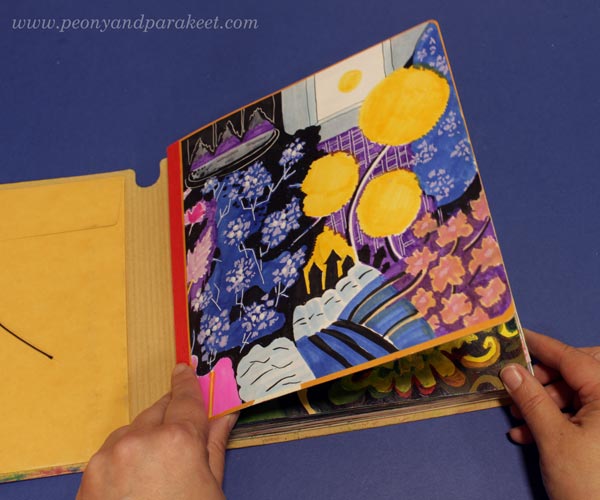
I started this journal about five years ago, and have almost filled it. But I like to keep working on the older pages, making them more beautiful. Like with the black journal, leftover paints find their way here.
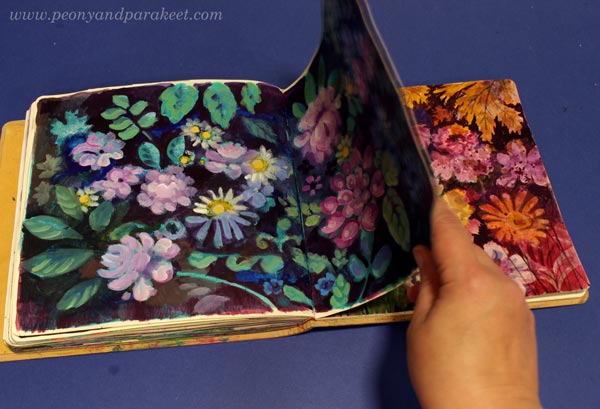
The paper holds water fairly well, and I use watercolors, acrylics, and oils there. I only wish that the paper would be bright white, not cream-colored. When the journal is full, I will record a flip-through video of it.
Half-Empty Art Journals – Question!
I have a shelf that has many full art journals. I have now put the half-empty ones on the right, so that they don’t get mixed with the full ones.
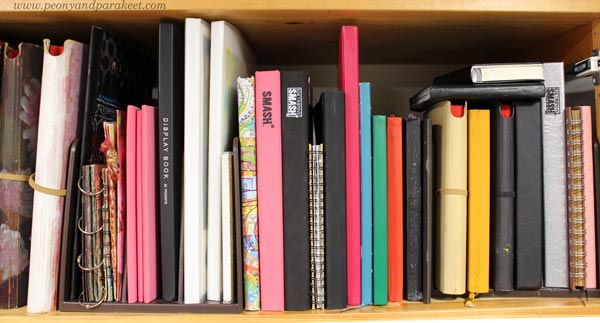
How many half-empty art journals do you have? Leave a comment!
Wild Garden – Paint with Me!
In the upcoming course Wild Garden we will paint flowers freely, intuitively, and expressively in watercolor. Watch the video and sign up now!
Wild Garden will begin on September 22, 2025. Sign up here!
Art Supplies I Should Not Use Anymore
When I look at my art supplies, there are many that just take up space and don’t bring me joy anymore. Recently, I have tried to use them up, but one crayon, for example, can last a long time. Maybe I should just stop using them and give them away?
This blog post is a little inventory of what art supplies don’t bring me joy anymore.
Arteza Gouache Paints
Arteza sent a big set of their gouache paints to me in 2019, and I made a blog post with a video about them.
>> Intuitive Painting in 60 Colors of Arteza Gouache Set

I prefer Schminke Horadam gouache paints, because they are much better quality.
In general, I like watercolors more than gouache paints because they are livelier and more transparent. In the course Decodashery, I have used both gouache and watercolors.

Gouache is great for decorative-style painting, so I will keep my few Schminke paints, but I should give the Arteza gouache paints away.
Derwent Artbars
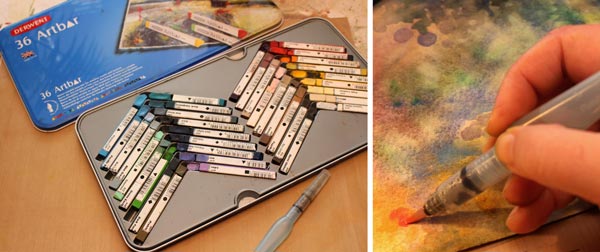
I have a love-hate relationship with these crayons. I have used them quite a lot, especially with water. But always when I look at the finished piece, I think that it would have looked so much better if I had used watercolors instead. For example, this recent art journal page would have been quicker to create and much more delicate with watercolors.
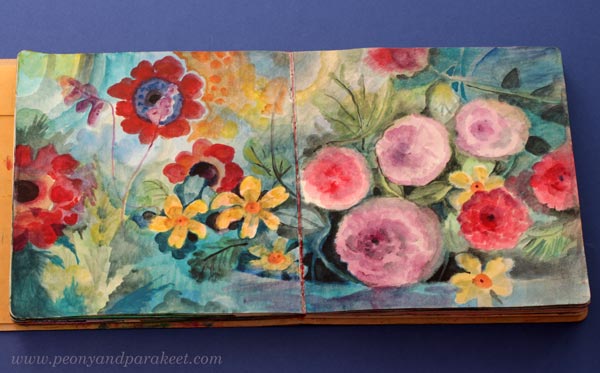
On the other hand, I really like many sketchbook pieces from 2017, like the one below.

In this blog post from December 2017, I share many projects where I have used Derwent Artbars.
I bought the Artbars somewhere around 2014, and even if I have tried to use them now and then, they may live longer than I do. I think I should either toss them or give them away. Watercolors easily replace them.
Faber-Castell Gelatos
I often wonder: “What did I think to achieve when I purchased these?”

I bought Faber-Castell Gelatos around the same time as Derwent Artbars. Mixed media enthusiasts thought that Gelatos were fun at that time, around 2010. I was very much into mixed media, and it was not difficult to sell new art supplies to me. Nowadays, I am much more traditional and don’t consider myself a mixed media artist anymore.
However, if you have Gelatos, you may enjoy this blog post from 2014 where I show some color mixing with them. >> How to Mix Colors (with Gelatos)
And this blog post where I work with Gelatos by using inspiration from art history.
>> Consistency and How to Get Inspired by It (with Gelatos)

I try to use gelatos now and then, and managed to use up one stick of the big set. But these are just a nuisance: no accuracy and not enough pigment. I should give these away.
Oil Pastels
I only have a small box of oil pastels. They really suit my art style. They have strong pigments and it’s easy to mix and blend them. Oil pastels look great a a top layer of pencil drawings and work well on top of many other art supplies too.
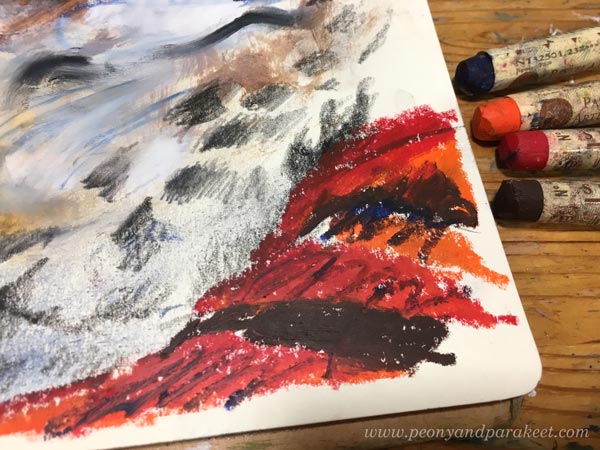
And I love the results! Here, the face has been painted in acrylics, there are regular pencil marks, and then the oil pastels add their flare.

See more images in this blog post from 2018: Oil Pastels and Spicing Up Your Art
I have also used a lot of oil pastels in this recent blog post: Using Up Old Crayons
And I have even made a course that uses oil pastels with other supplies. It’s called Innovative Portraits!
So, why should I not use oil pastels anymore when I seem to be so excited about them? Well, they are messy for sure, but also this: If I make a piece with oil paints instead, I can sell it and get more worth of my time. Oil paints (and acrylics) can do everything oil pastels do. Oil pastels are quicker, but the result is more valuable if I use paint. So, this is related to what kind of artist I am and what I need to get out of my time.
Alcohol Inks and Acrylic Inks
I bought alcohol inks in my mixed media years and loved them.

Alcohol inks are strong and work on any background, even on the top of acrylic paint. I used to use them to make backgrounds too, here’s one example from 2015.
And in 2012, I made many collages in the Collageland style where I also used splashes of alcohol inks, often pinks!

But now, they don’t feel so much fun anymore. Their odor is a bit disturbing too. But I have some pens that can be filled with alcohol inks, and will use the rest of them like felt-tip pens.
I also have some acrylic inks and acrylic watercolor inks.
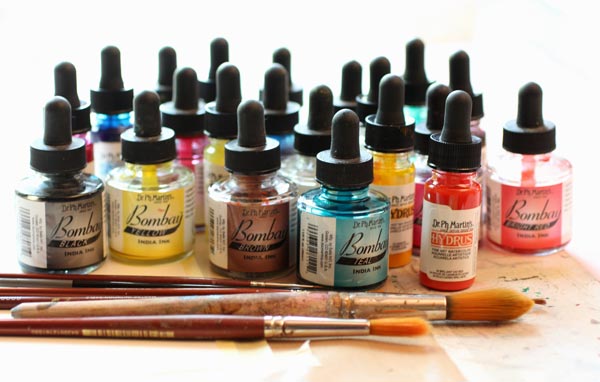
I prefer to use watercolors instead nowadays. I should just make some art journal pages to use up those few bottles or give them away. I actually found a fun idea from an old blog post: Inktober Warm-Up Exercise (inks + drawing, from 2019)
All That Glows
Gold, silver, pearlescent effects – they are not my thing. I love to imitate glowing effects with regular paints, but glowing surfaces are not what I like to create. I have tried too many times, and made some fun pieces too, like this one from 2020.
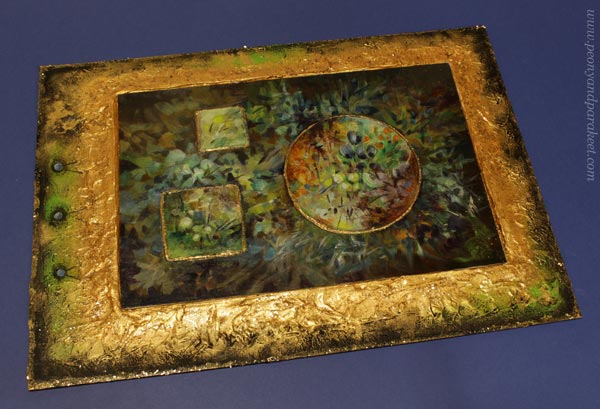
See more images in the blog post: Impressionistic Floral Painting on Structure Paste
And see how lovely glitter glue looks on the box cover, made in the course Doll World!

I have already given away many glittering paints, and I intend to give away the few that I still have.
Special Mediums
When visiting an art supply store, it’s tempting to try a new medium. I have velázquez oil painting medium, masking fluid, granulation medium, fiber paste …
Some of these mediums are for adding surface effects. For example, fiber paste creates a surface that can then be used for watercolors. Velázquez medium is for those who like to paint thickly. The more I have painted in oil, the smoother surface I want. For me, the smooth quality of the surface feels important to achieve. Smooth paintings bring old masterpieces to mind.
I know many use masking fluid and granulation medium for watercolors. I have used masking fluid in the course Watercolor Journey, but have stopped using it. There are ways to avoid it so masking fluid feels unnecessary nowadays. Granulation medium is not a miracle medium either. I like to keep my watercolors with water only. I think they don’t enjoy the makeup!
However, in Watercolor Journey, we use the masking fuild in a fun way – for doodling – and I think the result is fun!
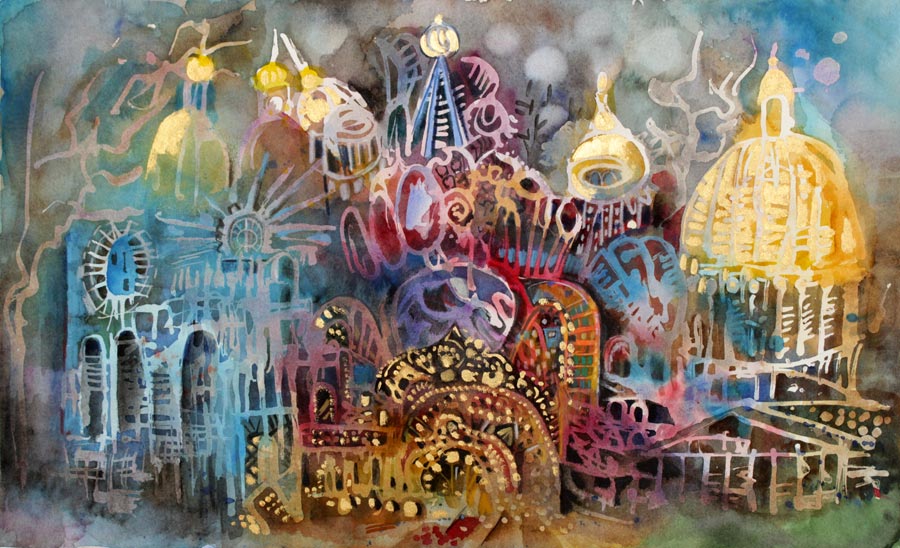
I have some masking fluid and granulation medium left. Maybe I should make some art journal pages with this doodling approach to quickly use them up!
My Basic Art Supplies
These are the basic supplies, I want to keep: oil paints, acrylic paints, watercolors, watercolor pencils, colored pencils, and felt-tip pens. Oil paints and acrylic paints are mainly for canvas paintings. Watercolors are mainly for watercolor paintings. And colored pencils and felt-tip pens are mostly for art journal pages and small drawings.
Mediums
With oil paints, I need painting medium. And with acrylics, I like to use gel medium and glazing medium for thinning in addition to water. I could give up the gel medium if I had to choose, because the glazing medium works better for thin layers. Then comes the question: how minimal to go and what would it serve?
What do you think?
However, nowadays when I want to have a treat while visiting an art supply store, I buy a new color, for example, a new colored pencil or a new tube of oil paint.
Drawing Sceneries with Watercolor Pencils
This week, I have a fun drawing idea: fill a paper with many small sceneries!

For this project, I have used watercolor pencils and Fabriano Accademia drawing paper (size: A4). The paper is very nice with colored pencils and goes well with watercolor pencils too.
Inspiration for Drawing Sceneries
Creating mini-sceneries is easy when you start playing with the scale. Think about a bumblebee – how it first flies over fields admiring the view and then finds a mini-world inside a flower.
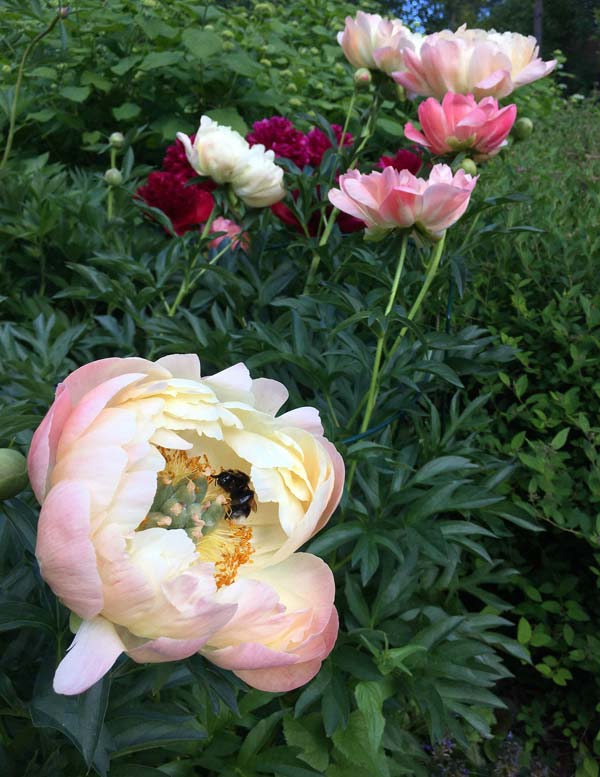
Your mind can be a busy bee, collecting a variety of ideas – big and small.

Your hand can then pick some of those ideas and put them into one picture like it would be a treasured collection in a secret museum. “Faberge eggs,” said my husband when I showed my picture to him.
Watercolor Pencils
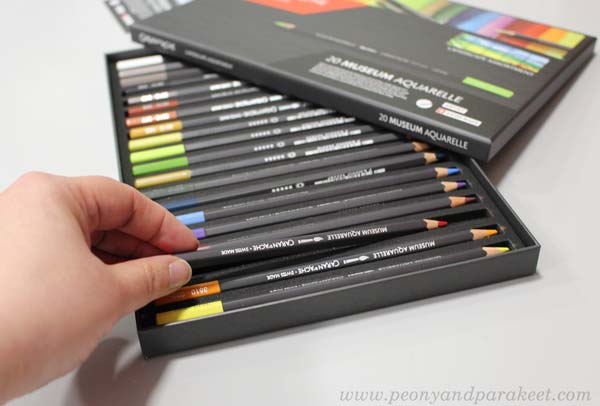
I often use regular colored pencils but slowly I have become interested in watercolor pencils too. I have had a few Caran d’Ache Museum Aquarelle pencils for a while and I love their quality – vivid colors, lovely to hold, and work well without water too. A couple of weeks ago, I bought 20 landscape colors to accompany what I already have.
Mini-Sceneries – Start Here!
Start your collection by picking a circle template, for example, a lid. Draw circles so that they overlap partially. Put one idea into one circle and color each of the circles separately.

This can be a “one in a day” project. Take your time to focus on each circle.
Watercolor Pencils in Use
Watercolor pencils are great for quickly filling larger areas. Color the area lightly and then add water over the colored area.

Let dry before adding a new layer on the top.
Drawing Sceneries – Playing with Styles
My favorite thing is to combine nature-related ideas such as landscapes and flowers with decorative motifs. I like to draw dots, other simple shapes, and lines so that they form frames and ornaments.

In this project, the circles are nature-related while the background has a more ornamental approach.

When you keep the background unified, you can use many styles in one piece. One paper then becomes a diary where anything handmade looks great together because it’s made by one hand and one mind.
Drawing in Ornamental Style

This project is another variation of the earlier blog post: Colored Pencils – Ornamental Approach. If you have taken the course Intuitive Coloring, would you be interested in creating something like this on a course next?
How to Combine Watercolors and Colored Pencils
In my new online course Freely Grown, we will use watercolors and colored pencils for a flower painting. Here are the basics for using both in the same piece.
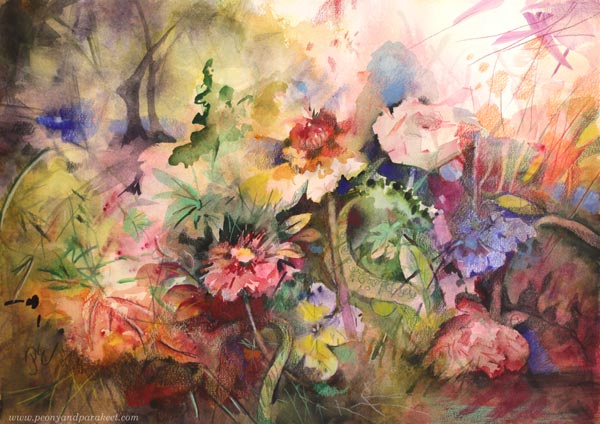
Watercolors and colored pencils have quite a lot in common, even though one is used for painting and the other for drawing.
Choosing the Paper
Both like thick and smooth watercolor paper. Of course, watercolors like textured paper too, but colored pencils are a bit more selective. I find it most enjoyable to color on Hot Press quality paper that has very little surface texture. But if you only have textured Cold Press paper in your stock, just start experimenting right away and buy smoother paper later!
All Brands Work Together
In both watercolors and colored pencils, you can combine different brands.
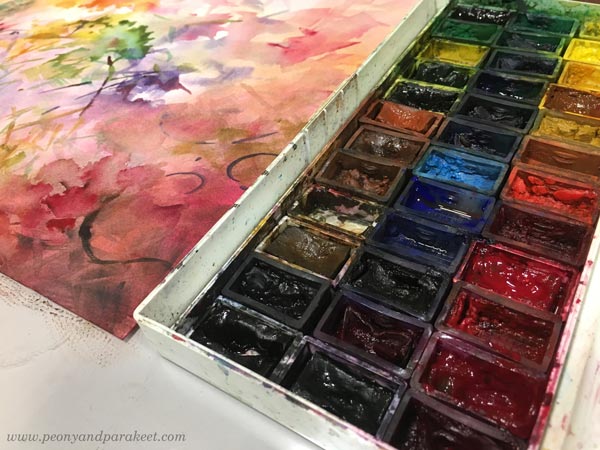
I also have many different brands in my watercolor set and even though I work with pans, some of the pans are pressed from tube colors. And I love to try different brands of colored pencils and organize them by color family.
Proceed Layer by Layer
When creating, it is good to start carefully with both watercolors and colored pencils. Introduce a new color little by little and change it layer by layer. Always dry the lower layer of watercolor first before adding another layer on top.
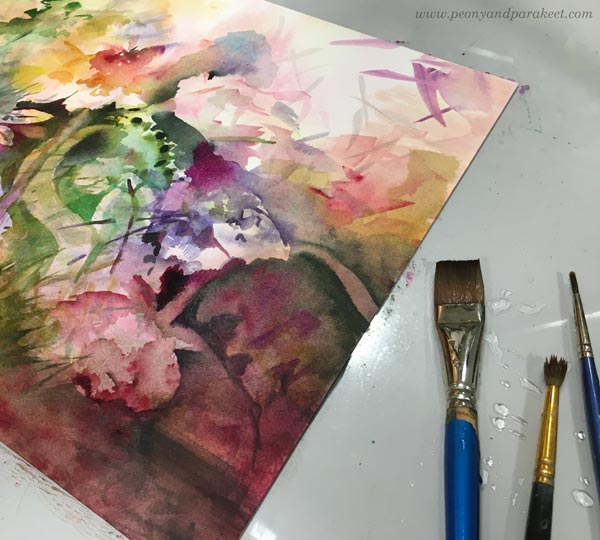
Translucent layers produce new color mixes. By saving the effect of white paper, you will have a more effortless look than if you color white later.
Watercolors First, Colored Pencils Second
You can color over a dry watercolor painting with colored pencils, but not vice versa. Sure, there are watercolor pencils that dissolve in water, but I usually use all of them dry. So I do a watercolor painting first, and then finish it with colored pencils.
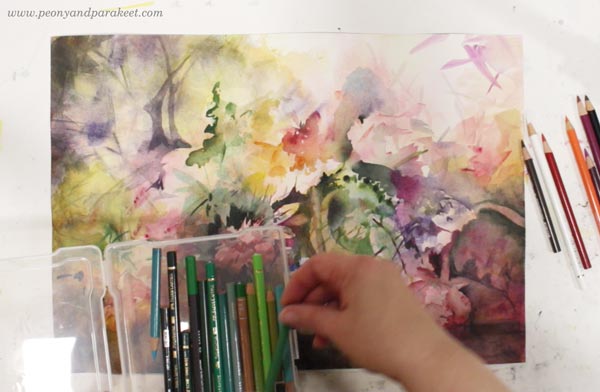
Painting with watercolors is fast, but drying between layers takes time. Colored pencils are slow, but the mark is detailed and you can immediately add a new layer.

The quickest solution is to paint most of the work with watercolors and only emphasize the highlights and add details with colored pencils.
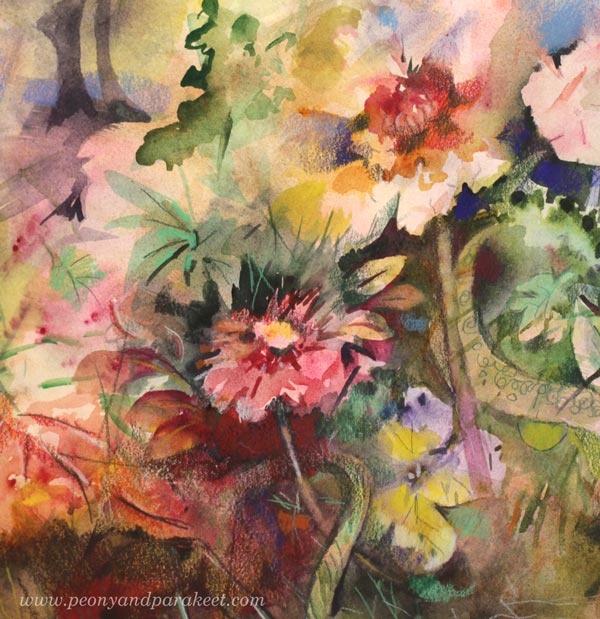
Freely Grown – Sign up Now!
Combine watercolors and colored pencils and create paintings where nature’s abundance takes over! >> Sign up for Freely Grown!
The early-bird sale ends on Oct 1st, 2023, at midnight PDT. Sign up now!