
Out in the Open – Feelings from the First Solo Show
This week I talk about my first solo show called Linnunrata (The Milky Way)
and share thoughts and feelings that being out in the open has evoked in me.
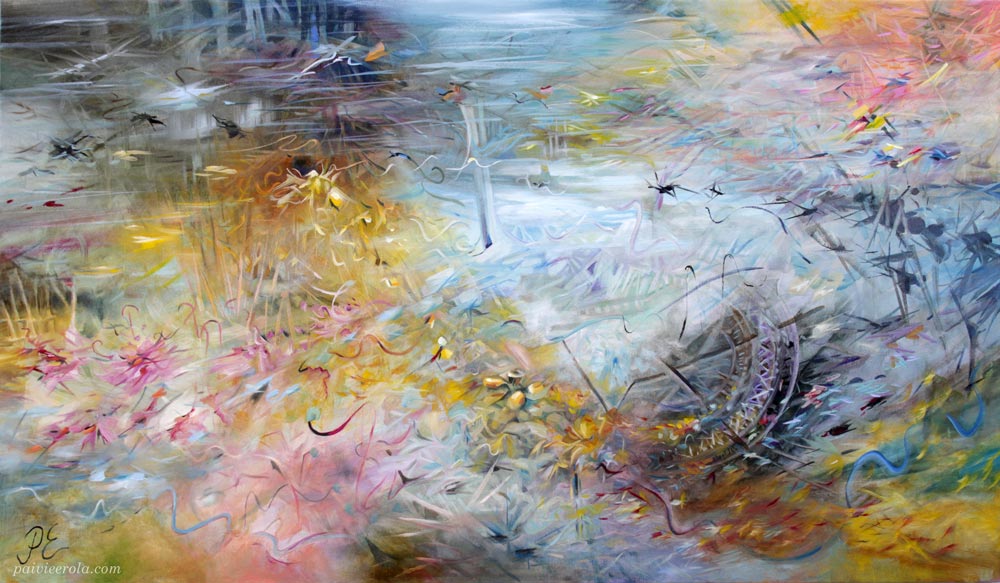
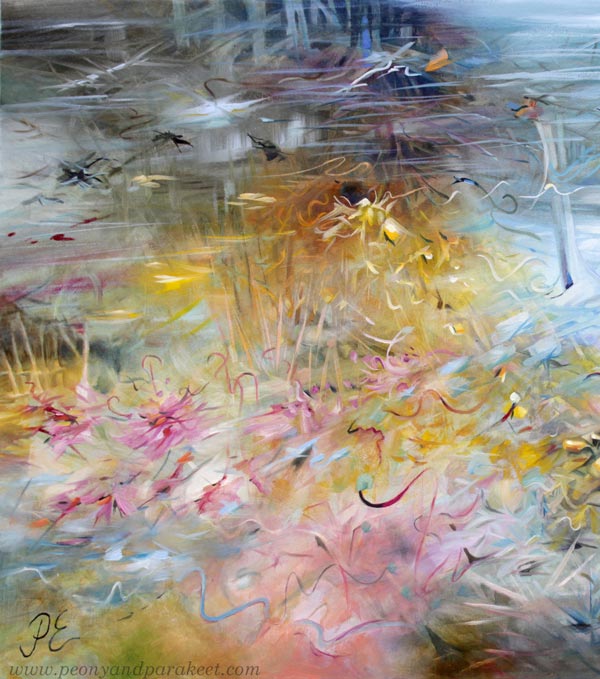
Here’s one of the last paintings that got finished for the solo show.
Click the image to see it bigger!
I started it in April when there were too many water puddles in Finland.
Water World
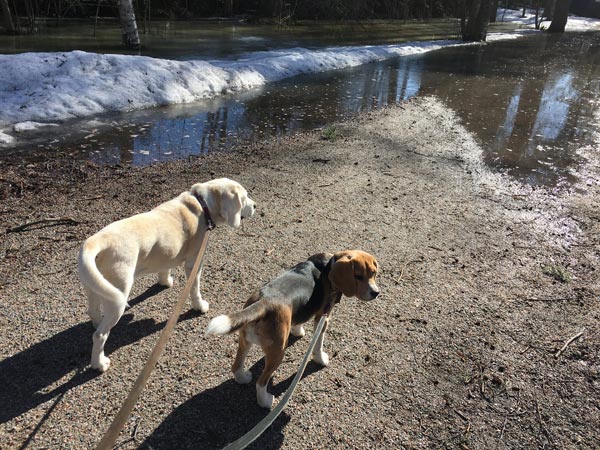
Water blocked roads and filled fields. It was frustrating and ugly and at the same time, magical and beautiful! I realized that I could watch the mud or look further and see the sky and the trees. Their reflections created a miraculous underwater world.

Just like the planet Uranus, this imaginary world had no solid matter – only gas and water!
Pressure Rises
Because I wanted to present my best work at the show, the pressure for bringing out the best of my skills was high. When I started the painting, its identity and colors were weak and the composition weird. I was worried if I get it finished in time.

It took many layers before the painting was finished. Because I like to keep the layers thin and fairly separate, lots of time was spent on drying between the sessions. My studio got too small, and there were paintings drying everywhere!
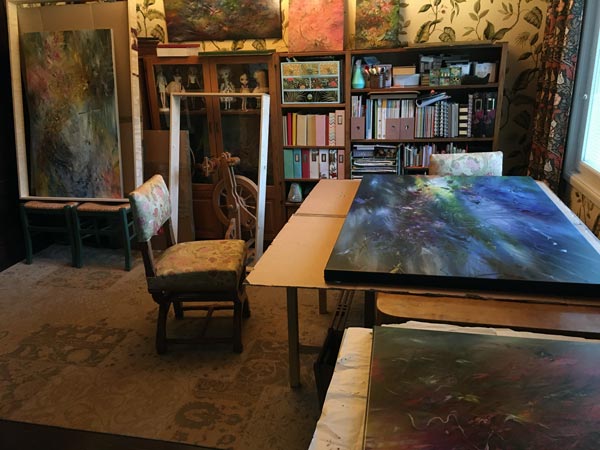
I find it quite nerve-wracking to handle wet paintings!
Unexpected Turn
I usually never change the orientation of the painting in the middle of the process, but this time I did. I felt that I could open the space more by doing that. However, I think this piece works in both ways, what do you think?


Hanging Plan for the First Solo Show
One of the most challenging things when painting for the show is to keep the overall selection coherent. I had a hanging plan right from the beginning, and I updated the plan after each painting. Here’s how the plan looked before the actual hanging.
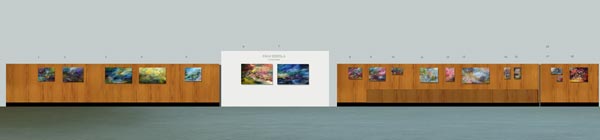
The problem with the last paintings was not only to create unique artworks but ones that would also complement the overall collection. I formed small groups from the paintings to give visual rhythm to the exhibition.
We mostly stuck with the plan.

I wanted it to be noticed as a main piece of the right side wall. But Court of Uranus was such a strong piece that I wanted to move it to a more central place.
I left some space around it so that it stands out. This painting causes bittersweet feelings in me, being both beautiful and spooky at the same time. It has been interesting to hear how people see it.
Gallery Space
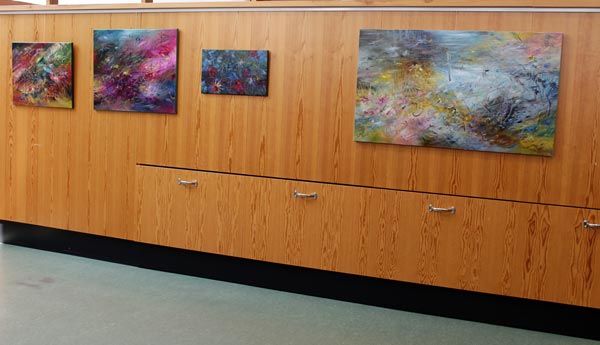
My show had four walls on the lower level. The building is from 1957 and the walls and the floors are protected. The wooden walls did not bother me, I think my art goes well with them. Here’s a better picture of the gallery space.

The two big paintings on the white back wall At Home in Pluto and Jubilee in Neptune were painted when I was middle of the series. I think it’s best to paint some smaller pieces first before making the largest ones. I used Neptune for the poster of the show.
When the main pieces are done, there’s more room for something unexpected. That’s how Court of Uranus was born.
Court of Uranus feels like the painting defines me rather than I would define the painting. It seems to display my future and show what more I could do.
The big yellow flower is perhaps the most beautiful thing I have ever painted, and still, it makes me uncomfortable, like I have gone too far, revealed too much.
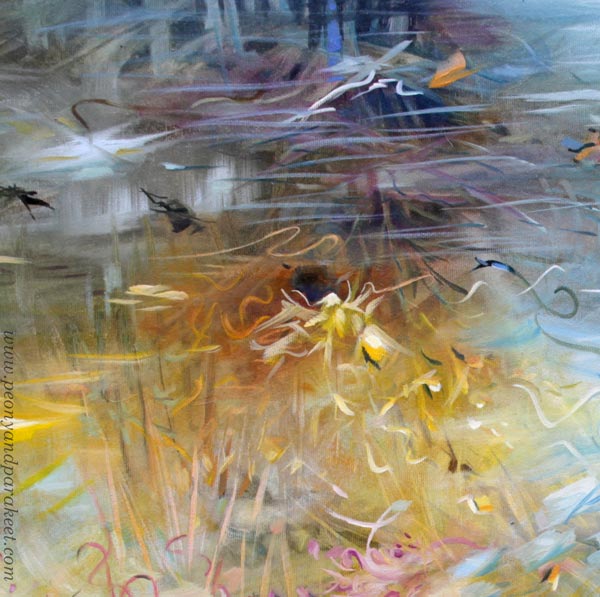
I like how light-weighted the flower is. Like she has no worries at all!
At the Opening of the First Solo Show
Riika Anundi‘s show was also her first, and we had an opening together. I gave a speech, we had nice sparkling wine and delicacies, tens of guests, and a very enjoyable atmosphere.
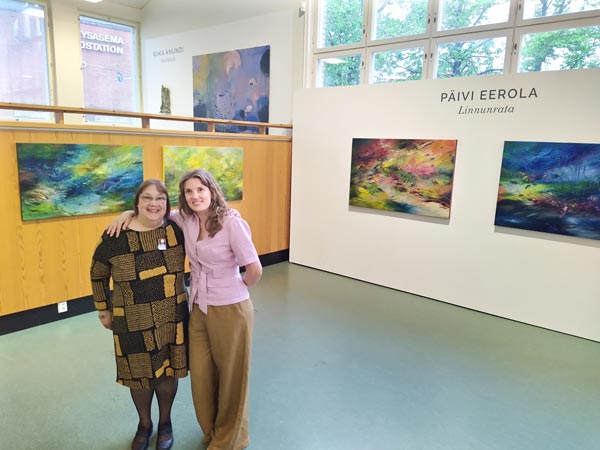
I had invited both relatives and old friends from the past decades. It was wonderful to relax and enjoy after the hard work that the show required.
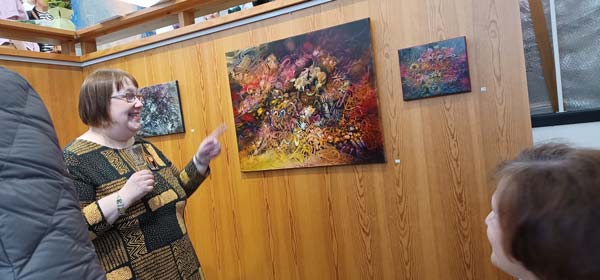
Every series has a painting that looks forward. In the picture above, I am talking about Vanitas, the painting that I made last year.
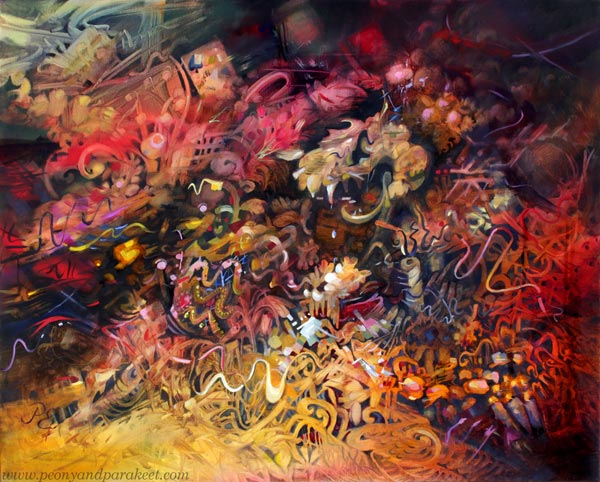
This painting, especially the top left corner, led my thoughts to outer space and thus, it was essential to display it at the Milky Way show. I don’t know where the court of Uranus is leading me, but it definitely sets a new direction.
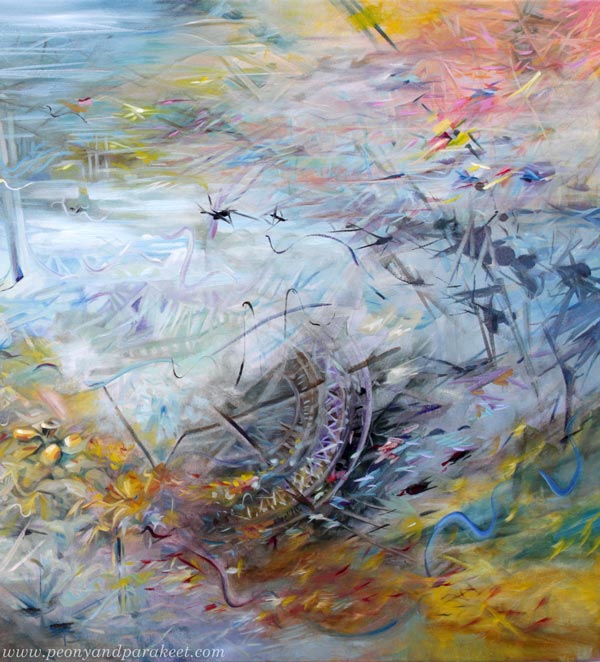
Even if the colors are dreamy and pastel, there are also technology-inspired details in the painting.
Life After the Solo Show – Open Question
Lastly, I want to show you an old crayon drawing, made as a teenager at school. The subject was the underwater world. Even if I have always hated swimming, never been diving, and never liked water, the drawing came out naturally. Like I had known what I was made to paint already back then.
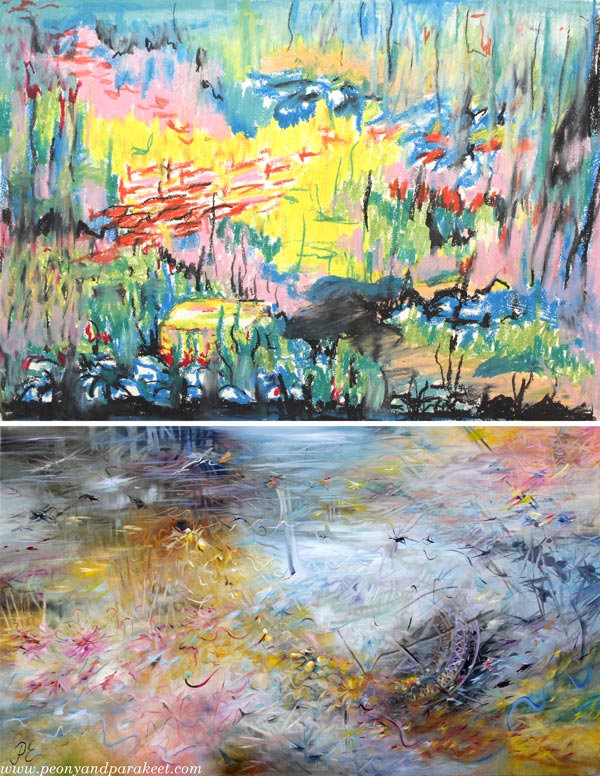
This post is perhaps more like an open question than an answer that closes everything. Time will tell where my journey goes next! Thank you for walking (or swimming) with me!
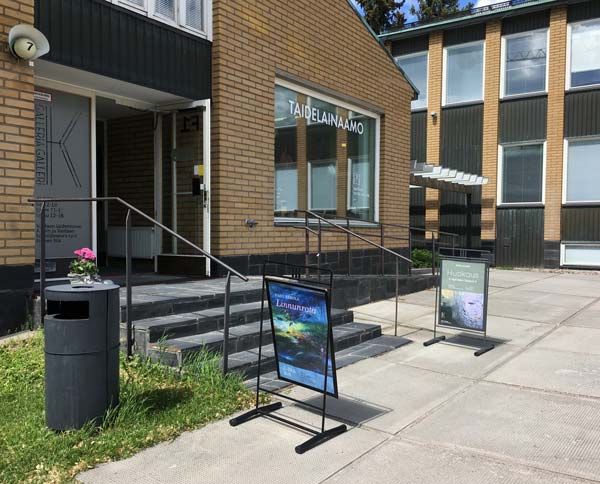
Linnunrata – The Milky Way is open from June 3 to June 19, 2022.
Last week! Thursday-Friday 11-17, Saturday-Sunday 12-16
Galleria K, Asematie 7, 01300 Vantaa, Finland
Coming Up with Ideas that Make You an Artist
This week’s blog post is about working with ideas that bring more of you together and make you an artist.
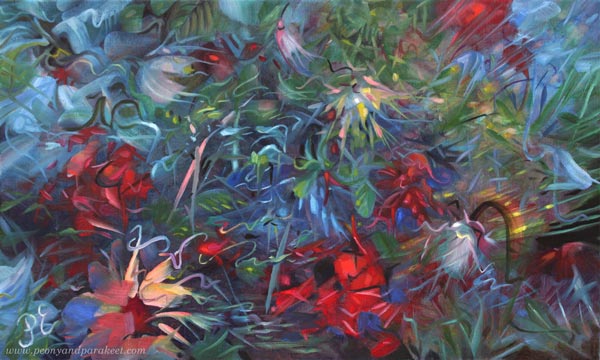
Here’s one of my newest paintings called Merkuriuksen lämpötilat – Mercury Temperatures. This oil painting is a part of my series Linnunrata – Milky Way, where I explore planets and outer space. (See previous work: Neptune here, Pluto here, the Earth here, Venus here, and the Sun here!)
My first intention was to create Mars, not Mercury, so I started with sharp strokes and fiery colors.
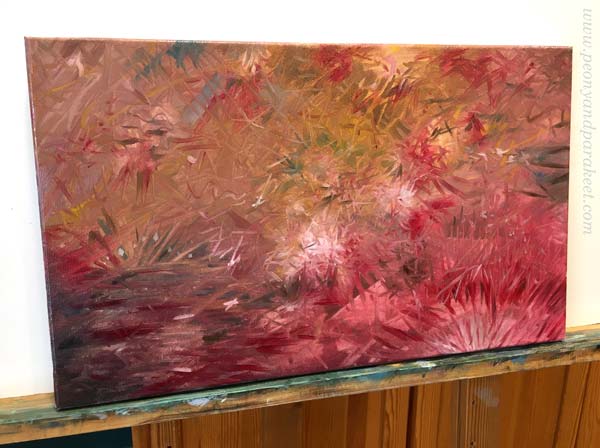
But it happened that Mars appeared in another painting, so I changed the subject after the first layer. This wasn’t hard. All I needed was to get back to left-brain thinking, which I call my inner engineer.
Fact-Finding for Artistic Inspiration
It has been fun to find out facts about the planets. I have also had great discussions about them with my husband. We both love science and are interested in the bits of information about outer space. The mind-blowing fact about the planet Mercury is that its temperature varies about 650 degrees! Night and day in the same location can have very different temperatures.
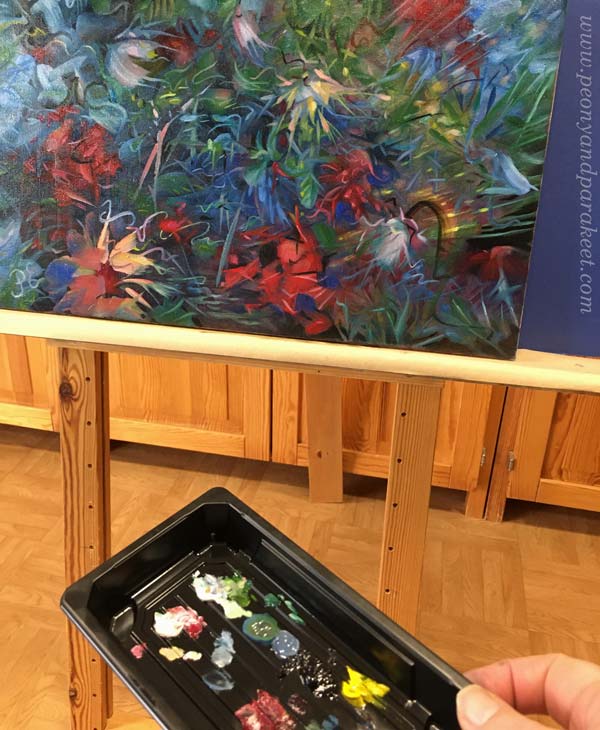
I try to keep the fact-finding separate from the painting process as possible. I want the facts to be just one of the many inspiration sources and be intuitive and inventive during actual art-making. For example, in this painting, I also thought about pattern designs, interior decorating, wallpapers of William Morris and Designers Guild, fantasy stories with unicorns, gardening … all kinds of inspiration got mixed into one piece.
Hidden Love for Natural Science
Over a couple of years, natural science has got more and more impact on my art. However, I have been pretty quiet about it because it feels weird to talk about science and then show flower paintings. But now, my inner engineer said that Mercury Temperatures is the only appropriate name for the piece, and I noticed how happy she looked, being involved and accepted more than many times before.
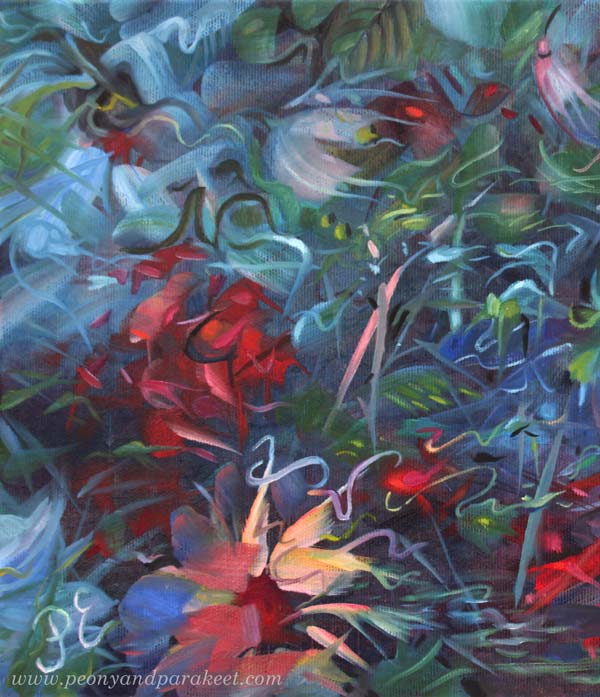
This spring, I have learned a lot about leading myself artistically. I have noticed that if my inner engineer can provide concepts like “temperature changes” rather than direct images, my inner artist can then tie them freely with visual ideas. Together they form an effective pair. My inner engineer can provide exciting ideas based on her background studies, and my inner artist can still get all the creative freedom she needs.
Digging Deeper into the Professional Identity
It has started to feel that there’s a reason why I first studied engineering, then moved to design, and only finally to art. I play with the question that if my career had started as an artist, would I be studying technology now? It feels that my ideas are on several levels, and if I omit the science level, something is missing.
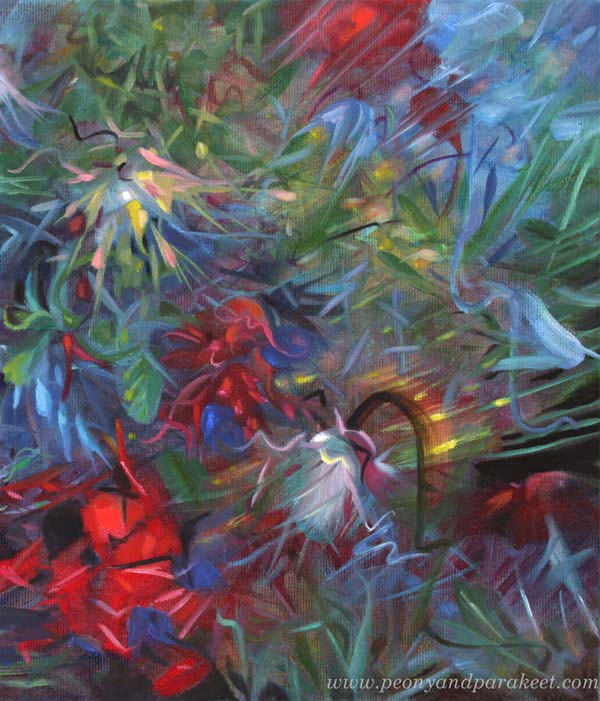
For years and years, I have been trying to manage what my inner engineer can do and how she should not disturb the inner artist. But now, when I have given the inner engineer a significant role, the inner artist hasn’t complained at all. On the contrary, it feels like the artist praises the engineer and vice versa.
This understanding has also closed the gap between design and art. Some of my work can now be openly more design-oriented than others. My inner designer had a lot of fun participating in this painting.
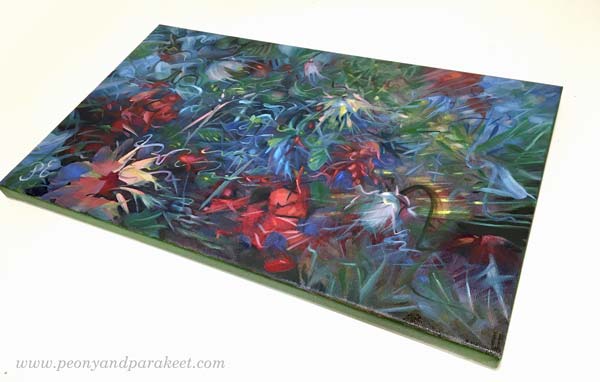
I feel happy about being able to use my curiosity about natural science in the artistic process. I have even started to think that my background in technology and science can be one factor that makes my art unique, even if it doesn’t get the leading role when marketing my work.
Coming Up With Genuine Ideas
We often think about using the skills from one profession to another very literally. But the identity in one can be used for another when we get to the level of ideas and inspiration. Every field has pieces of information that are super inspiring, especially if you already have the foundational knowledge of the area. With the knowledge, your imagination can build bridges between what is and what could be.
Ideas that make you an artist are not about art.
The artistic identity is more like an umbrella rather than an individual thing. An artist is a connector rather than a lonely one on a closed island.
What do you think?
Creating Hope – Artist’s Mission
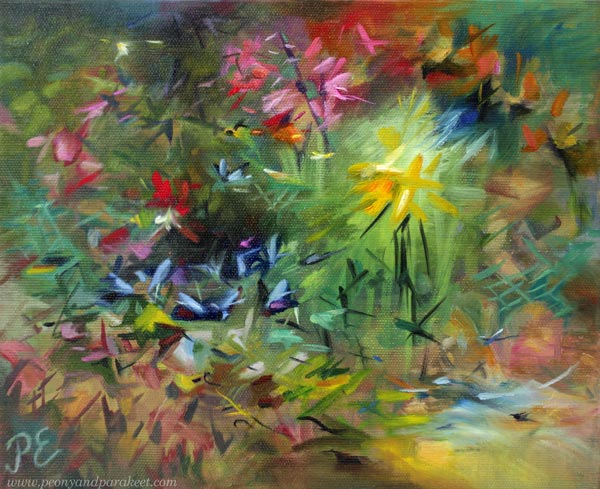
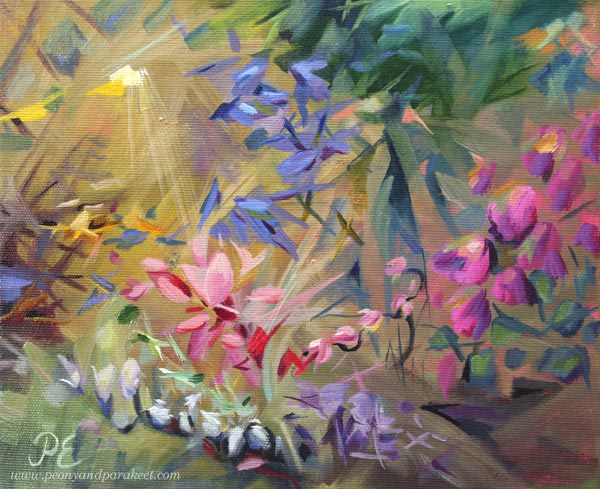
This week, I show three small paintings and talk about my mission of creating hope.
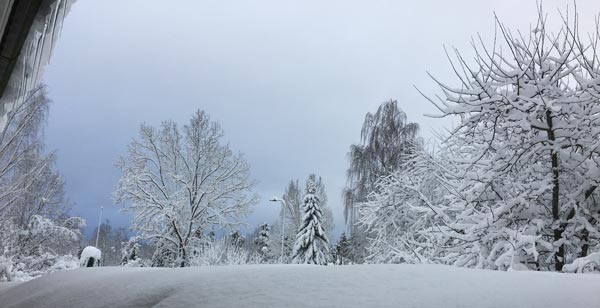
Even if we have had some winter wonderland sceneries recently, the weather hasn’t been so great in Finland – icy roads, rain, darkness … And now, the horrendous news came about the war in Ukraine.
But this post is not about war, but the opposite. Namely, a long time ago, I realized that my word is “hope”. Here’s the story:
I visited a hospital to see my old ant, and another old woman grabbed my hand. She wanted me to say something that would take her pain away.
I still remember her desperate eyes begging for consolation.
We discussed shortly but then I ended the conversation by saying that I am quite young and I don’t have all the wisdom. She nodded, turning off the glimpse of hope she had got when I entered the room. At that moment, I knew that I wanted to do more of that hope thing, but how.
Nowadays, I try to transfer hope to every painting, and to every class as well. Yesterday I dug out small canvases that looked quite hopeless. I had started them last year and used leftover paint from bigger paintings. Then they had looked just ugly paintings that might not ever get finished. But now, all they missed was some hope!
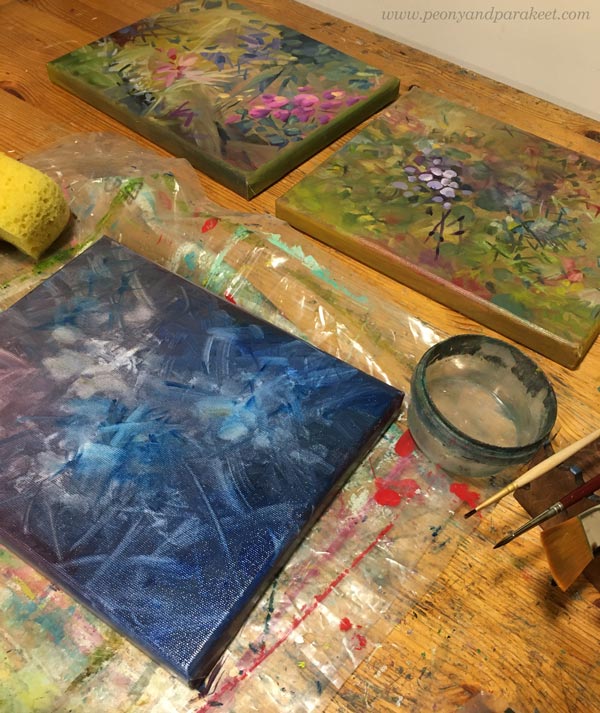
So I painted hope: saturated colors over muted ones, light glow over heavy shapes, rising wings on the top of descending petals – signs of life.
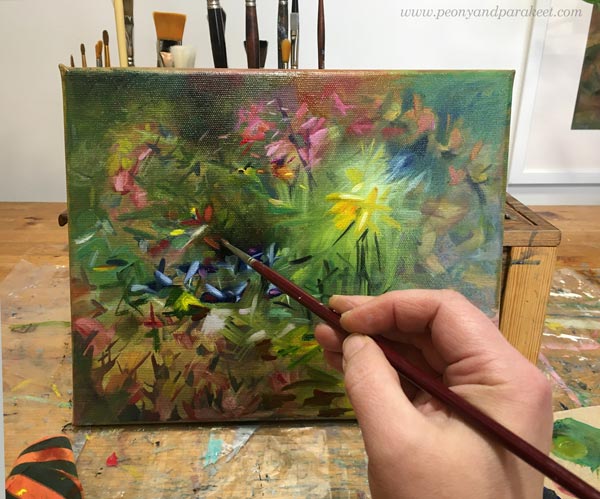
I wanted to remove the harshness and replace it with gentleness.
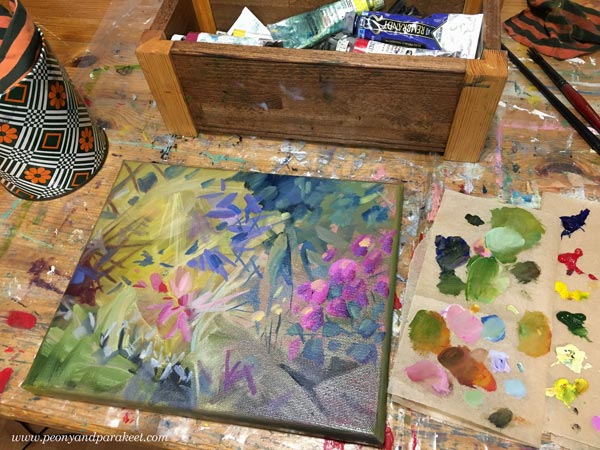
I also added the much-needed drop of utopia as well.
After leaving the hospital, I cursed myself for not giving the old woman what I called false hope. But now I think that the correct word is fantasy.
We all need fantasy to keep going.
Fantasy didn’t come to my young engineer’s mind, and it would have required the kind of bravery I didn’t have. But now, when I paint, I can do brave too.
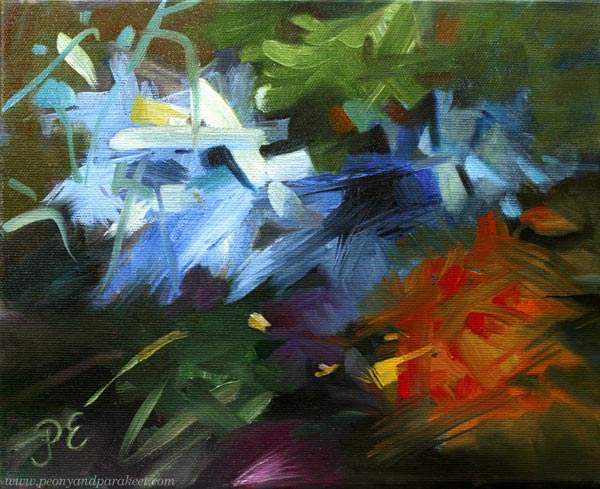
The qualities that don’t seem to be a part of me, can still exist in my art.
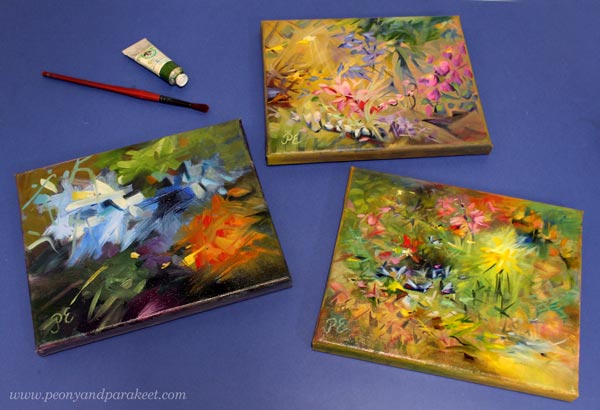
It gives me hope as a human.
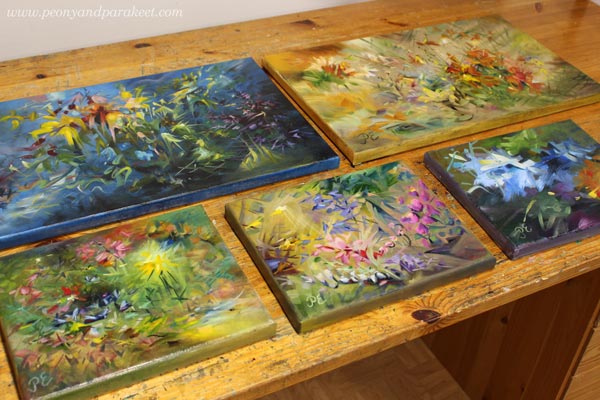
Whether I use oils and canvases or colored pencils in a journal, all I create is hope. A gift that was initiated by a stranger in a hospital bed.
I am looking for March when the new class will begin!
What to Do When You Admire an Artist
This post is about art, admiration, and spirituality and enabled by Arts Promotion Centre Finland. This is the ninth blog post of the project; see the first one here, the second one here, the third one here, the fourth one here, the fifth one here, the sixth one here, the seventh one here, and the eighth one here!
This week, I finished the last oil painting of the new series. It’s pretty large – about 27.5 x 35.5 inches – and I think it completes the series well because it’s the most dynamic of the seven.

My goal in the series was to express spirituality through abstract art. The plan was to explore Wassily Kandinsky’s idea about releasing the inner sound of the shapes and get inspired by art from the 16th to 18th centuries. This last painting is a salute to my favorite artist: Peter Paul Rubens (1577-1640).
Going Deeper – The Experience of Working with a Grant
Sadly, my three-month period of working with the grant is now coming to an end. During that, I painted a series of seven oil paintings, wrote several blog posts and weekly emails, plus a fictive essay in Finnish that that will hopefully get published somewhere. I still have the summarizing report to write and several paintings to varnish, but all the main work is done.
During the past months, my little studio has been filled with paintings. Every morning, before anything, I have gone there to both worry about the project and to enjoy the kind of excitement that only uncompleted work can give.

Despite the theme of spirituality, I haven’t lit any candles, meditated, or prayed. But I have slowed things down and taken time to question without forcing out the answer. At the same time, a clear schedule and content plan have brought structure to my days. I am grateful for the opportunity of doing this kind of deep work.

Many times when we create art, we hurry. A part of it is that we want to see the piece finished, but there’s more too. Art can make us feel uncomfortable and bring up memories we would rather want to leave behind. But making art can also point out stiffness, clumsiness, and differences between who we are and the artist we admire.
When You Admire an Artist – Rubens for Example!
Dear Peter Paul Rubens, I want to paint like you. I want to master the curvy lines, the soft transitions from one shade to another, the effortless flow in the composition, and something that I can’t name but that makes my heart beat faster every time I see one of your masterpieces.
With masterpieces, I mean paintings like “Four Continents” or “Four Rivers of Paradise” – this artwork has two alternative titles.

Experts used to think that the painting had four continents and four rivers. Europe is the woman on the left, and her partner is the river Danube. Africa is the black woman, and her man is the Nile. The woman in the center back represents America, and her man is Rio de la Plata. The woman on the right is Asia, and her man is the Ganges. However, there’s a competing interpretation of the river figures. They may represent the four great rivers of the ancient East/paradise: the Euphrates, the Tigris, the Gihon, and the Pishon.
Rubens was born in an era where a shape could not be freed in the way we now can. He had to build a representation layer that people could explain and understand in a specific way. We humans have a strong need to label things. For example, when people see my work, they immediately begin to describe what they see.
But my paintings can produce many interpretations because I try to make shapes so that they raise several different kinds of associations. When painting, I focus more on how the shapes and colors interact with each other, not on one interpretation of what they represent.
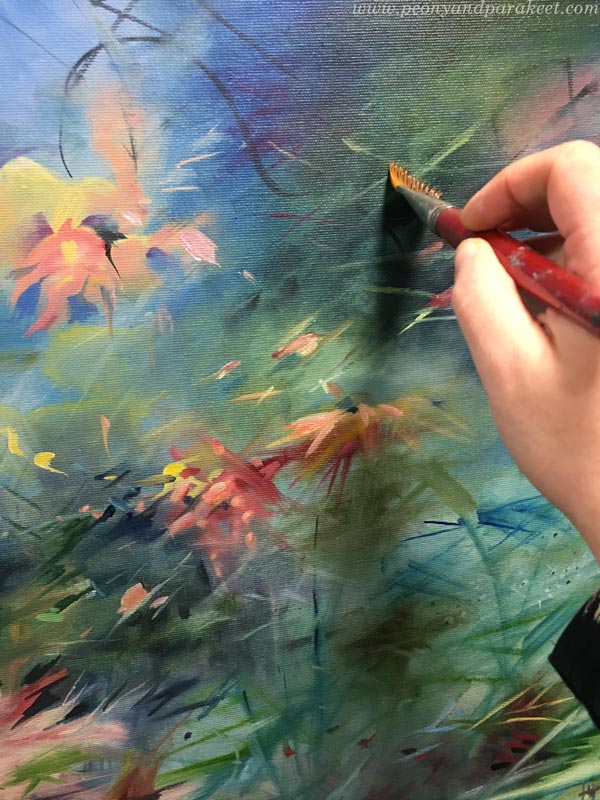
Rubens didn’t have the luxury to leave the shapes abstract – it would not be treated as a completed painting in the 17th century.
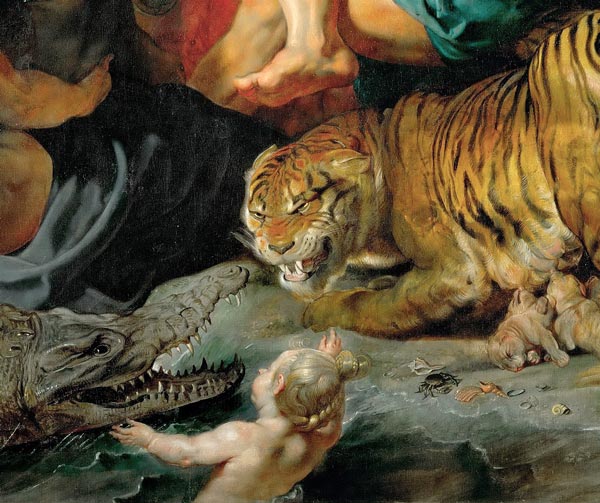
And still, his expression has such a sense of mystery that it draws me in and forms a spiritual connection with humankind.
Creating with Hurry vs. Taking Time to Imagine
Recently, I have started to feel that it’s ok that I am not Rubens, Kandinsky, or any other admirable artist. By taking time for imagination, I still can feel a connection with them.

Rather than trying to reproduce what my favorite artists have created, I imagine that my little studio is a time capsule where they hang around. My sensitivity for them can get mixed with the rest of my imagination, and produce my kind of work, still supported by them.

The core of art is that we are free to imagine. We are allowed to break the limits of time, explore the inner world, and go beyond literal ideas and explanations.

This journey has taught me that it is possible to live with wild thoughts no matter what direction they take. Like a rare animal, a thought can be shy and fast, and thus, require sitting before the trust is formed.
I started the project with the definition of spirituality, but now the greatest lesson seems to be to let go of any single definition and find more, no matter what the subject is.
I’d love to hear your thoughts on this post. Who do you admire, for example, if not anything else!