
Roaming Instinct – Why Not to Limit Artistic Inspiration
This post is about artistic inspiration and spirituality and enabled by Arts Promotion Centre Finland. This is the seventh blog post of the project, see the first one here, the second one here, the third one here, the fourth one here, the fifth one here, and the sixth one here!
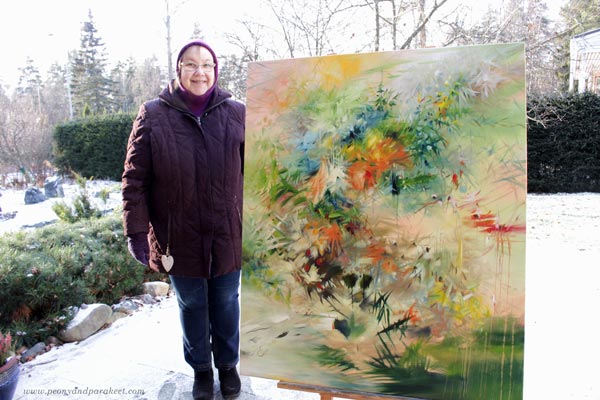
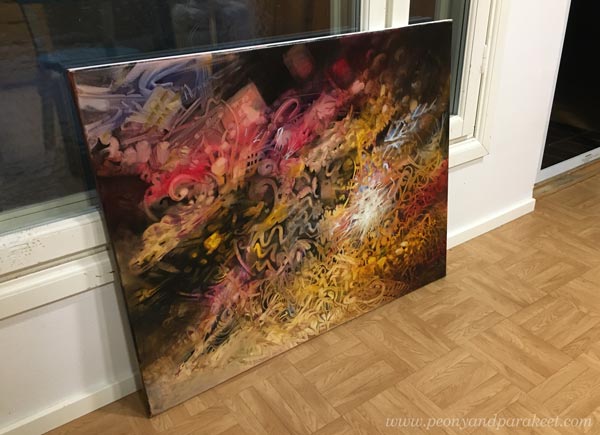
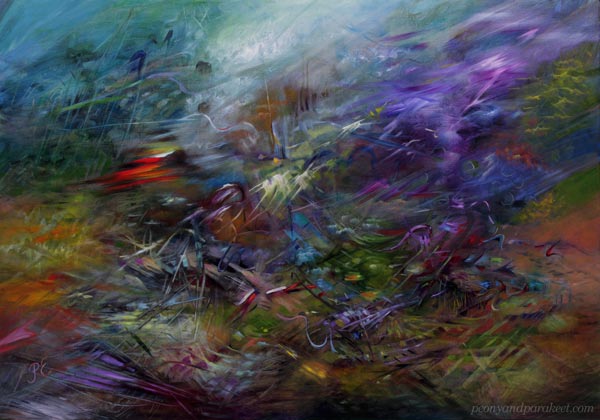
My second big painting is called “Roaming Instinct.”
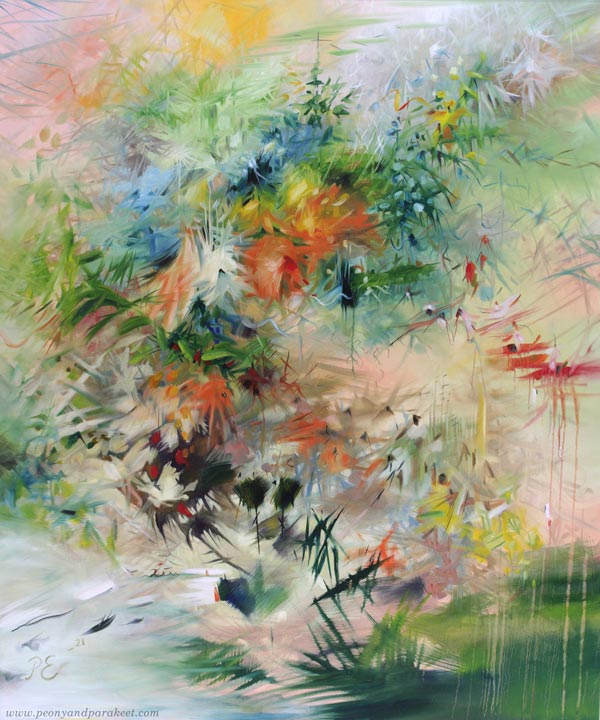
This painting and the previous big one have been really significant to me.
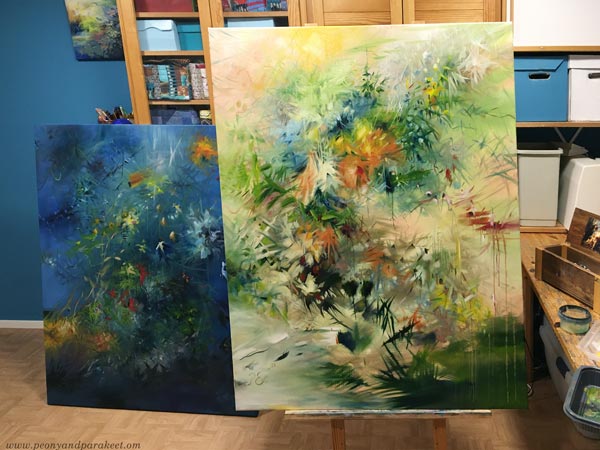
Regular practice and the big size have helped me to relax and let go – break the glass between the inner and the outer world, as Wassily Kandinsky would say.
Can There Be Too Much Artistic Inspiration?
As long as I have created art, I have been inspired by a variety of things. It has often felt like it’s too much.
Here are some:
- old portraits in fancy dresses
- houseplants and their pots
- midcentury-modern interiors
- colorful kitsch
- primitive dolls
- dressage horses
- English country gardens and cottages
- Tibetan yaks
- base jumping
- mountain climbing
- skateboards
- graffitis
- physics
- outer space
- mathematical algorithms
The list is ongoing and overwhelming!
I think this is not exceptional at all. The world is full of artistic inspiration. Like animals, we have a roaming instinct to explore further. No wonder they say that the hard choice for art-making is to choose what inspiration to pick.
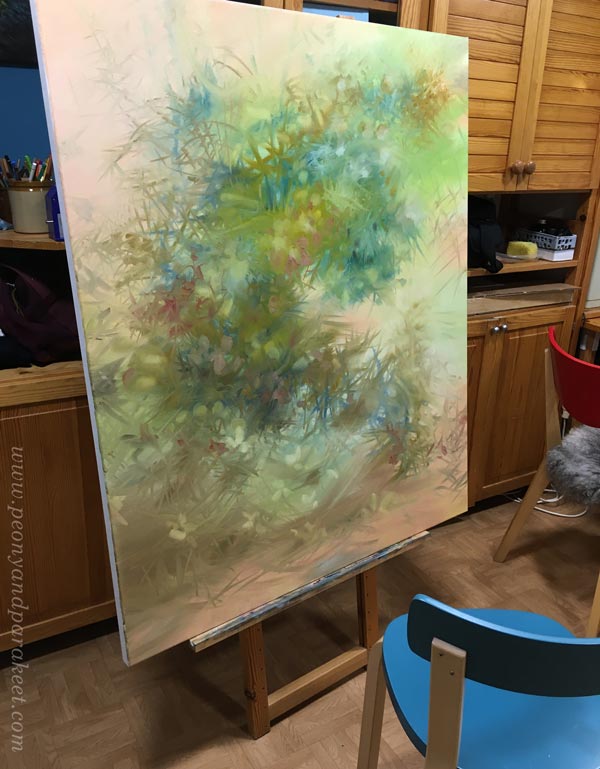
But recently I have felt like I don’t have to pick. No matter what I paint, I can bring it all together. If I paint a flower, it can look like a nomad, or a mountain, or a furry animal, or a space station, I don’t have to define.
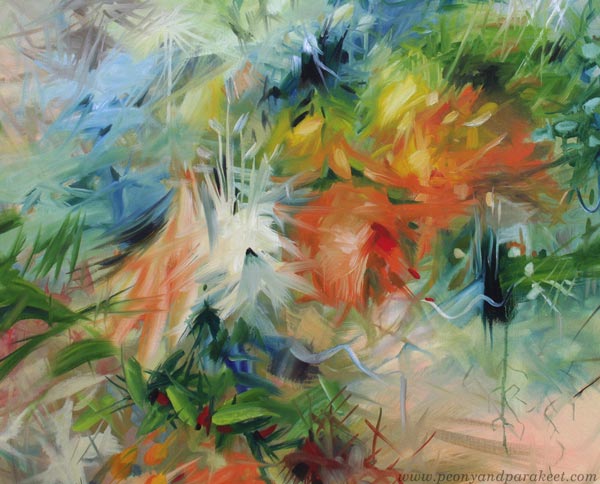
Every element can have a strong identity and the overall scenery can have a strong sense of location even if I can’t name it. Some people say my paintings are underwater sceneries, others see outer space. For me, they can be both, and yet neither. I feel I am delivering more than what can be labeled.
Finding Your Artistic Voice/Style/Spirituality/Identity – Whatever You Call It!
I have created art for a long time expecting to become better at what to pick and why. I assumed that art would make me know myself better and yes, it has. But it’s surprising that now when I am painting, it doesn’t really matter who I am and how I get inspired. My art is not to limit or to focus but to integrate.
When I started the project, one of the goals was to get clearer about my spirituality. My question was: “Can a former engineer create spiritual art?”
At the moment, I find it difficult to separate physical from the spiritual. All material things seem to have a spirit and everything immaterial seems to have a figure. When I paint, they mix and merge, and after a while, the painting seems to have a mind of its own. It tells what it wants, and my job is to obey.
Does this make sense? What do you think?
Messy Art Journal Style with Colored Pencils
This week, we go deep into the messy art journal style. See how to mimic messy mixed media pages in colored pencils!
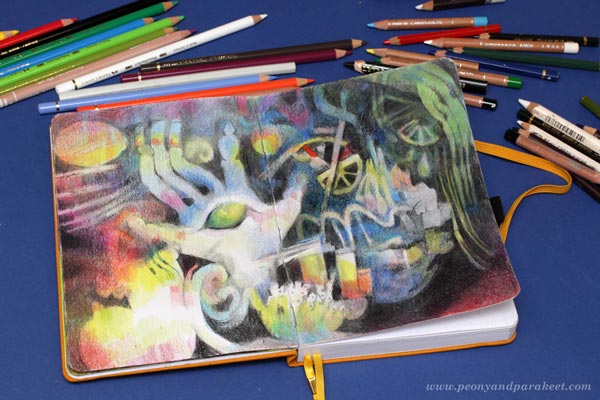
I wanted to add some happy freedom to my colored pencil diary. So here are the most recent spreads!
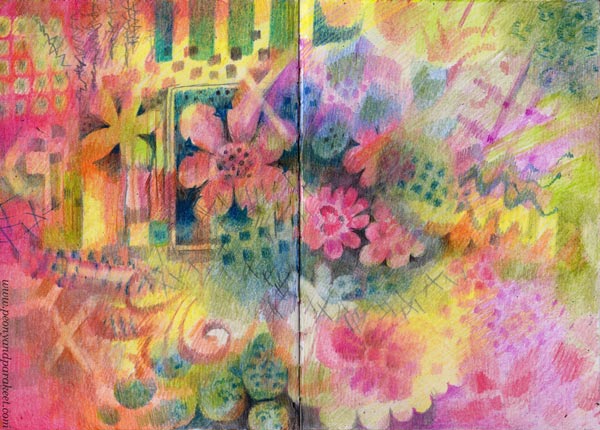
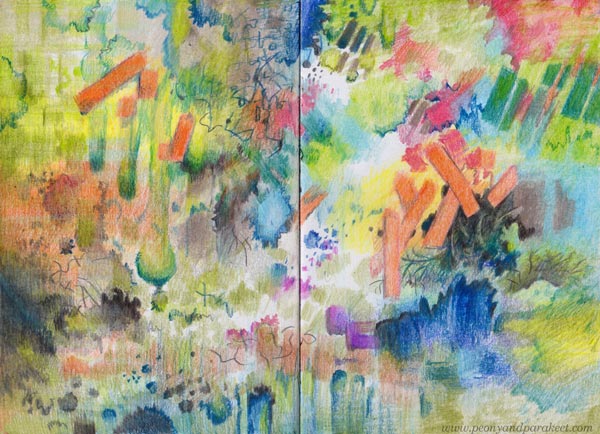
These spreads have an impression of a messy mixed media look – collage, paints, and all – but they have been made with colored pencils only.
Confessions from a Former Art Journal Book Junkie
Let’s first turn back time over ten years when my best hobby was art journaling. My day job took a lot of time, so buying became a part of self-expression. I bought almost every possible book about art journaling and dreamed about becoming a mixed media artist.
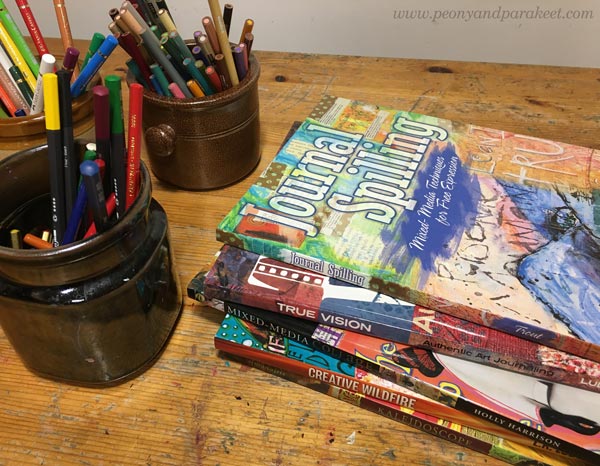
Now when I look at these books, their examples look clumsy, sometimes even ugly. But I still get attracted by the easiness that made me buy the books: “Messy is ok, you can do it!” And so did I: mixed paints, pens, collage, and all the possible media into one spread. “Mixed media techniques” was the word that I was looking for when browsing a book store or Youtube.
Art Journals Started a Journey
These journals were all the art that I created for a long time. Like the books stated, I assumed that the messy pages would be enough to define me as an artist. In some ways, I was right. A messy art journal style was a ticket to the world of art-making, blogging, even teaching. For example, in Collageland, I use paints, pens, and scissors to create fun and messy pages.
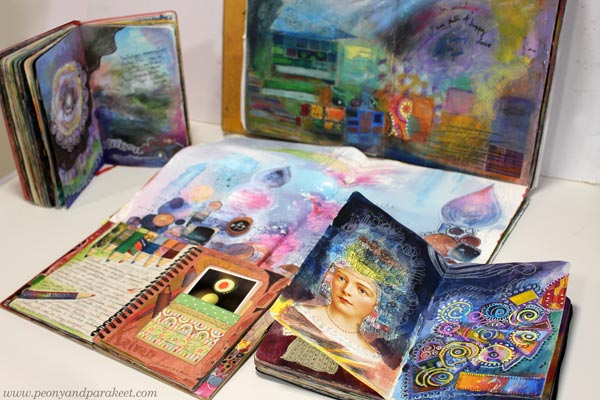
But in 2013, when I was in a local art supply store and proudly presented one of the journals to the owner, his fake smile told me that I hadn’t even started yet. In the traditional side of art-making, that is!
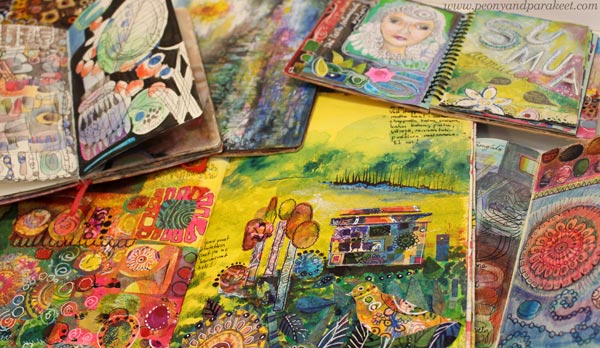
Nowadays, I think of myself being a traditional artist rather than a mixed media crafter. I prefer to stick with one medium at a time and my main artworks are more on the traditional side. And I wince every time when someone calls me a mixed media artist!
But art journaling has led me to so many happy places that I don’t ever want to get too far from it. Often, I have just replaced images from magazines with my own hand drawings.
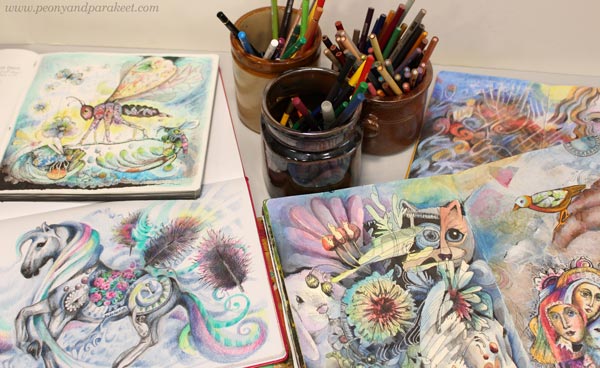
So, instead of collecting products, I can be the product. My most popular classes like Animal Inkdom and Magical Inkdom have started on that idea.
Choosing the Shortest Pencils
The best thing that I have learned from art journaling is to not over-think and just start creating. It often feels like my hand knows more than my brain. So, when I want to think further and forward, I say to my shortest pencils: “Let’s create something messy, like in the old times!”. And these little pensioners are always willing to get back to work and do what’s expected.
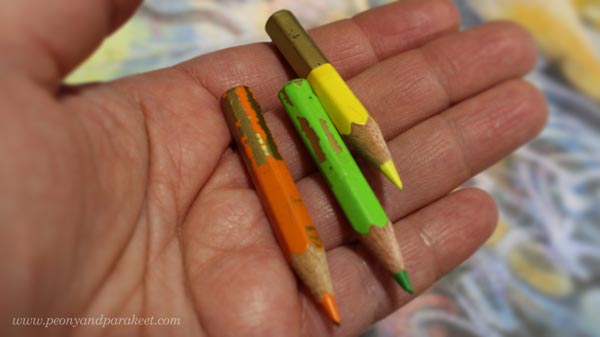
Using old and much-used pencils also takes off the pressure of pursuing brilliancy right from the beginning. For example, before I started building the class Intuitive Coloring, preliminary pieces were made with the shorties, and then for the actual recordings, I picked longer and more prestigious pencils.
So, when coloring a mess, do it with a small and diverse set of retired pencils that no longer care if you are a true artist or not!
Collage Imitation in Messy Art Journal Style
On the first spread, I mimicked what we used to include in our messy art journals: paper scraps, geometric stencils, scribbling, simple marks like x’s and o’s, flowers, and curves.

Just keep layering until the paper is covered, and don’t forget to mimic the glue too! Make the elements go on top of each other, or erase a part of them to make everything look integrated.
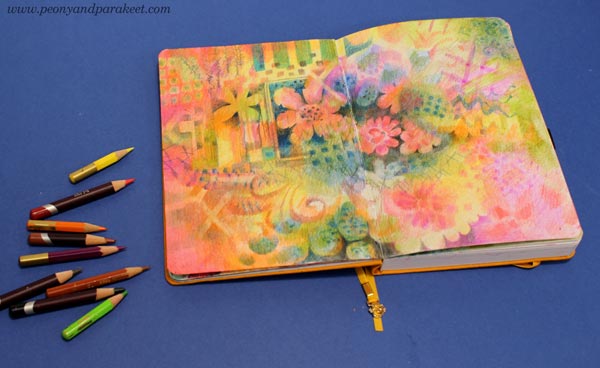
Look at my little pencils! Aren’t they endearing? I have started to carry them in a pencil case so that they are always with me, ready to be pampered.
Paint Imitation in Messy Art Journal Style
Then let’s change the mindset a bit and move from mimicking products to imitating paints. Start with stripes and small splotches and slowly grow them so that they cover more of the blank page.
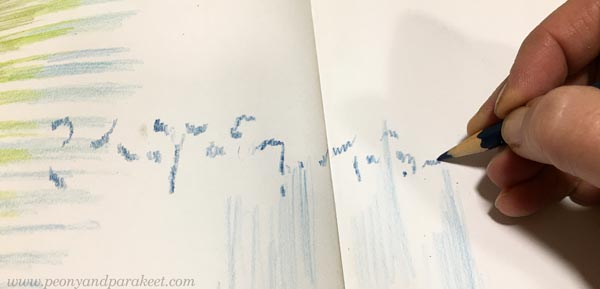
When we make a mess with paints, the edges are jagged, so color freely and intentionally make errors on the shapes.
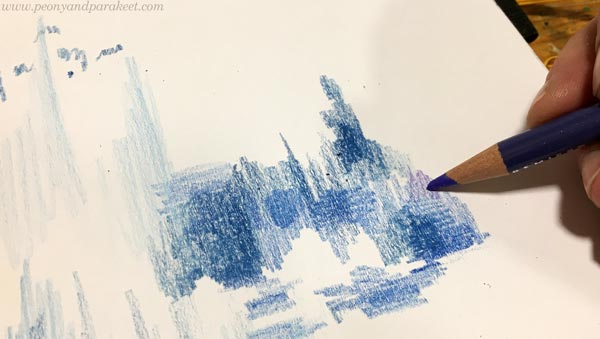
My orange rectangles represent a product, a stencil maybe, but most of the elements are more like watercolor, acrylics, or inks.
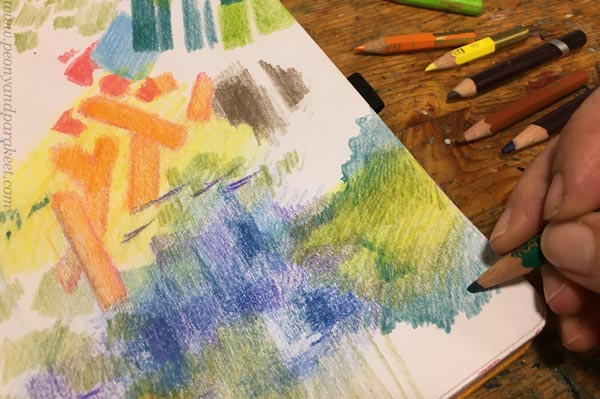
Watercolor spots have dark edges that softly fade away. By adding more colors, you can make the spots look translucent.
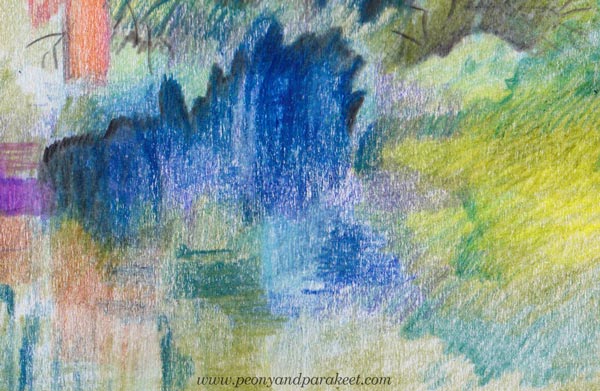
Acrylic paint has wider shadows, reflections of light (stripes and spots), and less transparency.
Add tiny spots too and make sure that their patterning is irregular.
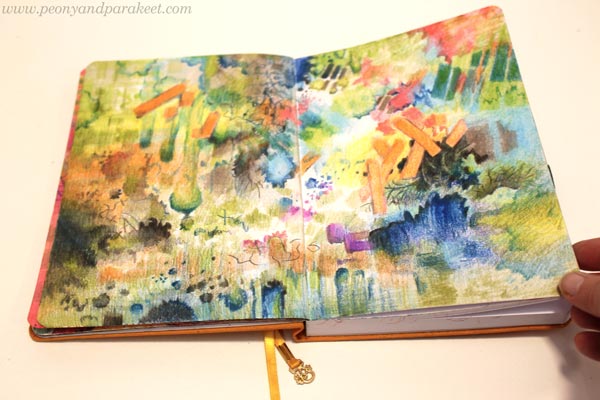
Drawing all kinds of splashes and drops was so much fun that I am now thinking: could I imitate watercolor in oils. Doesn’t this prove that mess-making and traditional fine art are not so far away from each other after all?
I hope this inspired you to pick your pencils and start faux mixed media with them!
Art Journey to Spirituality – Let’s Begin!
This week, we will begin a journey to express spirituality through art. Think about this and the upcoming blog posts as an interactive diary that you can adapt to your own work. The idea is to question and examine first and then intuitively find more truths.
Introduction to the Journey
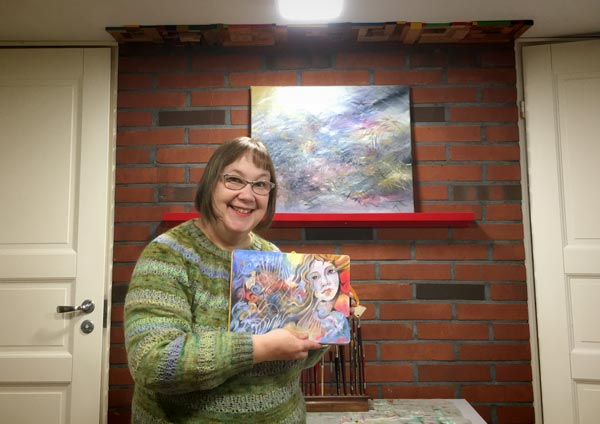
As I wrote last week, I have got a grant from The Arts Promotion Centre Finland to create a series of paintings and write about the process.
In the series, I will dive deeper into Wassily Kandinsky’s idea of unleashing the inner sound of form (check the class Floral Freedom). I will also examine the art of the 16th and 17th centuries and get influences from there. My paintings will express spirituality, but they won’t be subject to any particular worldview or religion.
I will work both systematically and intuitively. I will create studies in my colored pencil diary that help me to build a formal language for each intuitive painting (check the class Intuitive Coloring).
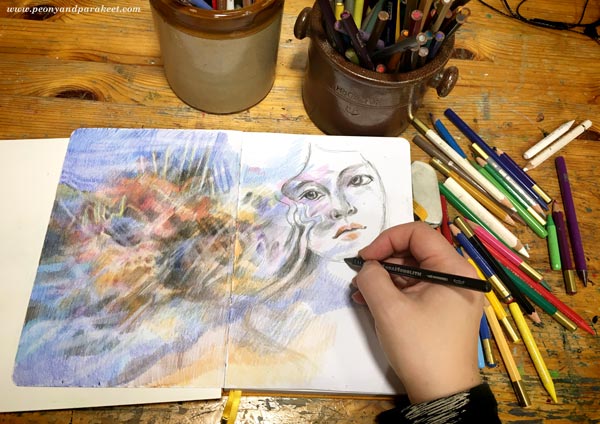
I hope this 3-month project inspires you to start an art journey to your spirituality! Take a bit of time for it every week, have a sketchbook or an art journal, maybe create a few paintings too. You can also write down names, quotes, and personal thoughts. The idea is to keep ideas and associations flowing while art gets created!
I hope to hear your thoughts in the comments! If you want more social support, purchase any of my classes and you will get to my community Bloom and Fly for the rest of the year. We will have discussions about this project in the Facebook group of the community.
Ok, let’s begin!
How to Define Spirituality
First, let’s ask what spirituality is! Google replies:
“the quality of being concerned with the human spirit or soul as opposed to material or physical things.”
But as artists, we don’t have to obey any general answer. Rather, it’s expected that our art expresses our personal points of view. I also believe that any word can start a journey. The first answer is just a ticket, and the answers get deeper piece by piece.
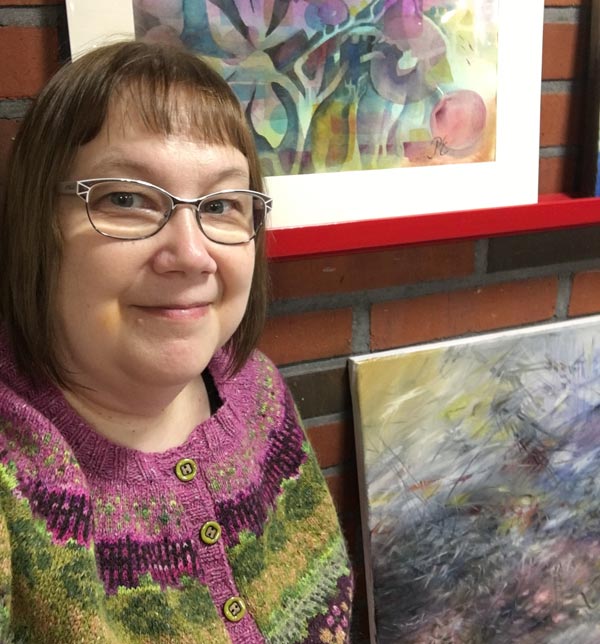
Connection, empathy, and understanding – I imagine squeezing these three words in my hands like they would be paper tokens. I want to connect with artists in the past, empathize with their shapes, and understand how to go deeper. But instead of getting overly serious, I also want to learn to play. The goal is to create a spectrum rather than one truth.
What three words would you pick as your tickets to a spiritual journey?
Meeting Sandro Botticelli
The first painting of the series will be the one that started last July. It was then black and white, an underpainting only.
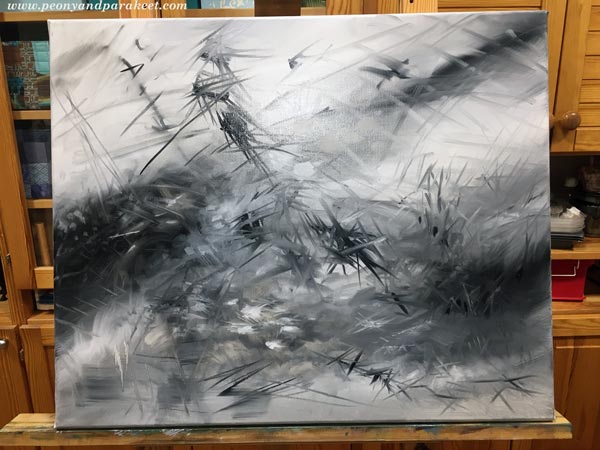
This week I got back to it and brought in more colors.
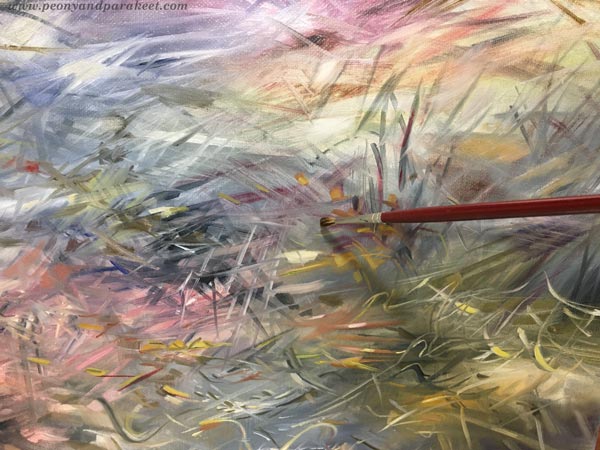
Even if the painting is not finished yet, the colors took me to meet the first companion of my journey – Sandro Botticelli.
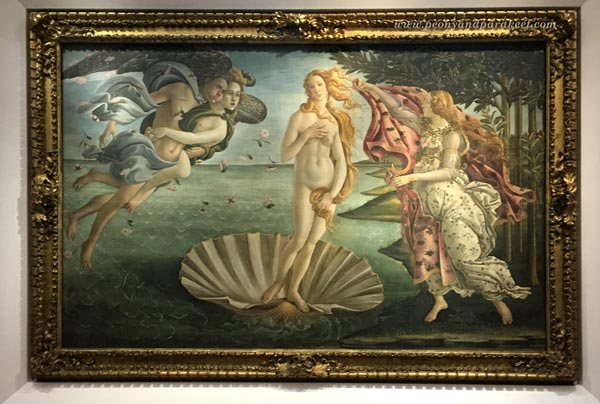
Sandro Botticelli (1445-1510) was an Italian painter. I have seen his famous paintings Primavera and The Birth of Venus in the Uffizi Gallery, Florence, but many other pieces inspire me too.
Botticelli equals perfection in many ways. His shapes and lines are so flawlessly beautiful that they make me shiver. He didn’t paint alone but had apprentices. I wonder what it would be like to work in his workshop – trying to paint a curvy line that would get his approval! Botticelli was born again in the 1850s when the Pre-Raphaelites found him. The easy way to fall in love with Botticelli’s work is to look at, for example, Evelyn de Morgan’s (1855-1919) romantic ladies. After those, it’s easy to greet Sandro too.
Botticelli’s Spirituality
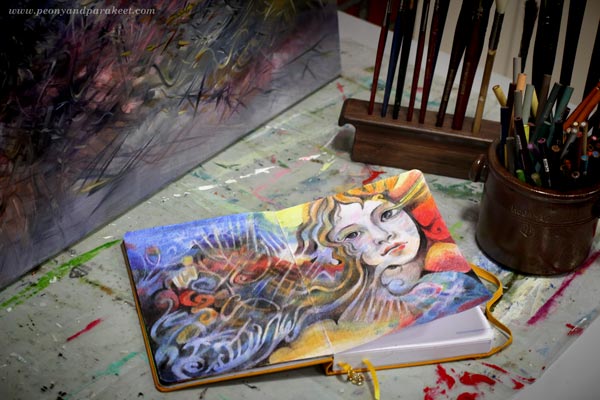
I made this little study of Botticelli’s style in colored pencils to examine how his shapes are. It’s often good to let the hand think instead of using only the mind.
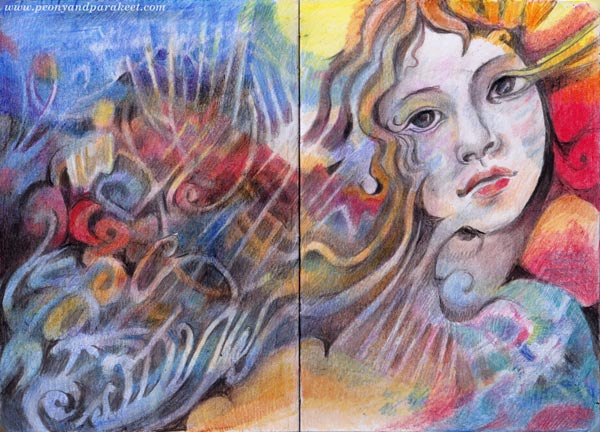
When I imagine discussions with Botticelli, he whispers out romantic mysteries. “Your stories would make great plays,” I tell him. But what interests me most is not the characters themselves, but how ornamental their speech is and how much in detail he describes their clothing and the overall setting.
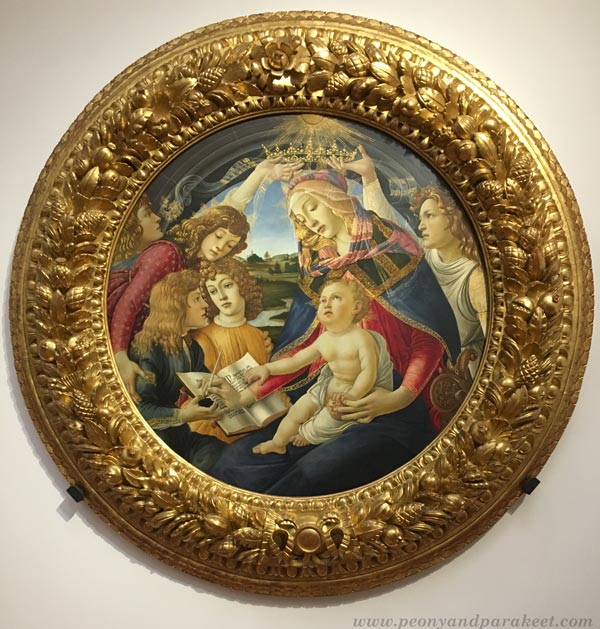
I think the spiritual in Botticelli is the way he empathizes with things. For example, how a thin vail looks like the extension of the soul. Or how the flowers that are on the ground continue on the dress and fly in the air. Sandro’s people look immersed in their surroundings.
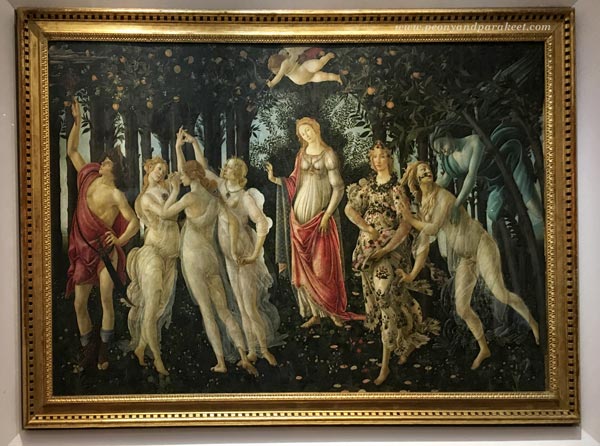
Like Wassily Kandinsky would say, they seem to be not watching something as outsiders but being an integral part of the overall experience. I hope that this understanding will somehow help me to finish the painting!
Tell me, who is the first companion in your art journey to spirituality? Botticelli or somebody else?
Art is a Lemon Tree – How’s Your Lemonade?
This week, I talk about art and lemonade and share some news about the rest of the year!
I was going to make a cheerful spread on my colored pencil diary, celebrating a beginning of a period that I have never experienced so far in my life. But I started the drawing intuitively, and here’s what came up: a murky image with a bittersweet impression!
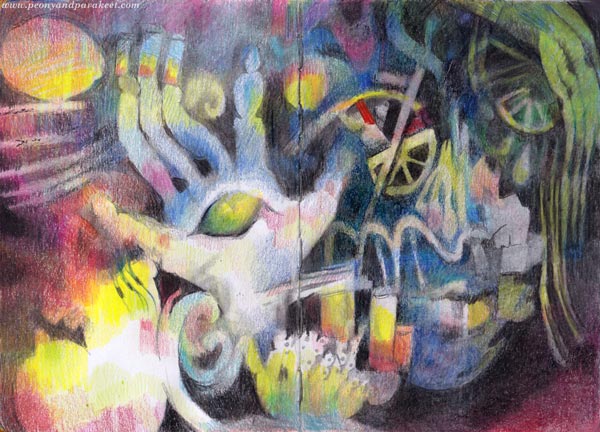
“When life gives you lemons, make lemonade,” they say.
I have never been fond of that kind of forced optimism, but I guess there’s also a seed of truth. In art, you have to make most of what you have.
What Kinds of Lemons Does the Tree Produce?
In 2014, when I became a full-time artist, I thought about growing my skills and how that would naturally lead to something good. But nowadays, my leap has felt more like changing a long CV in technology and service design to a very short, almost non-existent, CV in art.
Art is like a lemon tree. You can nurture it, but you can’t change its variety. Over the years, I have learned not only to teach but also to illustrate, make surface designs, and even draw ornaments and logos. But my heart has always been in fine art, and especially in intuitive abstracts.
In my opinion, fine art makes the best lemons. But the weather is harsh, and the harvest becomes too small to be enough for the lemonade. So my passion for teaching has often been the lemonade maker, not the actual paintings.
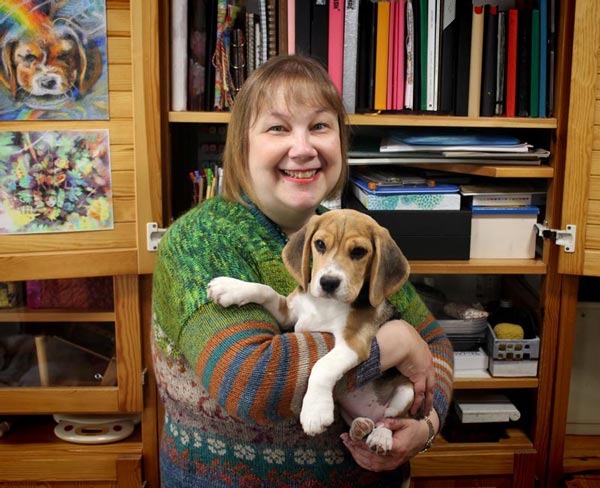
But now, things change for a few months. I have got a grant from The Arts Promotion Centre Finland to create a series of paintings and write about the process. I will publish the art and most of the writings here in my blog, so you will also get to drink this lemonade!
The project has a set theme that also includes a background study. I will also continue the colored pencil diary and document a part of the process in colored pencils. Later posts will reveal more.
I hope that my project will also inspire you to create – grow more lemons and make your kind of lemonade!
P.S. You can still sign up for Intuitive Coloring! You will get the published lessons immediately after signing up, and can start having fun right away. >> Sign Up Now!