
Butterfly Art and Beyond
This week, I have some butterfly art, stories from the past, and plenty of inspiration for art-making.
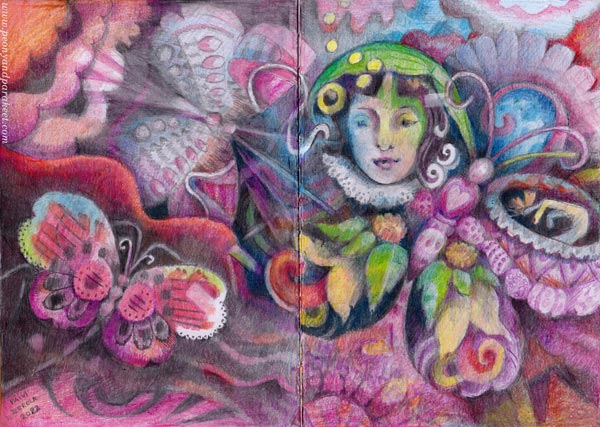
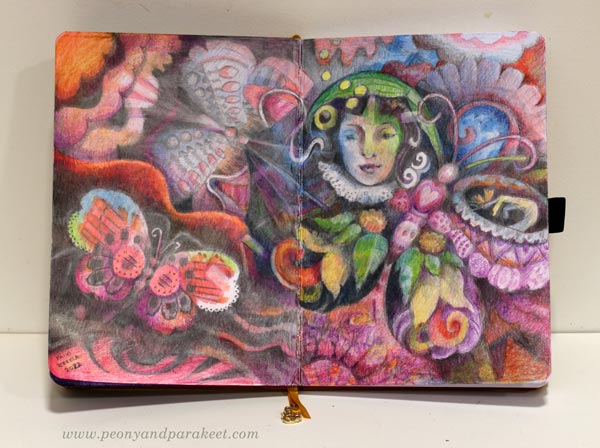
Here’s the newest spread of my colored pencil journal. I think it’s a little different than the pages so far – more detailed at least! You can see most of the previous spreads in this video; tell me what you think!
With this butterfly fantasy, I want to take you more than a hundred years back in time – to the end of the 19th century when a famous Finnish artist Helene Schjerfbeck (1862-1946) painted Violets in a Japanese Vase in 1890.
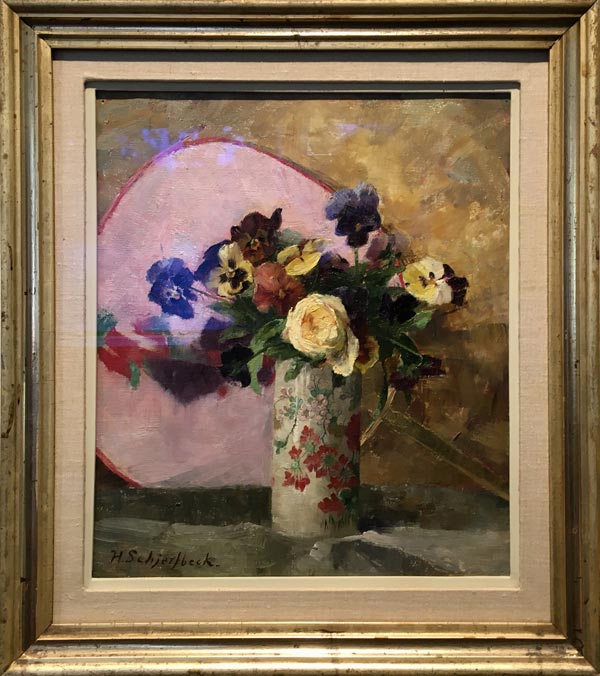
Although Helene wasn’t as famous back then, she had traveled and studied abroad. And now, she had just got back home after spending a year in Paris and England. After painting people, Helene was now drawn to make nature-themed pieces. It felt refreshing to change big and challenging portraits to small landscapes and still lives. Flowers became Helene’s consolation pieces. When she was sent to St. Petersburg to copy Russian masterpieces and thus bring educational reproductions to Finland (“here’s how the masters paint”), she painted flowers for her own joy in the evenings. (See Helene Schjerbeck’s later style and my adaptation for colored pencils in this blog post!)
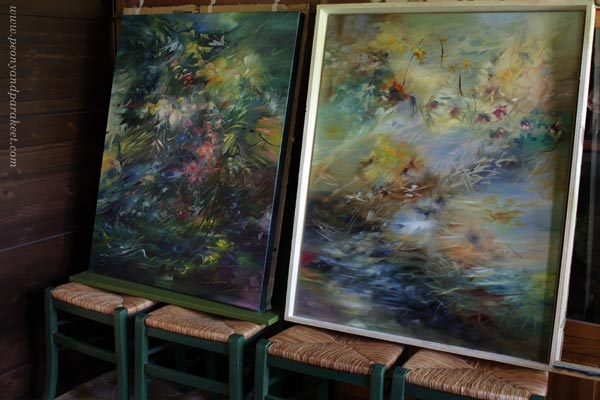
I can relate to Helene. My main work is big oil paintings – abstract florals or landscapes – but I also make art that soothes and maintains rather than breaks through. While the first pieces of the new series are drying and waiting for their next layers, I feel drawn to the boxes of pencils.
At the beginning of the week, after painting the whole Sunday, I wanted to draw something just for me. “Butterflies!” my inner child asked.
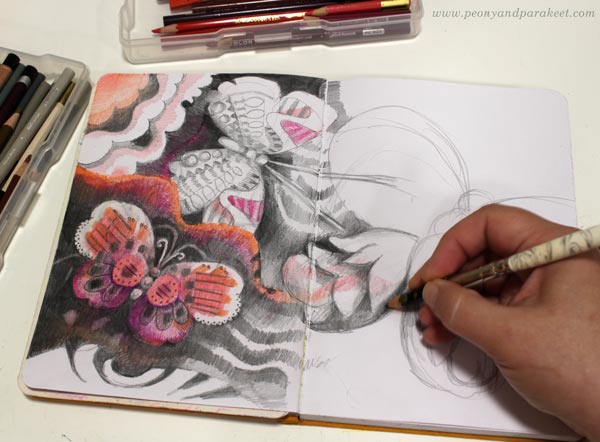
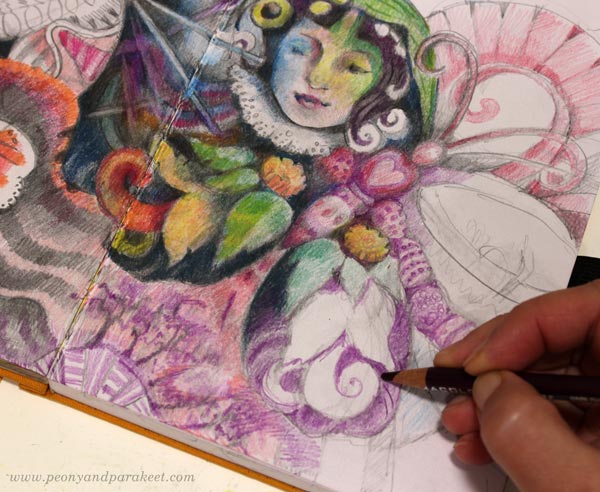
Here’s how far I got in one evening. This was before I traveled back in time to meet Helene – and another artist called Torsten Wasastjerna!
Fantasy Art in Villa Gyllenberg
In the middle of the week, my husband and I visited Villa Gyllenberg in Helsinki. It’s a museum that used to be the home of Signe and Ane Gyllenberg in the 20th century. The house was built in 1938, and it has a wonderful location near the sea.
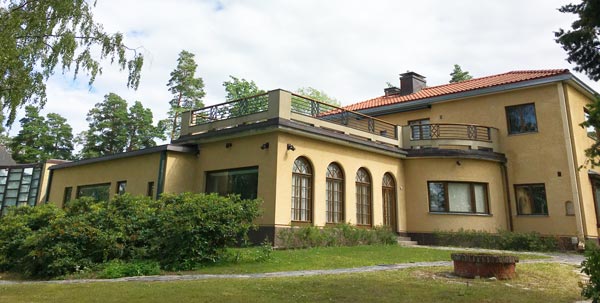
A part of the museum is a furnished old home with an extensive art collection, including Helene Schjerfbeck’s violet painting.
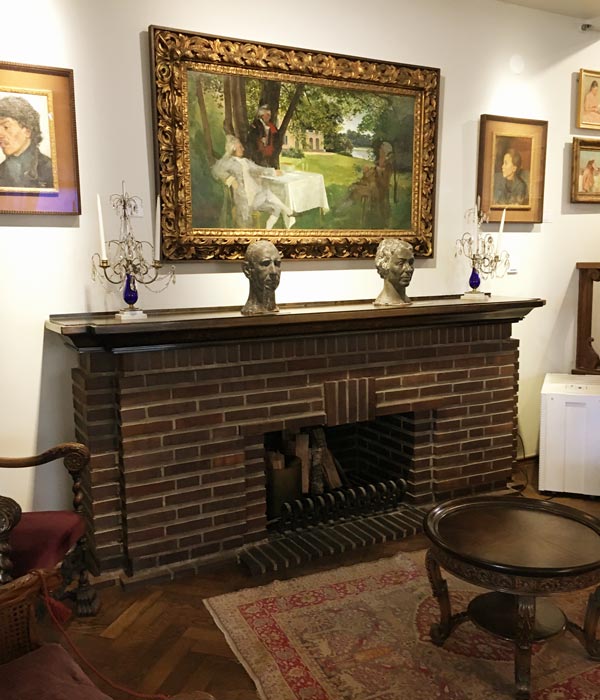
Just recently, Villa Gyllenberg got a new extension for art exhibitions. The new space has high walls and plenty of space, but still, there was something too big to fit there straight!
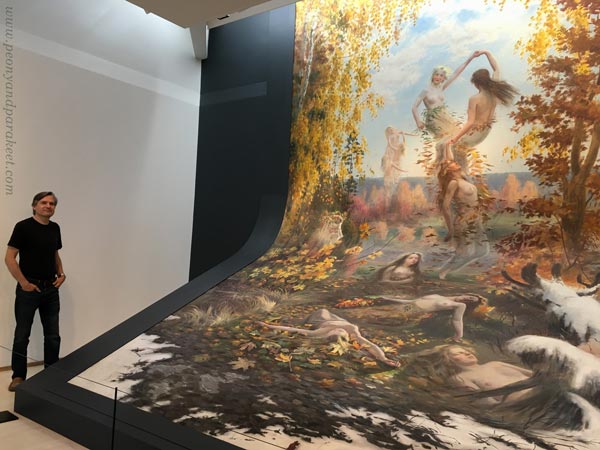
This is Torsten Wasastjerna’s oil painting Falling Leaves, made in 1897. It’s 550 cm high and 370 cm wide, one of the biggest Finnish paintings ever. My husband agreed to model beside it so that you get an idea of how big it is.
Inspired by Torsten Wasastjerna
Like Helene Schjerbeck, Torsten Wasastjerna (1863-1924) got an education in fine art and studied abroad too. But his consolation was fantasy. He did commission portraits to pay the bills but loved illustrating fairies and angels. He even wrote books. The first one was called Dröm och Värklighet – Dream and Reality.
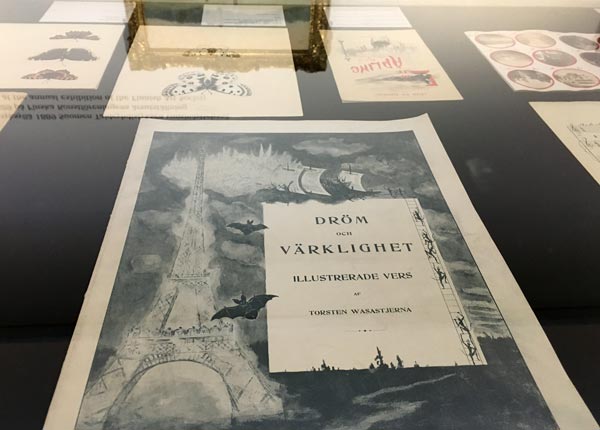
Torsten Wasastjerna’s fantasy world wasn’t as surreal as mine, but it felt close.
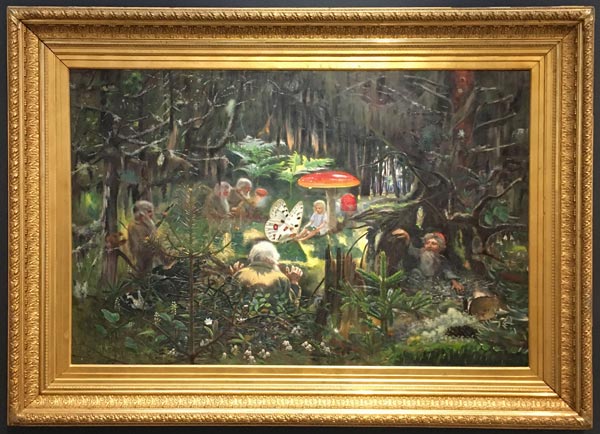
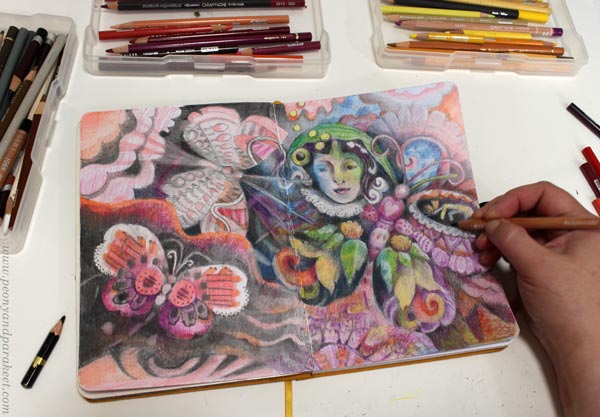
When I got back home, I was inspired to work on the butterfly piece with much more detail than I first had planned.
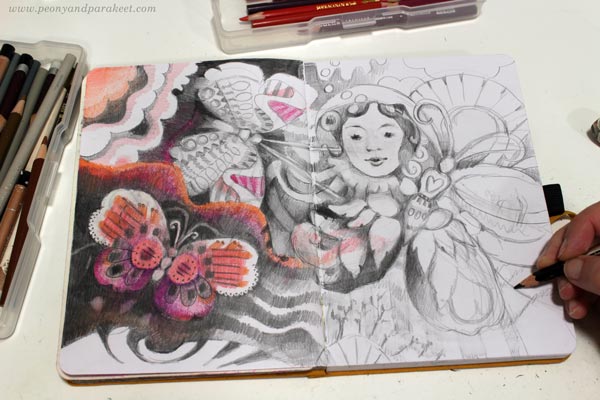
I added a person, a butterfly girl or a boy, to one of the wings.
Butterfly Art and Beyond
I am impressed by how dedicated Torsten was to his fantasy art, even if it was not valued by others.
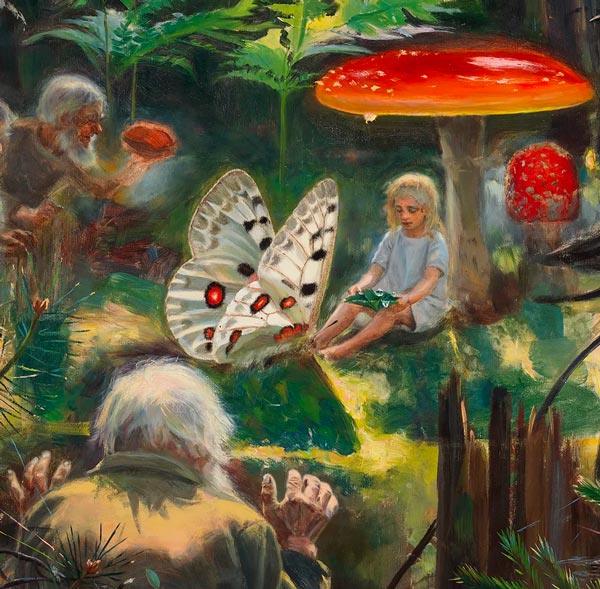
It made me think that I, too, can create “butterfly art” that goes beyond the butterflies – that challenges both my imagination and dedication.
So, I spent more hours than normally with this spread, adding details and then adjusting their shapes and colors.
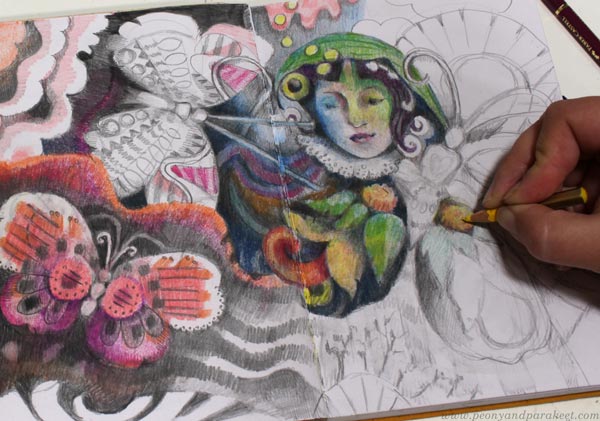
It felt like my pencils reached a new level, getting closer to my heart than before.
The world that is naturally and effortlessly born in my paintings fed the more illustrative work too.
All this makes me think about how important it is to go to see art and use that for inner discussions: how am I different, what are my consolation pieces, and how do I show my dedication to art? Then butterfly art can go beyond butterflies in the same way as Helene’s violets are not just “violet art.”
What do you think?
Hearts and Flowers – Draw Freely with Me!
This week we will grab colored pencils and draw freely in full color. Follow me step by step!
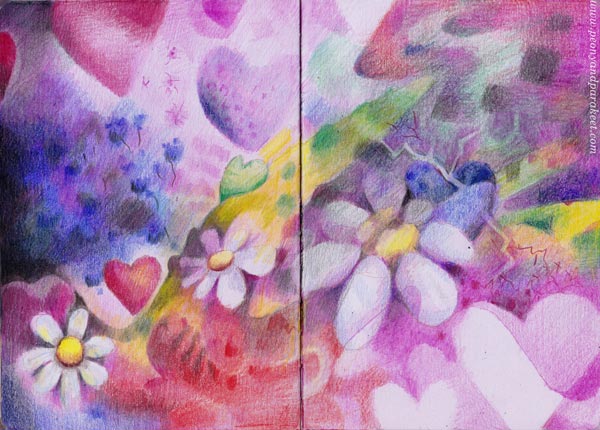
This exercise is set so that we start simple and then get more creative. If you are a beginner, you can stop earlier, and if you have more skills and patience, you can go to the very end. You only need paper and colored pencils. I drew the picture in my colored pencil journal.
Step 1 – Draw a Flower and a Heart
Pick a brown or blue colored pencil and draw a flower and a heart.
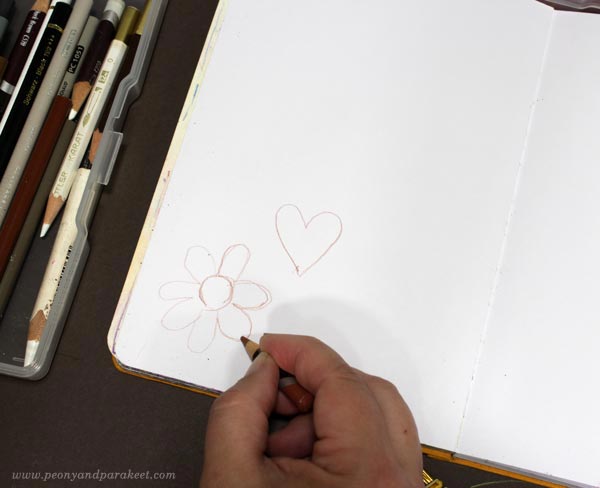
There’s nothing creative here, these are just the basic symbols of a flower and a heart. Place these on the corner of the page so that they are like a starting point for the rest of the image.
Step 2 – Draw a Tilted Flower and a Heart
Now draw a flower and a heart so that they look tilted. Having variation makes the image!
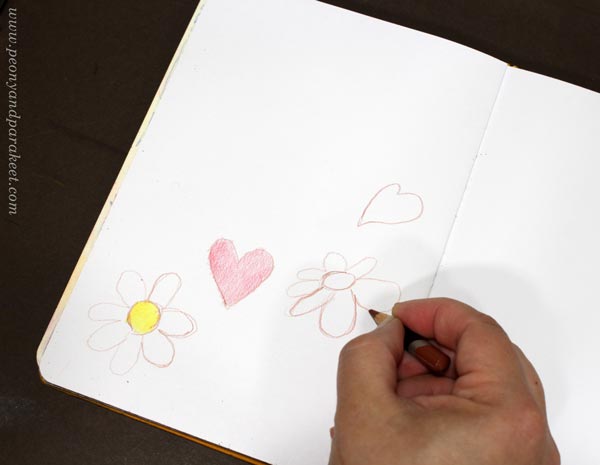
Instead of a circle, draw an oval for the center of the flower. Change the length of the petals gradually. Draw the other side of the heart smaller so that it’s not symmetrical anymore.
I like to add some color right away – not much, just a light layer as a warmup.
Step 3 – Draw a Big Flower and Then a Heart Behind It
I bet your flowers and hearts are pretty similar in size and placed separately – like mine are! Let’s add variation by drawing a big flower and by placing a heart behind it. So here, the heart is only partly visible.
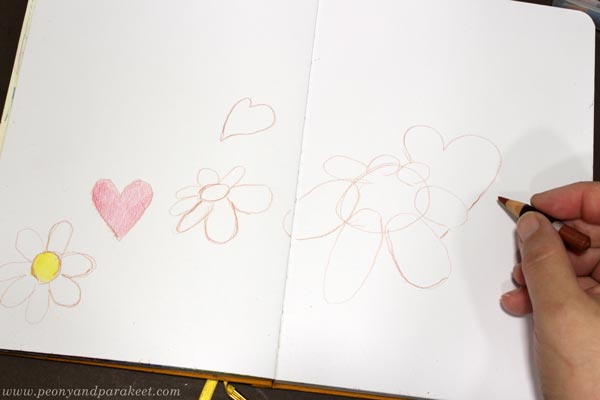
Again, I drew the flower a little differently than before. I made the petals go on the top of the center. Now when the flowers and hearts are all a bit different, they look more lively too.
Step 4 – Color the Hearts and Flowers and the Background Around Them
Now pick a wider selection of pencils and color the hearts and flowers. Also, choose a background color and add some of it to the background.
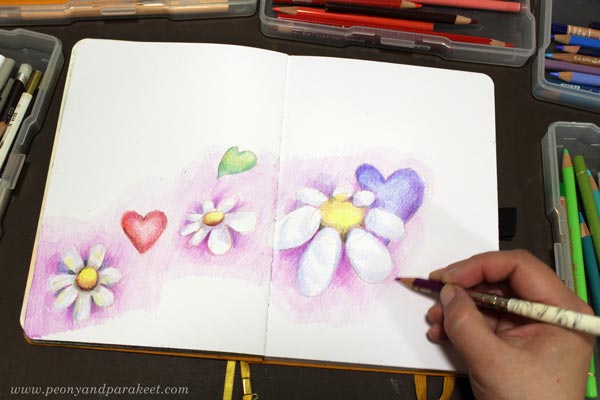
You can adjust the outlines if needed with the background color. Color lightly and leave most of the background blank.
Now you have a cute little drawing, but let’s draw more freely next!
Step 5 – Color Flowers on the Background
We now have stereotypes of flowers, but let’s go further and question them. When a flower wants to be free, it becomes less defined, and the center disappears. Make the background more lively by coloring three big blurry flowers freely.
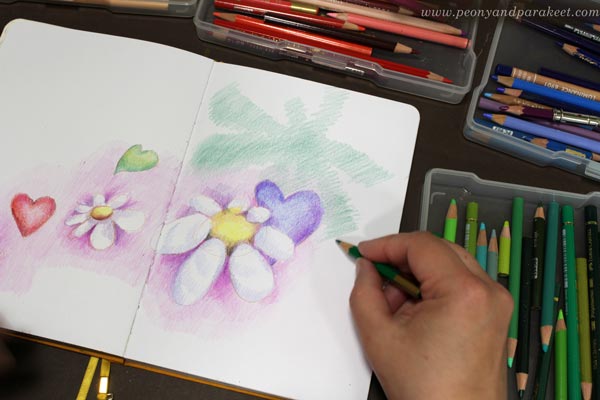
Without thinking about typical flowers, color stripes that go in different directions. They can have different lengths, be straight or curvy, and the result can look pretty odd!
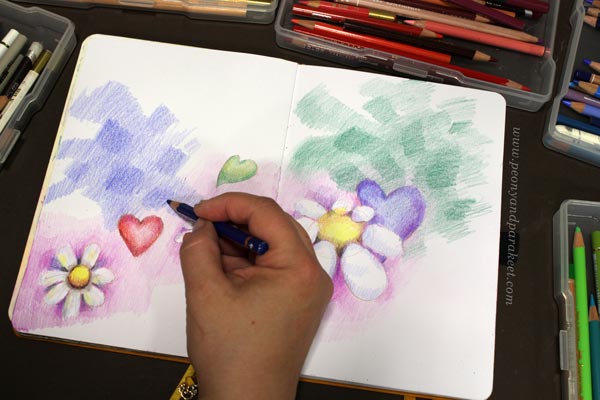
Then color rectangles on the top. Make three blurry flowers total – sets of stripes and rectangles, that is!
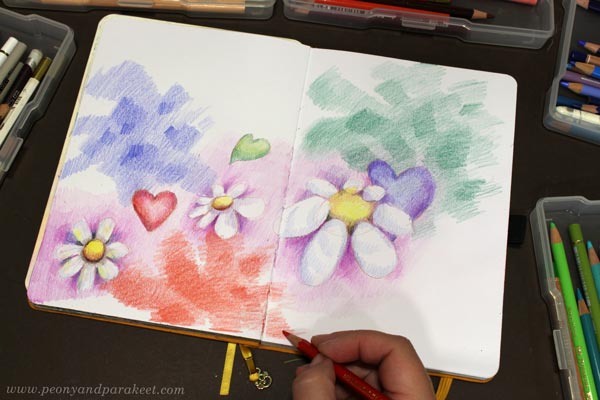
Connect the elements so that the new ones go a little behind the old ones. When you want to create an emotional connection, create a visual connection!
Step 6 – Color Hearts on the Background
Without outlining, color a set of hearts with the background color, and then make a second set of white hearts by coloring the background.
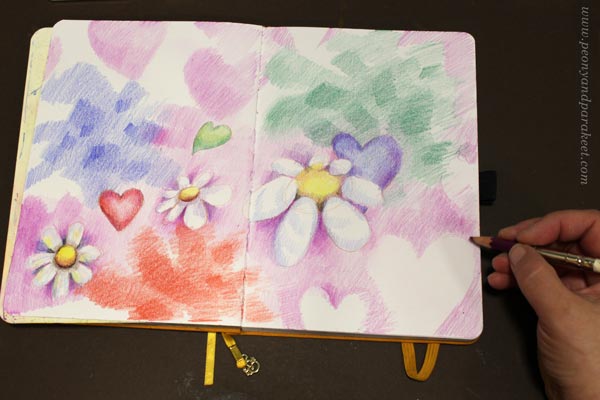
Color around the heart, not the actual heart! The hearts can have various sizes. Place a part of the hearts near the edges so that they are only partly visible.
Then add more background color so that it goes partly over the background elements and makes the image a little darker and calmer.
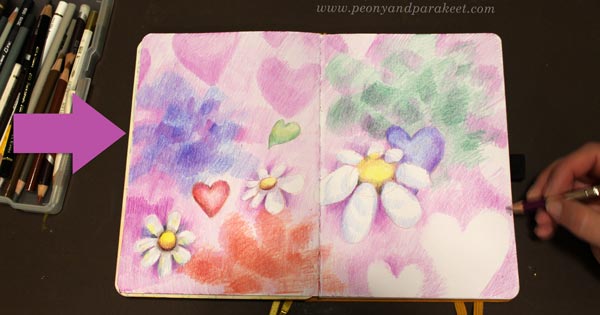
Now you have some free expression, but next, let’s go further and add more drama!
Step 7 – Color a Dark Path
Light always shines more brightly when there are also dark colors. Pick black and other dark pencils and plan a path that goes across your image from one corner to the opposite side of the center.
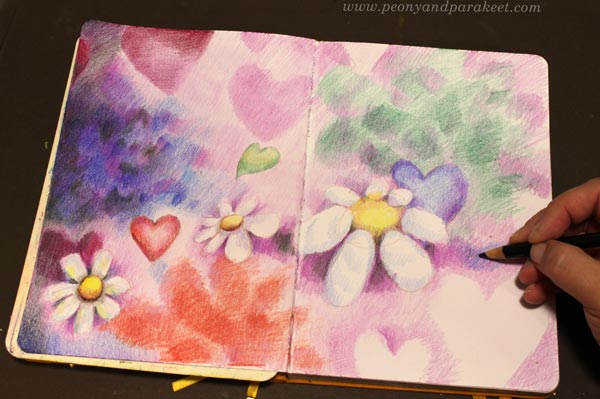
First, color the chosen corner and the nearest edge. Then move towards the center. There, add shorter stripes and spots that mark the path and highlight the best parts of the image.
Now you have set the basic lighting. But in nature, light often travels less straight and makes the overall impression less stiff.
Next, we will get creative and free up the light!
Step 8 – Draw a Freeform Line and Color Its Sides Differently
Take a deep breath, and practice first. Stand up, and move a pencil in the air so that it creates curves. Then sit down and draw a curvy and continuous line that goes across the page.
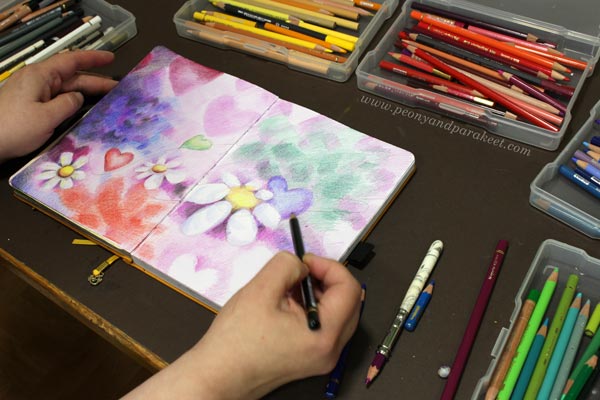
Draw freely and lightly!
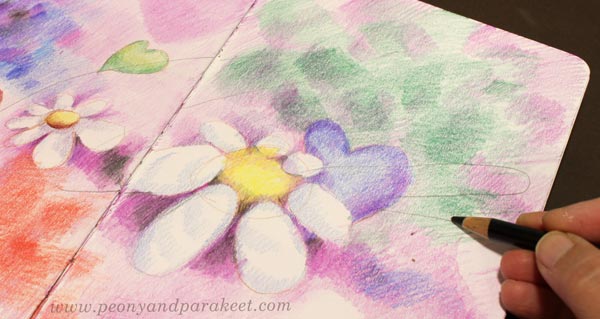
Then color around the line so that light and shadows alternate there. When darkening an area, notice that you can also color smaller shapes and patterns instead of using a solid color.
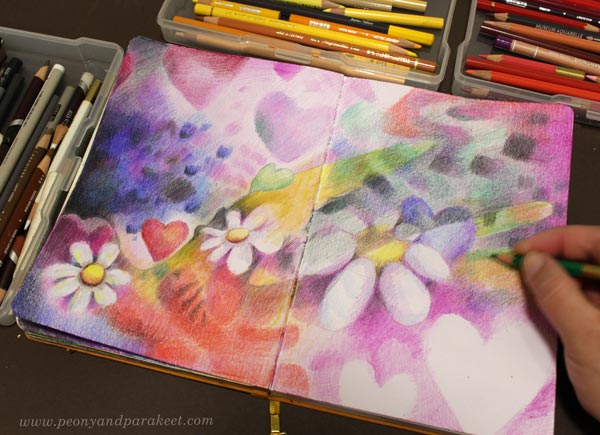
Hearts and flowers can also interact with the division so that they add more little curves to it.
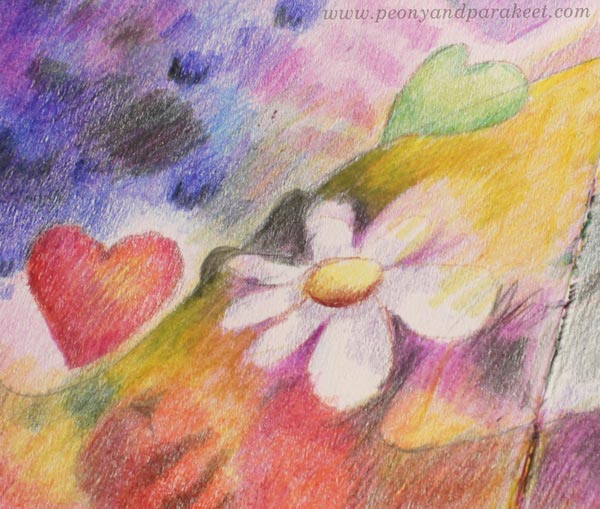
Here, the petals push the line away, creating small bumps.
If you want to add more interest to any other area, you can do the same: draw a line and then color the sides differently.
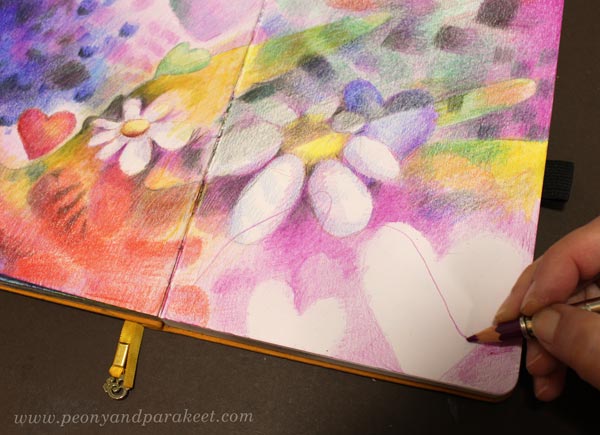
Now you have an atmospheric image, but does it have a message?
Next, let’s ponder what to express and color a little more!
Step 9 – Finishing with a Message
Ask yourself: what element do you like the best? My favorite thing was this blurry heart.
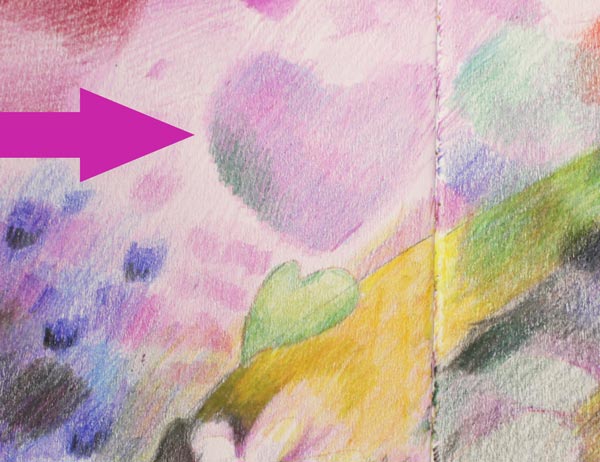
Even if it’s not a centerpiece like the big white flower, it felt like a force that affects the scenery the most. I often discover this kind of “background force” in my drawings and paintings. It seems to be the most strongly connected with the overall message that I want to tell.
The pink heart is like a lady who makes everybody fall in love with her. I want the overall scenery to look feminine but also have elements that include agony and the more desperate side of romantic feelings. I like the tension that I gave with some sharp lines and dramatic curves.
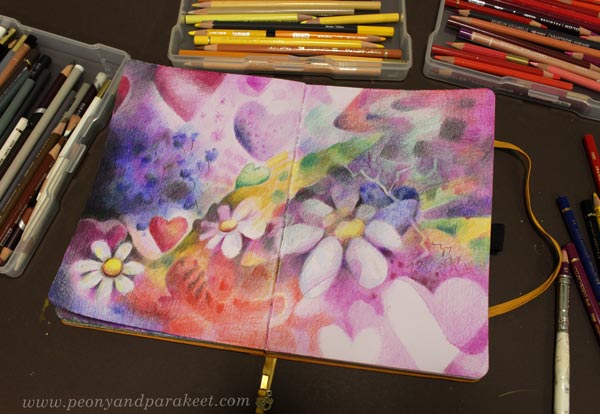
Because everything has two sides, often finishing with the message means adding more tension. It makes the image feel more real and more relatable.
I hope this inspired you to draw freely!
Let’s Get Inspired by Tassels!
This week, we dive deep into the soul of tassels and get the most out of our creativity.
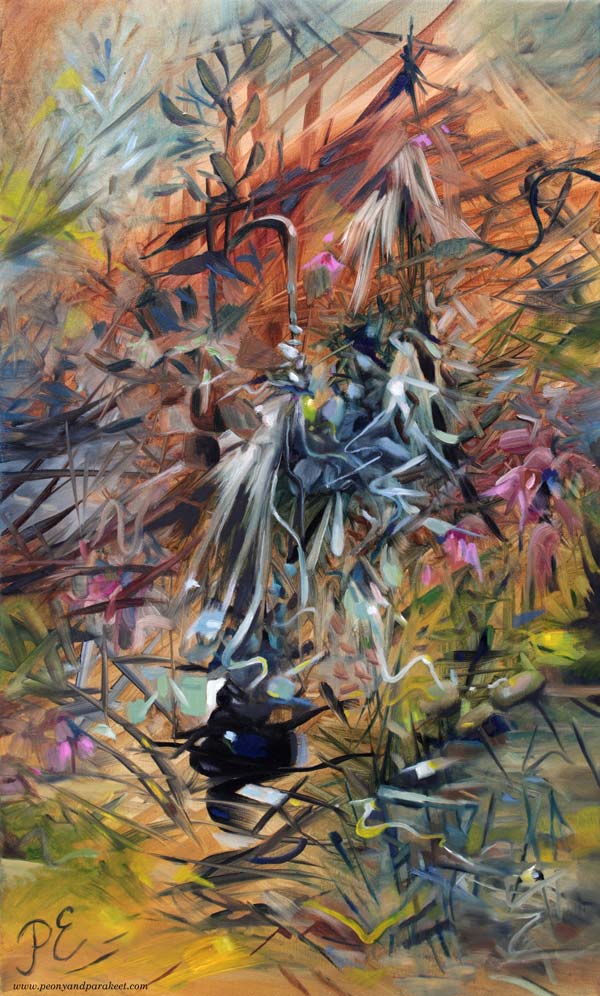
Here’s one of my newest paintings called Church of Saturn. This oil painting is a part of my series Linnunrata – Milky Way, where I explore planets and outer space. (See previous work: Jupiter here, Uranus here, the Moon here, Mercury here, Neptune here, Pluto here, the Earth here, Venus here, and the Sun here!) When I painted it, I thought about the rings of Saturn, the god of agriculture, branches and twigs, an old wooden church from my childhood, wabi-sabi, and the beauty of – tassels!
Tassel Dolls
When I was living in Eastern Karelia in the 1970s, the simplest doll we could make was a tassel doll. I painted it in watercolors so that you can check if it’s something that you had too!
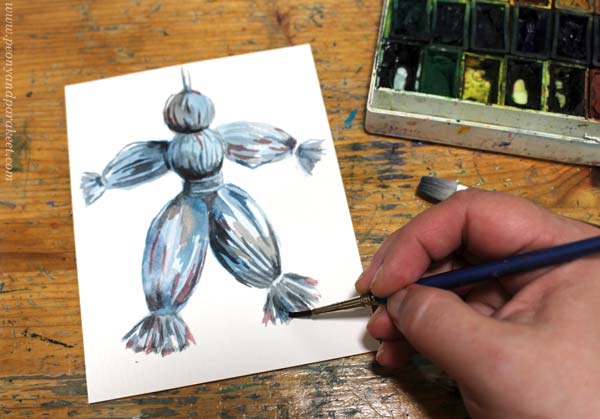
The doll was made of wool yarn and so simple that even a 5-year-old could make it. It’s a good example of a thing that is not valued by our adult self, but that brings up our inner child: “Hey, Miss Tassel, where do you want to go?”
Tassels as Extra Decorations
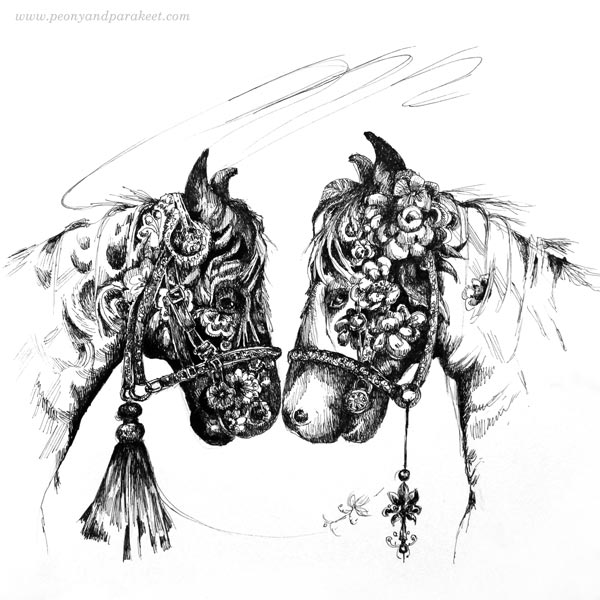
I rediscovered my love for tassels in 2018 when I participated in the Inktober challenge. Back then, I thought of tassels being a fun accessory and I have enjoyed using them as extra decorations in my drawings.
This week, I drew a new tassel for my boxes of joy and had a lot of fun making it.
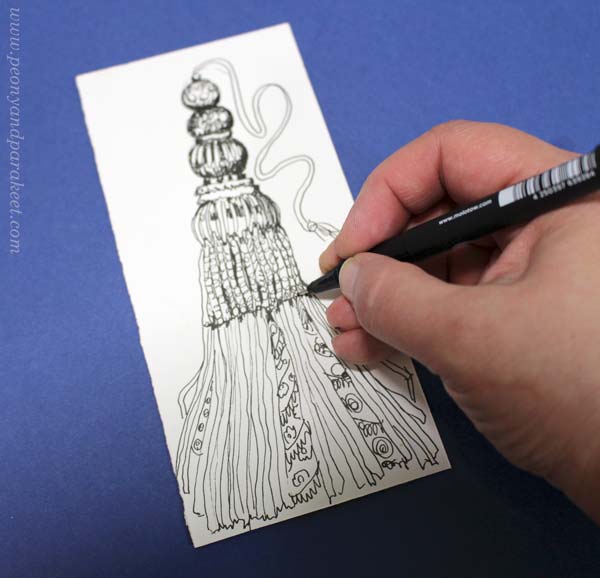
First I drew some circles and lines with a black drawing pen, then added textures and shadows in the style I each in the classes Animal Inkdom and Magical Inkdom.
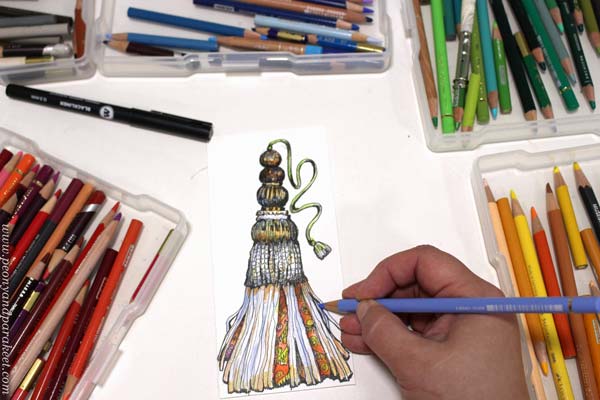
After colored pencils, I picked some other hand-drawn pieces from my boxes and admired the luxurious collection.
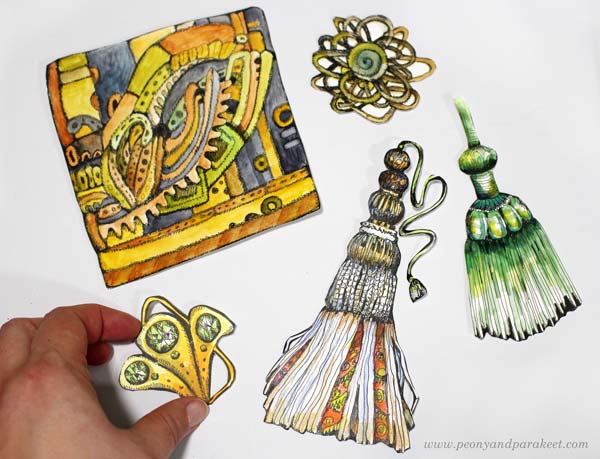
Who needs shopping when you can have your own personal store and draw all the good stuff for it!
Blowing Life to a Tassel
A tassel drawing can be more than a decoration only. You can have more fun by playing with it so that it will get a personality. Imagine a tassel as a person or an animal – a living thing. Here I see two tassel ladies on a stroll!
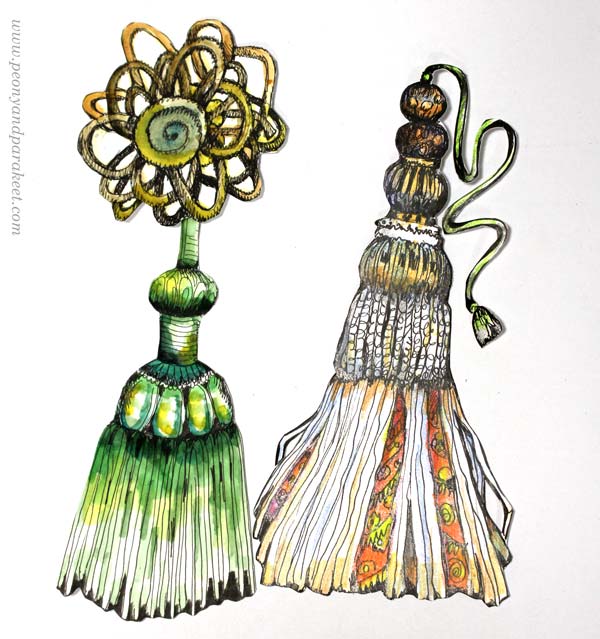
Now, the tassel has a mind of its own. An artist can see any simple object as an element of expression.
In the painting “Church of Saturn,” the tassels have a spirit that makes them an integral part of nature.
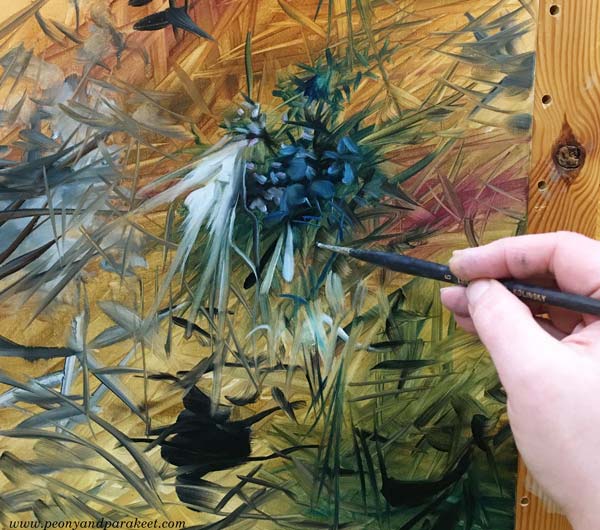
These tassels are organic, and the style is abstract rather than illustrative.
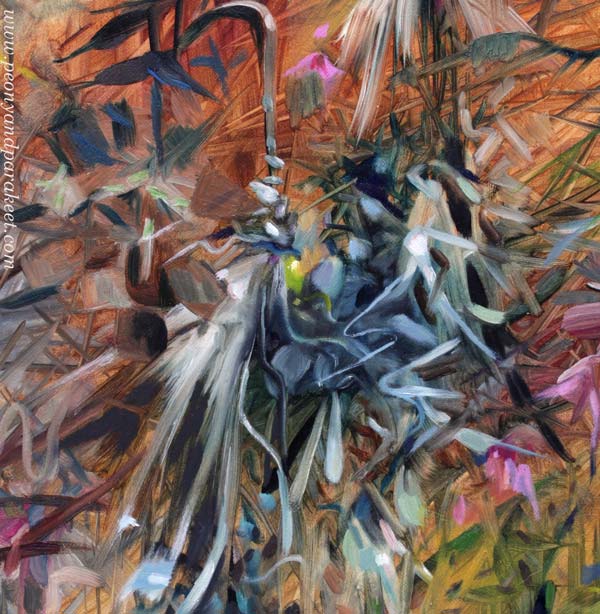
As artists we need to do this – go beyond what’s expected and commonly seen.
Ornamental Figure with Tassels
In the class Magical Inkdom, I draw a funny bunny with a tassel on her head and now I got the idea of making an ornamental figure so that the tassels form the body.
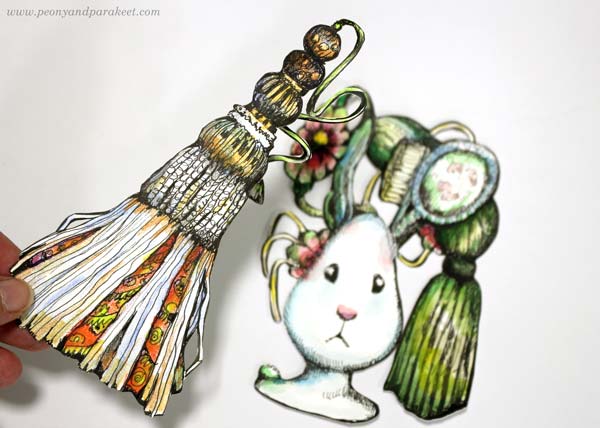
To make a symmetrical ornament, I traced the tassel three times on the right side marker paper. Marker paper is thin so it’s easy to see through it.
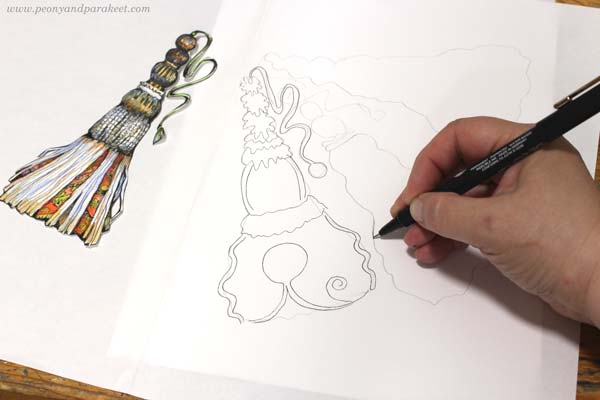
Then I taped the paper to the window and traced the three tassels on the left side of the paper. I added additional elements to the center and some facial features too. My tassel doll!
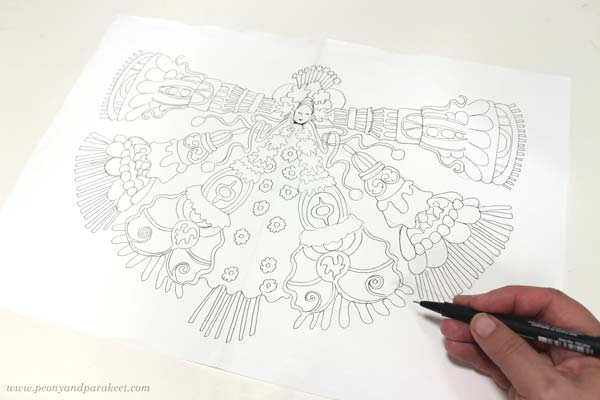
But when I continued the drawing, I got a crazy idea of a knitting hamster. Tens of years ago, I was a hamster breeder, attending shows and everything. I know those little animals well! Knitting is one of my favorite hobbies and the thought of a hamster collecting all the yarn and trying to knit it made me smile.
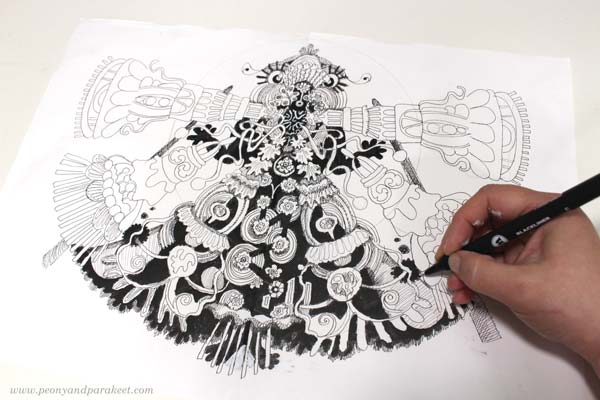
Then the word “Knitwork Orange” came to my mind, and I included the orange as well!
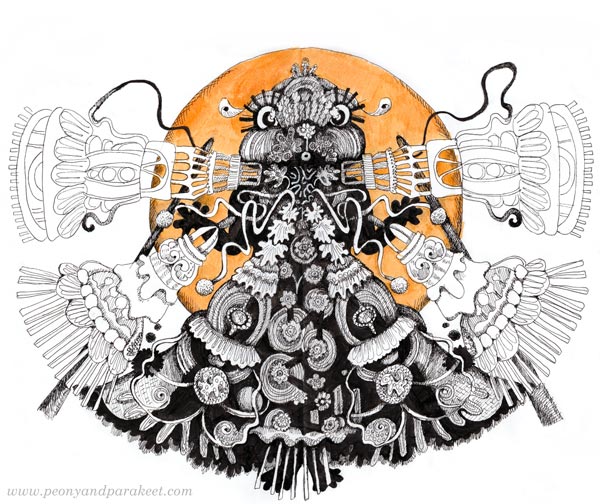
Here’s me, in the middle of the night, knitting away!
Tassel Dolls on Mars
Last spring, I had a small canvas that was first just a mess. I like to start my paintings in this intuitive way and without a plan. I had some leftover paint so nothing was wasted.
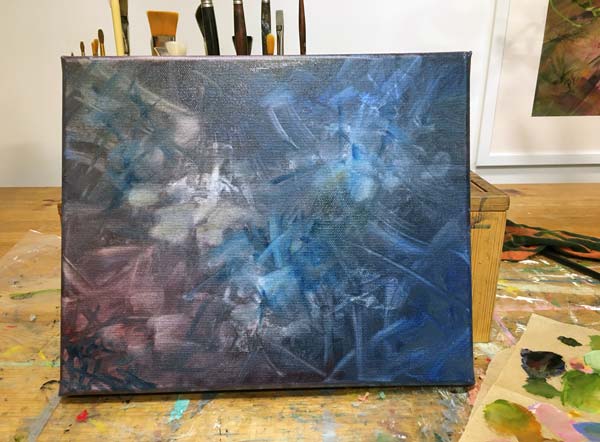
The first ideas are terribly traditional and mine was to make a vase with flowers.
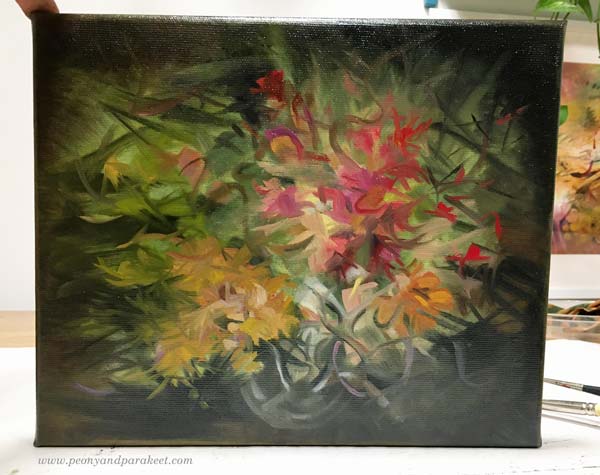
But after this, I was taken to another planet, to Mars! There, tassel dolls met art deco, and I had a lot of fun finishing the painting with all the decorative details.
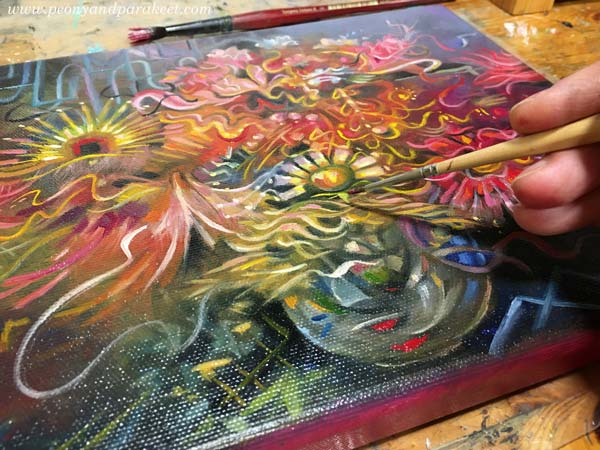
I love the Great Gatsby movie from 2013. It has the best party scenes and good music. I had a lot of fun creating a tassel doll party that took place on another planet.
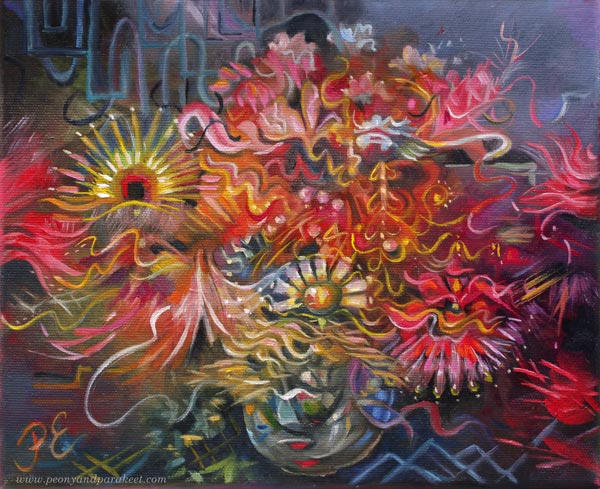
This small piece ends the Milky Way series – 11 oil paintings from March to May. I have taken a break from creating art, but feel like I am recovering now. Thanks to making the tassel drawings for this post! I hope they work for you too!
Out in the Open – Feelings from the First Solo Show
This week I talk about my first solo show called Linnunrata (The Milky Way)
and share thoughts and feelings that being out in the open has evoked in me.
Here’s one of the last paintings that got finished for the solo show.
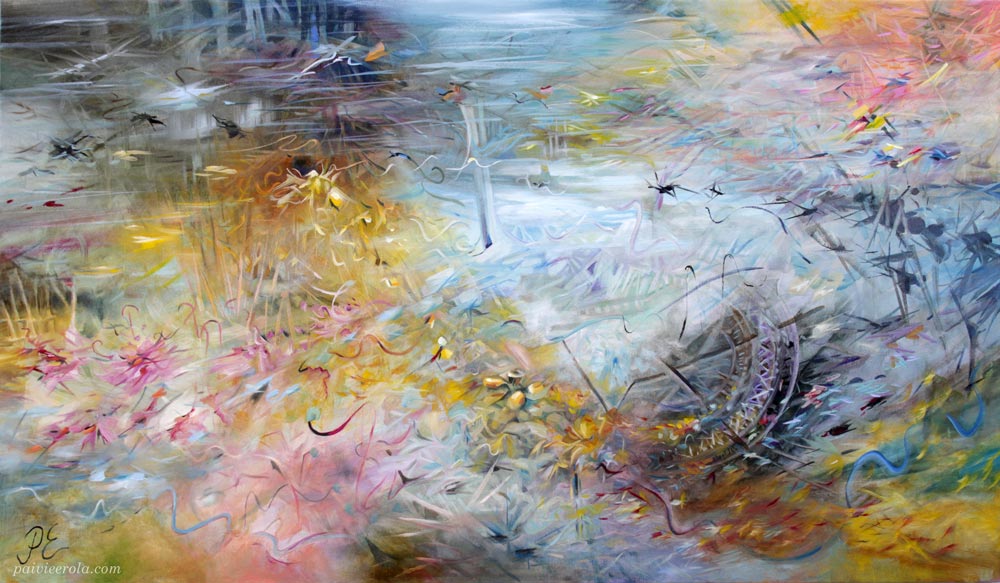
Click the image to see it bigger!
I started it in April when there were too many water puddles in Finland.
Water World
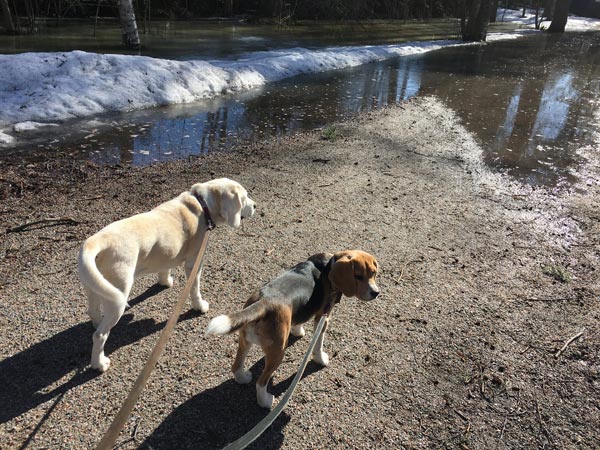
Water blocked roads and filled fields. It was frustrating and ugly and at the same time, magical and beautiful! I realized that I could watch the mud or look further and see the sky and the trees. Their reflections created a miraculous underwater world.

Just like the planet Uranus, this imaginary world had no solid matter – only gas and water!
Pressure Rises
Because I wanted to present my best work at the show, the pressure for bringing out the best of my skills was high. When I started the painting, its identity and colors were weak and the composition weird. I was worried if I get it finished in time.

It took many layers before the painting was finished. Because I like to keep the layers thin and fairly separate, lots of time was spent on drying between the sessions. My studio got too small, and there were paintings drying everywhere!
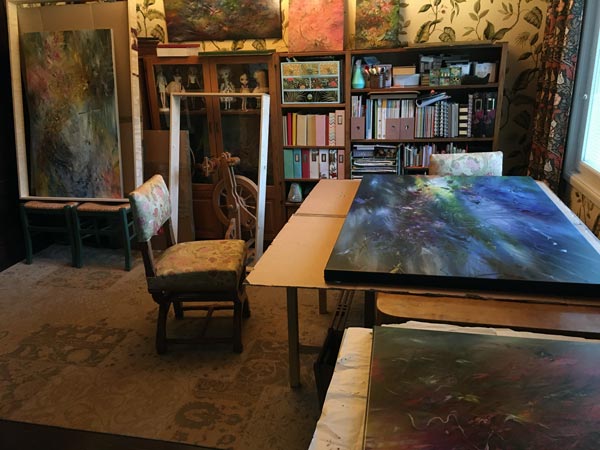
I find it quite nerve-wracking to handle wet paintings!
Unexpected Turn
I usually never change the orientation of the painting in the middle of the process, but this time I did. I felt that I could open the space more by doing that. However, I think this piece works in both ways, what do you think?


Hanging Plan for the First Solo Show
One of the most challenging things when painting for the show is to keep the overall selection coherent. I had a hanging plan right from the beginning, and I updated the plan after each painting. Here’s how the plan looked before the actual hanging.
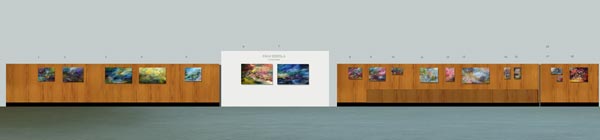
The problem with the last paintings was not only to create unique artworks but ones that would also complement the overall collection. I formed small groups from the paintings to give visual rhythm to the exhibition.
We mostly stuck with the plan.

I wanted it to be noticed as a main piece of the right side wall. But Court of Uranus was such a strong piece that I wanted to move it to a more central place.
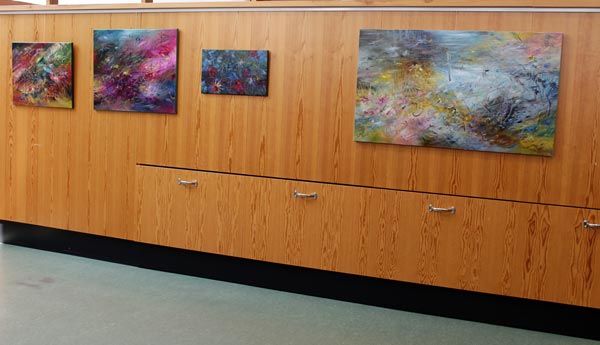
I left some space around it so that it stands out. This painting causes bittersweet feelings in me, being both beautiful and spooky at the same time. It has been interesting to hear how people see it.
Gallery Space
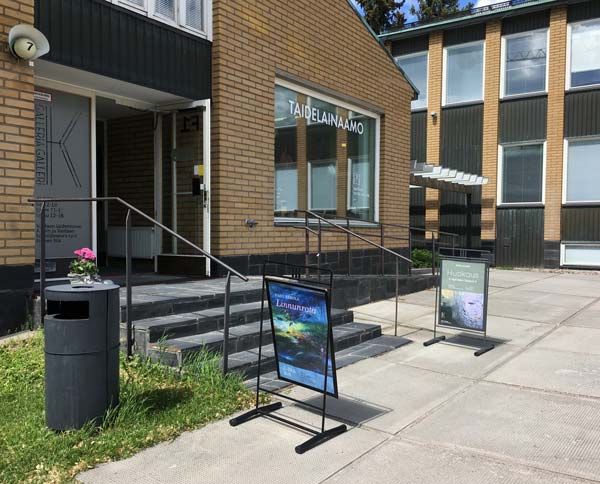
My show had four walls on the lower level. The building is from 1957 and the walls and the floors are protected. The wooden walls did not bother me, I think my art goes well with them. Here’s a better picture of the gallery space.

The two big paintings on the white back wall At Home in Pluto and Jubilee in Neptune were painted when I was middle of the series. I think it’s best to paint some smaller pieces first before making the largest ones. I used Neptune for the poster of the show.
When the main pieces are done, there’s more room for something unexpected. That’s how Court of Uranus was born.
Court of Uranus feels like the painting defines me rather than I would define the painting. It seems to display my future and show what more I could do.
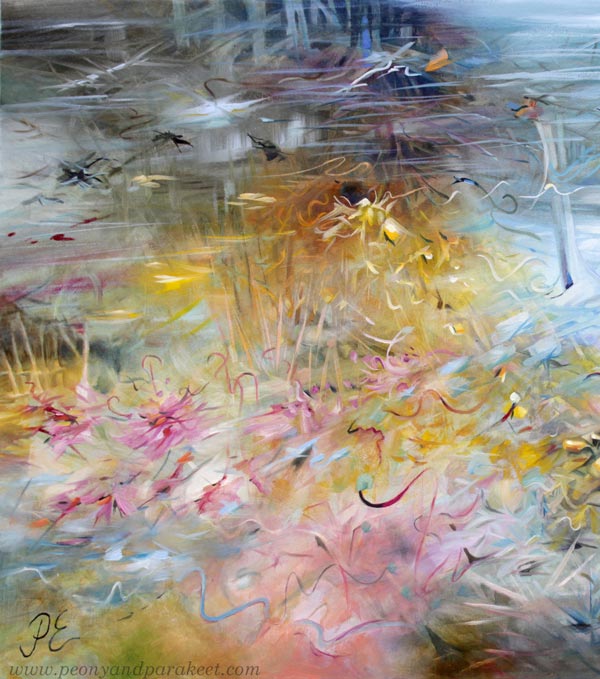
The big yellow flower is perhaps the most beautiful thing I have ever painted, and still, it makes me uncomfortable, like I have gone too far, revealed too much.
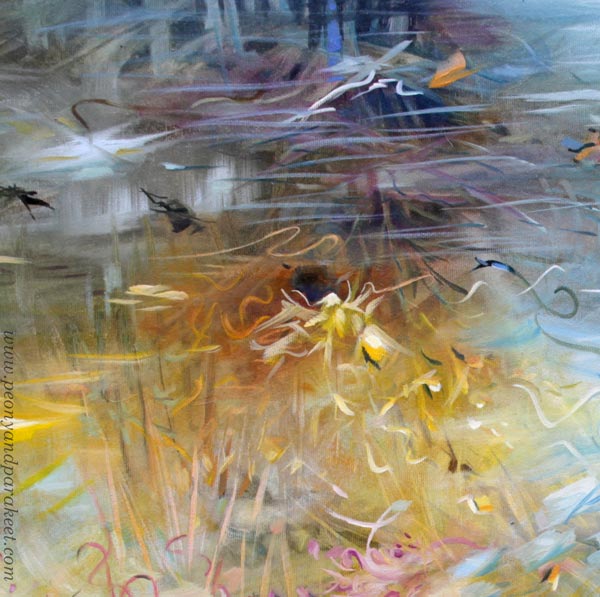
I like how light-weighted the flower is. Like she has no worries at all!
At the Opening of the First Solo Show
Riika Anundi‘s show was also her first, and we had an opening together. I gave a speech, we had nice sparkling wine and delicacies, tens of guests, and a very enjoyable atmosphere.
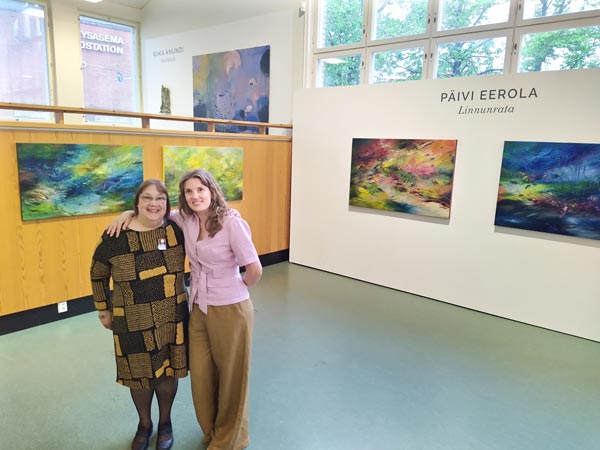
I had invited both relatives and old friends from the past decades. It was wonderful to relax and enjoy after the hard work that the show required.
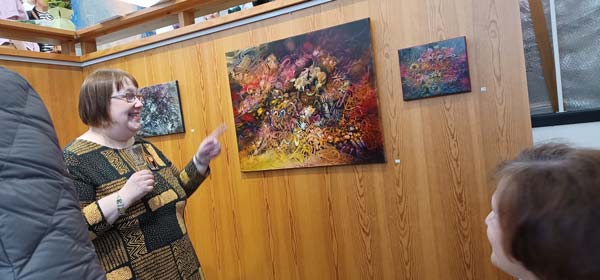
Every series has a painting that looks forward. In the picture above, I am talking about Vanitas, the painting that I made last year.
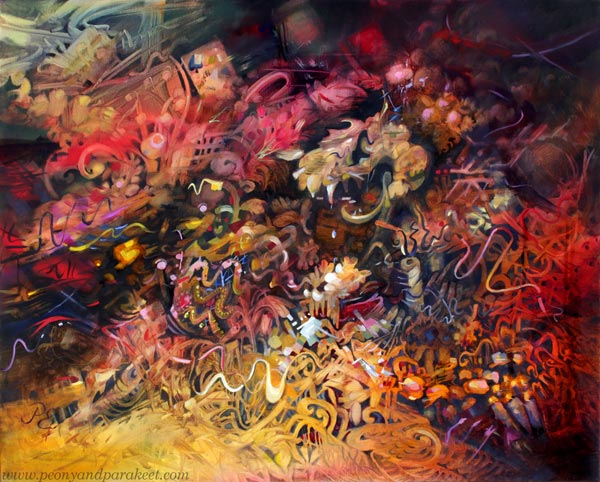
This painting, especially the top left corner, led my thoughts to outer space and thus, it was essential to display it at the Milky Way show. I don’t know where the court of Uranus is leading me, but it definitely sets a new direction.
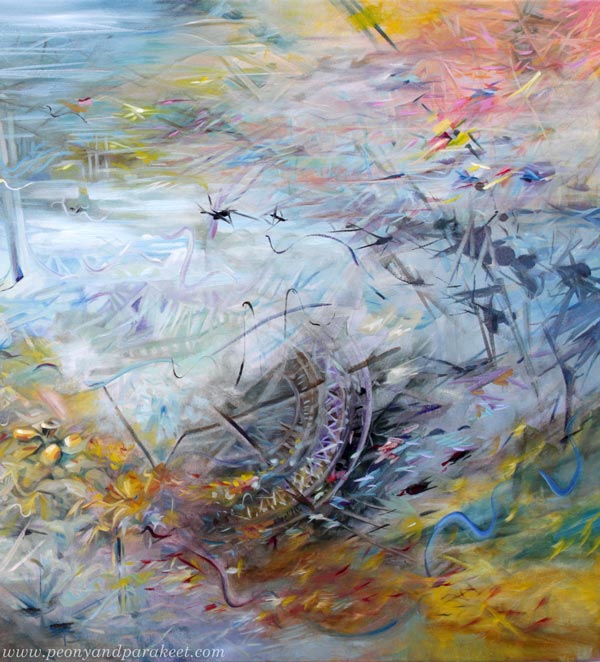
Even if the colors are dreamy and pastel, there are also technology-inspired details in the painting.
Life After the Solo Show – Open Question
Lastly, I want to show you an old crayon drawing, made as a teenager at school. The subject was the underwater world. Even if I have always hated swimming, never been diving, and never liked water, the drawing came out naturally. Like I had known what I was made to paint already back then.
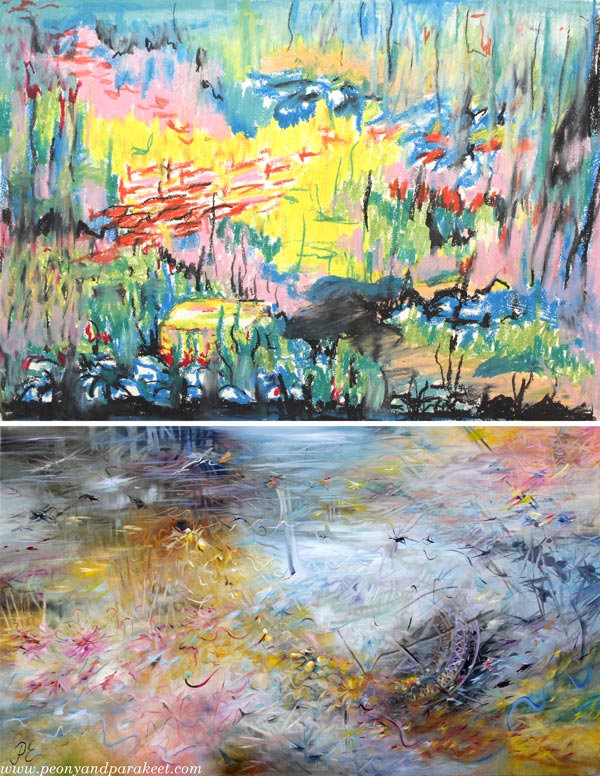
This post is perhaps more like an open question than an answer that closes everything. Time will tell where my journey goes next! Thank you for walking (or swimming) with me!
Linnunrata – The Milky Way is open from June 3 to June 19, 2022.
Last week! Thursday-Friday 11-17, Saturday-Sunday 12-16
Galleria K, Asematie 7, 01300 Vantaa, Finland