
How to Color like Monet – Step by Step Instructions
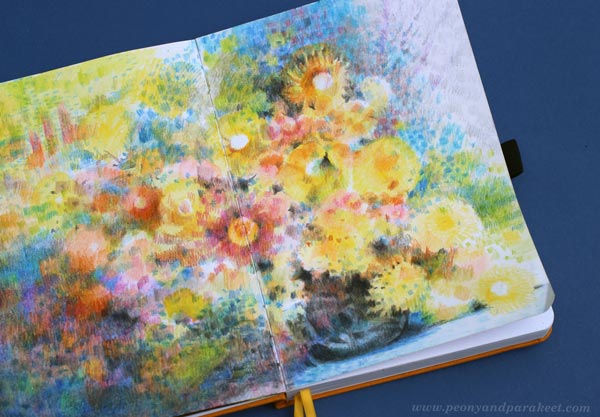
This week, I share the newest spread in my colored pencil journal and show how to make pages in Claude Monet‘s style.
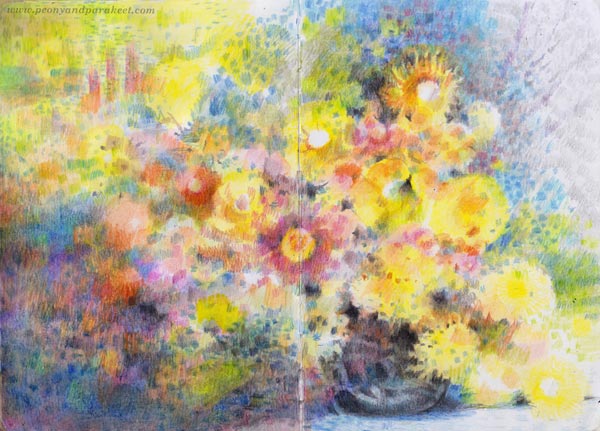
This project is just simple flowers in a vase, but the layering of colors in an impressionistic style makes it special.
Supplies – Colored Pencils and Paper
I used watercolor pencils but mostly dry, so you can have any colored pencils for this project. My selection has some fancy Caran d’Ache Museum Aquarelle pencils, but mostly old Staedler Karat watercolor pencils.
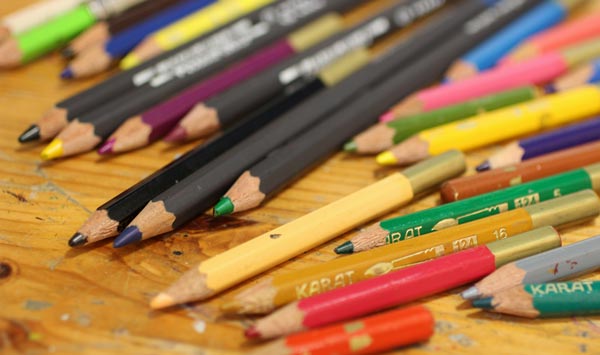
Karat pencils are getting so short that I need an extender for convenient coloring, but they look endearing and I want to give them a long life!
Step 1 – Color Circles Across the Page
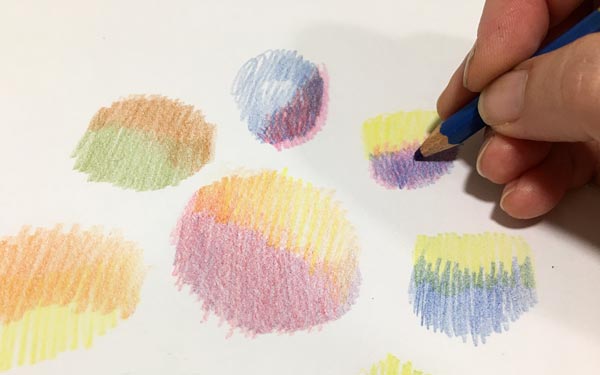
Let’s begin with circles. Color a variety – full circles, half-circles, hollow and filled ones, big and small! Pick only a few colors first, and only fill a diagonal that goes across the paper.
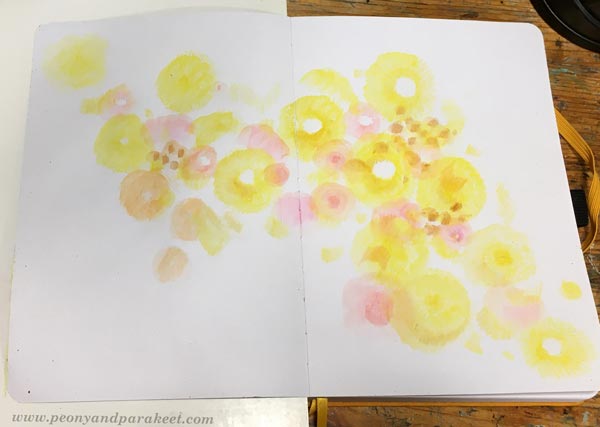
Color lightly so that you can add more layers on the top later. If you have watercolor pencils, you can spread the colors with water.
Step 2 – Color Short Stripes on the Top
Color short stripes over the circles. Now you can use a wider variety of colors and enlarge the size of the colored area.
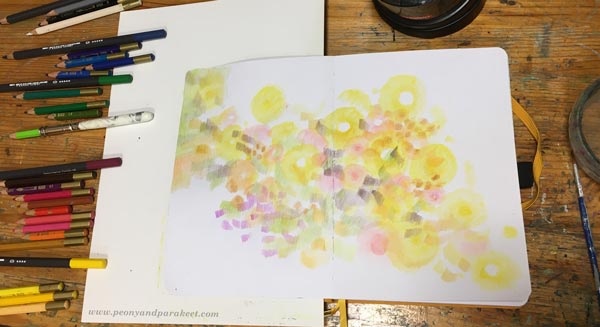
I arranged my pencils so that they are grouped by color families. It helped a lot in this project, especially for the color areas in the next step.
Step 3 – More is More!
Continue coloring circles and stripes in various sizes and colors so that they fill the paper.

You can have so short and tiny stripes that they are more like spots. Stripes can go in different directions. Change the orientation of the paper once in a while.
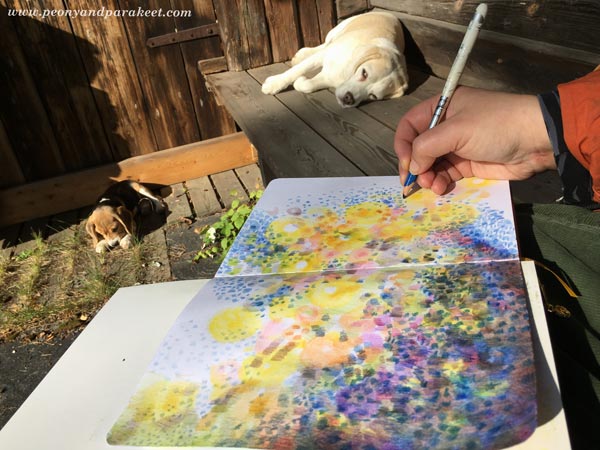
Even if you color tiny elements, divide the page into big areas. The diagonal in Step 1 is one of them. Each area can have many layers and colors but decide which color will dominate. For example, I have a blue area on the left bottom corner.
Step 4 – Color a Dark Vase
Color dark stripes on either side of the centerline to form a vase. Leave some space between the stripes so that it looks like it’s dark glass.
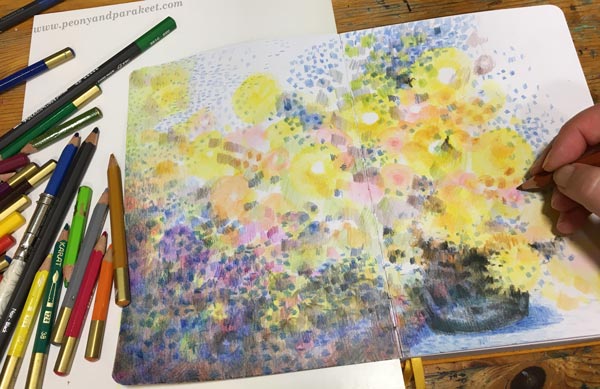
You can also add some shadows below the vase to make it look more like Monet’s work. I used blue for them.
Step 5 – Highlight the Best Flowers
Add more bright colors and details to make a few flowers that catch the eye more than others.

I don’t draw any outlines, but continue to color freely in short strokes.
Step 6 – Make Sure That You Have Enough Variety
Color more so that you have a wider variety of colors and shapes. See how I have used both vertical and horizontal stripes on the left top corner. They look a bit like windows or trees. Monet often had abstract elements like these in his work.
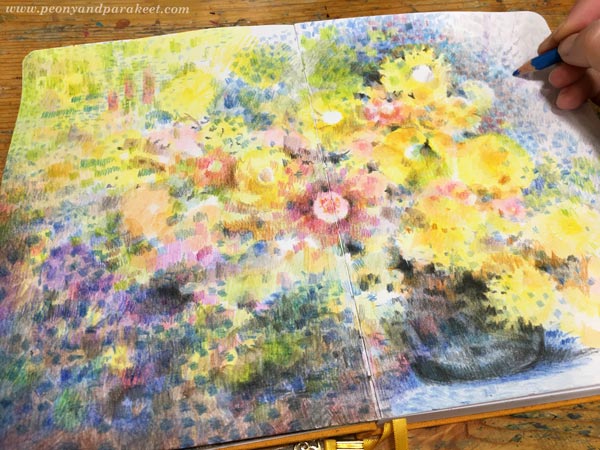
When you color more, make sure that blank paper isn’t visible everywhere. Color lightly over the areas that are less important. When they don’t have any bright white, the overall impression is less busy.
Step 7 – Finishing Like Monet
Go through your colorings one more time. Color lightly over large areas to make them look more unified and add dark spots near the best details so that they become more noticeable.
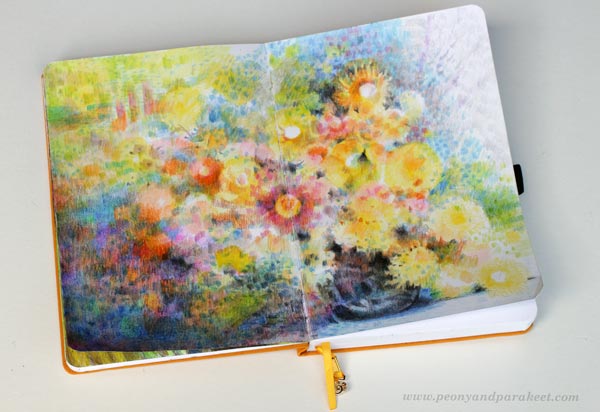
Here’s a closeup of the finished work – lots of small dots, stripes, and layers!

Colored pencils are very versatile. You can really color like Monet! I like this painterly look a lot.
P.S. For more colored pencil inspiration, sign up for Intuitive Coloring!
P.P.S. Thank you all who have signed up already, we will have a lot of fun!
Intuitive Coloring – Examples and Thoughts
This week, I show sneak peeks and process pics of simple intuitive colorings and talk about intuitive art.
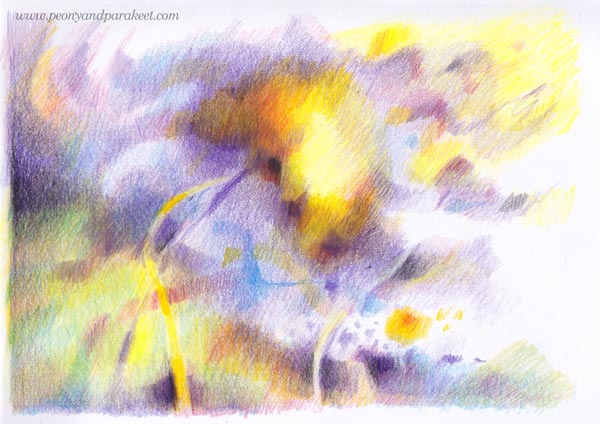
Since I made the last free video “Colored Pencils – Intuitive Approach,” I have been thinking about free coloring. First, it felt like I have explored it thoroughly in the e-book Coloring Freely and in the class Inspirational Drawing. But as soon as I began to make some notes about intuitive coloring, I realized that there are things that I haven’t shared in these blog posts or in my classes so far. Many of them are things that seemed complicated and heavy at first, but the more I have experimented with them, they appear to be very simple and light.
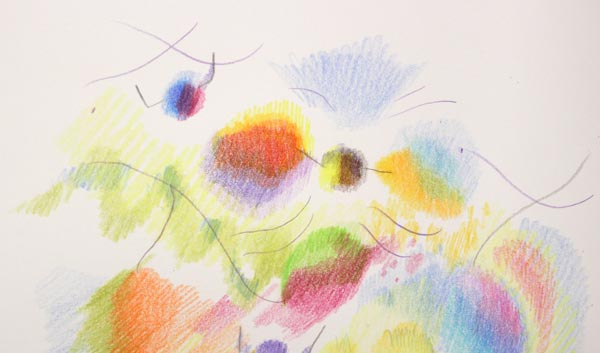
And it feels fun to color freely on a blank paper, and there’s a sense of playfulness too right from the beginning.
I am a more-is-more kind of a person, but after making a series of large oil paintings, I wrote a mental note that says “less is enough” in capital letters.
Can Intuitive Coloring Be Taught and Learned?
I have also been thinking about the term “intuition” a lot. Why does it feel so intuitively correct to say that my art is intuitive? And not only that. Why do I want to teach intuitive art? Because isn’t intuitive just about letting go and emptying the mind on paper? Doing what you want, doing what feels right?
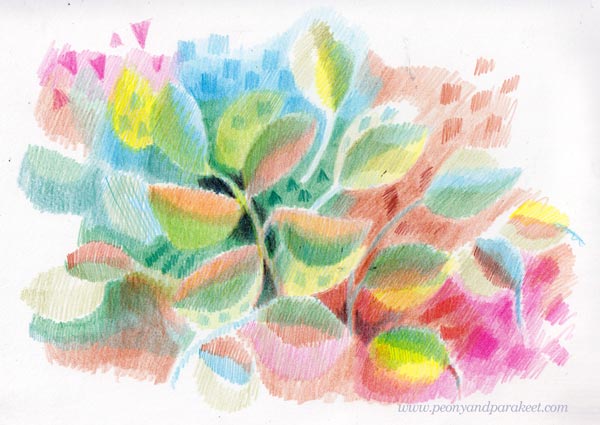
But as a former engineer, it’s always been hard for me to trust intuition when I am trying something new or reaching for a new level. Then the intuition is confused with the comfortable “same-old-same-old” routine. That old dog always stays close, but intuition and imagination are timid puppies. To find the puppies – that’s where I feel I can help.
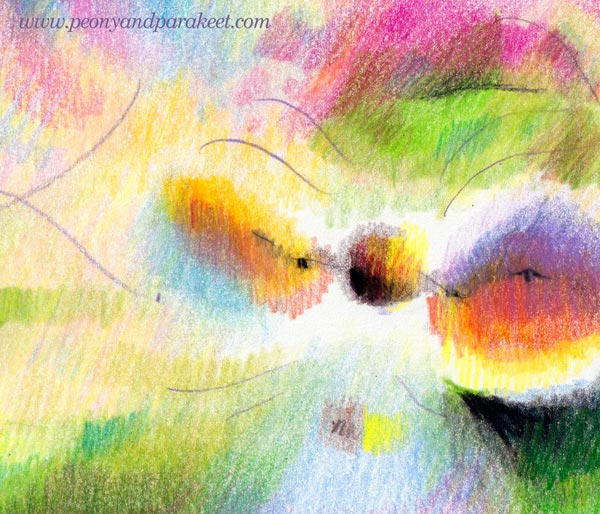
Would you be interested in this upcoming class?
Artist’s Life – What’s Boring and What’s Not!
This week, I make a watercolor painting and talk about how artist’s life can seem different than what it is.
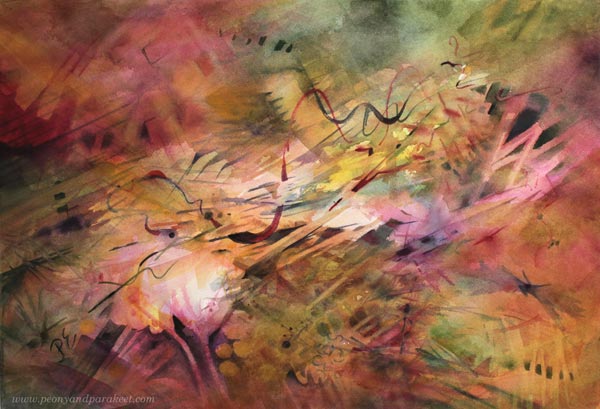
Let’s turn back time and see how this painting came to life!
Is the Art Understood – A Story about Hilma af Klint
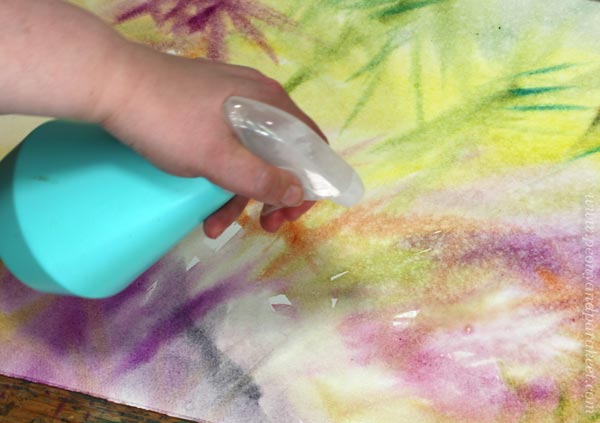
It’s a hot summer day, and watercolors are calling me. So I wet a paper, and after the water has soaked in, I start painting with a big brush.
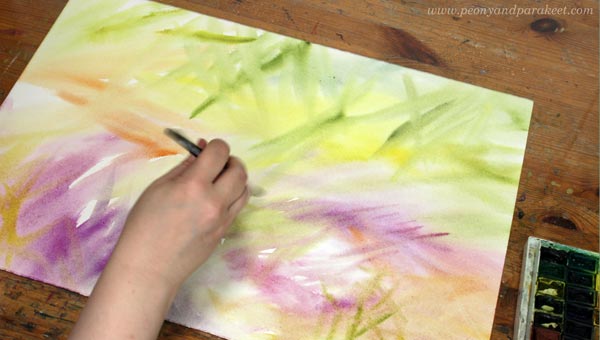
The paper is Fabriano Artistico (cold press). I buy watercolor paper in big sheets and split them in half.
With the first strokes, I listen to the last minutes of an audiobook that has kept me company for a few weeks. It’s “Hilma af Klintin arvoitus” (The mystery of Hilma af Klint) by Pirkko Kotirinta. It’s a new book, published this year and currently only available in Finnish.
Even if the book is about Hilma af Klint (1862-1944), an interesting Swedish abstract pioneer, the companionship with the book hasn’t been pleasant. Mostly because I wanted to know about Hilma’s thoughts and philosophies – her inner life. But the book focuses on the external events and on the author’s background investigation for those.
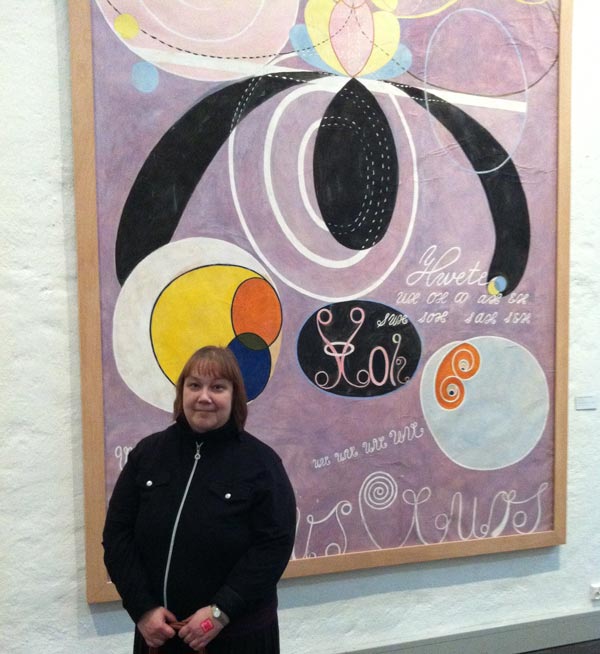
When the book ends, I think about how people who admire artists from the outside perspective often romanticize things that are not romantic at all. There has been a lot of them around Hilma too. These people say: “The artist chose not to sell her art” or “The artist wanted to keep her art private,” but honestly, no professional artist wants that.
Instead, it can happen as it did for Hilma, that despite all the effort, the art was not respected or understood, and that breaks the artist’s heart. Hilma af Klint decided that the time would be more suitable later. So, she stated that her work had to be kept secret for 20 years after death.
Every artist wants to be current, but art has its own timeline. Sometimes it’s too far in the past, and sometimes – like Hilma’s – in the future. Painting freely is like a game where every layer is a new level. The result is unexpected, yet synchronized with the inner clock of the artist.
Boring and Not – Two Sides of Artist’s Life
People who look at artists from the outside perspective think that they live a carefree and eventful life. Therefore, they try to solve the mystery of Hilma af Klint by tracking the external events instead of internal ones. Artist’s handwritten diaries can be too confused, and it’s less complicated to travel from town to town and follow the actual footsteps. But most of Hilma’s life was spiritual, and her 193 gigantic temple paintings, laborious to create.
From the external perspective, art-making is one of the most boring things if you measure it by the amount of silence and concentration.
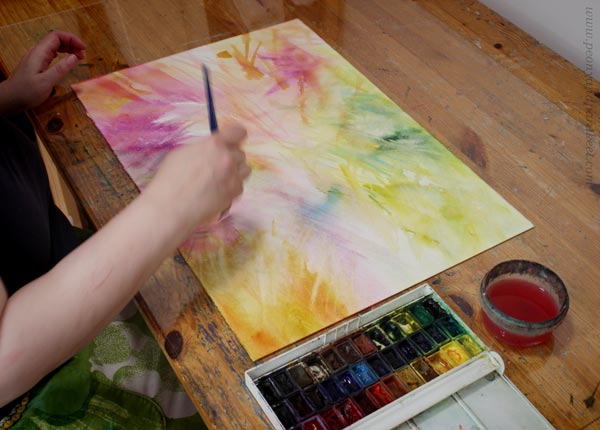
Here I am working with a flat brush.
However, what happens in the inner world, can make the artist’s life most exciting. We get to fly to a new land, find a color, be a color! We get to transmit a spirit through shapes and their interaction.
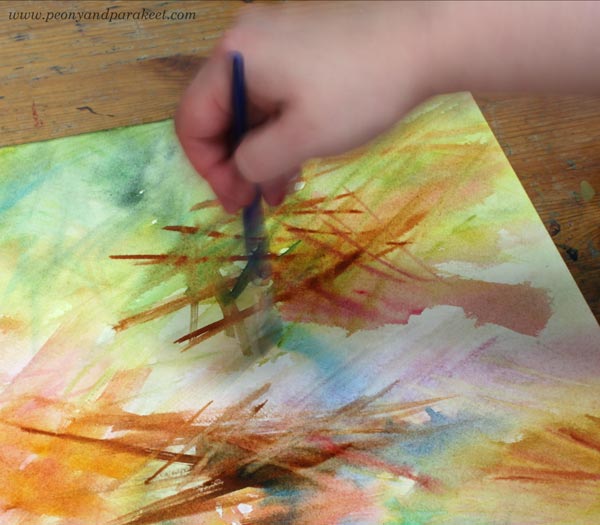
At first, accidental spots of color cause traditional associations: “Here could be a leaf, there a flower.” But when we let them go, a more personal layer opens: “Here’s something that reminds me of teenage years.” And slowly, more layers unfold, colors give room to shapes, and something that first sounded like a foreign language reaches the natural rhythm, and everything falls in place.
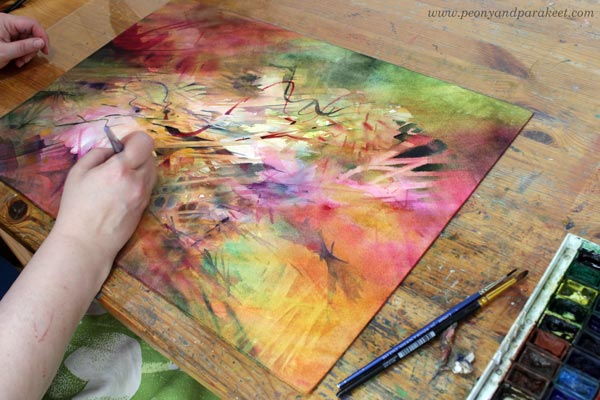
Negative painting – painting around the shapes – brings out light elements.
I work from light to dark and slowly add depth. The process of moving from traditional to natural is the toughest one for me. It requires to face many unpleasant memories – mental monsters that guard the paradise. From the outside perspective, I only make slow strokes for hours. But inside, I am crossing a storming sea feeling afraid of failure and success at the same time. The monsters are roaring on both shores and the only way to get through is not to beat but tame them.
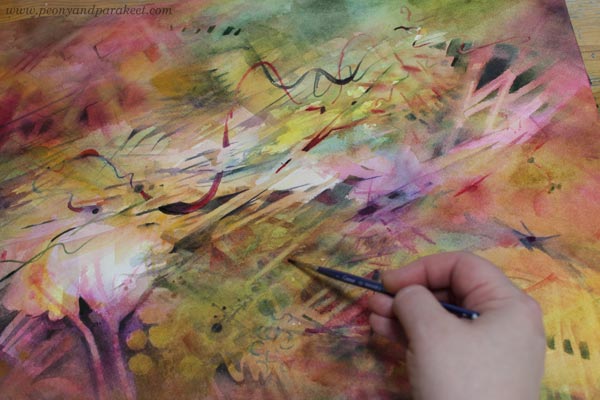
This painting took two days and several sessions.
The monsters are often visible in my paintings too. People often point them when choosing their favorite details: “I like this. How did you do that?”
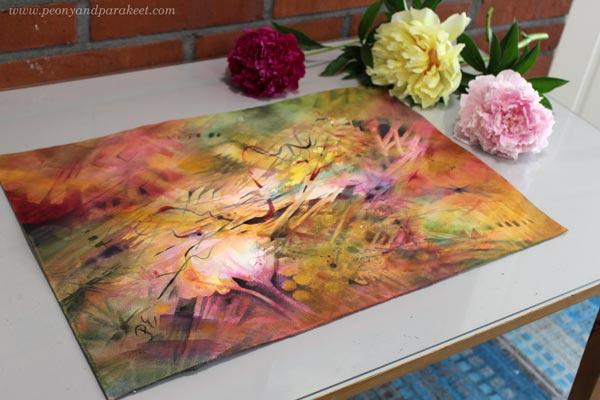
The two sides of art – the technical and the spiritual – are always present. Thus, art is always about both learning the strokes and living the strokes.
Paivi’s Watercolor Classes & Exhibitions
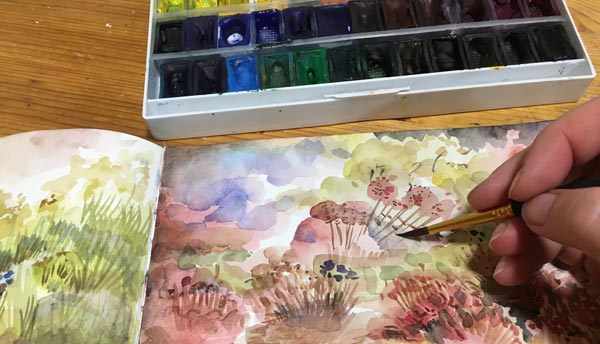
No matter what media you end up loving, watercolors have a lot to teach! Color washes, the negative painting technique, making simple shapes more elegant – all these techniques are useful for any art. Paivi likes to think about her watercolor set as a little assistant, always eager to work, and someone who sets her back on track.
- Watercolor Journey – outer and inner sceneries
- Floral Fantasies – loose and layered bouquets
- Magical Forest – intuitive watercolor painting
If you are in Italy or Finland, come to see Paivi’s watercolor paintings! “Shyeling” is displayed in the international group exhibition in Fabriano from June 20 to Oct 31. “Torchbearer” and “Maximalist” are displayed in the Akvart gallery in Helsinki from July 12-25, 2021.
Also check: Original watercolor paintings available in the shop
Mystical Side of Art(ist) in Progress
This week, I show an unfinished painting and talk about the mystical side of nature and art.
I have a big painting in progress. At least it’s the biggest one that I have ever made – 92 x 65 cm, about 36 x 26 inches. It’s an oil painting, and it takes time because it needs to dry between the sessions. The pics you see here are from the third session, and there’s at least one, maybe even two, to go. But this is the last piece of the series, so I don’t want to rush. The painting needs time to mature, and I want to end the series gloriously.
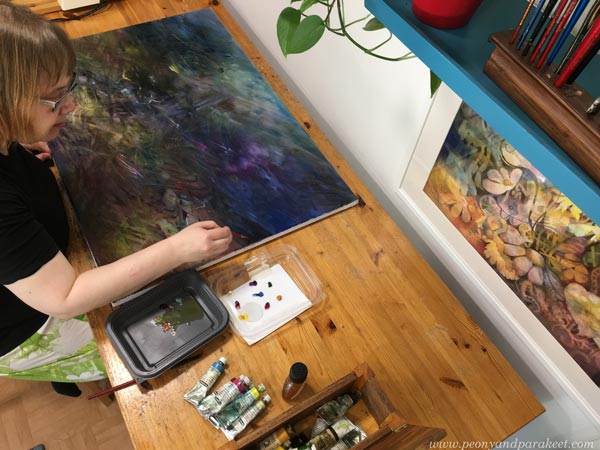
I don’t usually post about a piece that I haven’t finished yet. It’s like presenting an uneducated child that doesn’t quite know how to behave. But the more perfectly my art has aligned with my personality, the more I have started to embrace imperfection. My art will always be imperfect because I am imperfect. Life is imperfect.
Rational or Mystical?
My education in software engineering has shaped my beliefs about life for tens of years. But recently, I have had experiences that feel less scientific and more mystical.
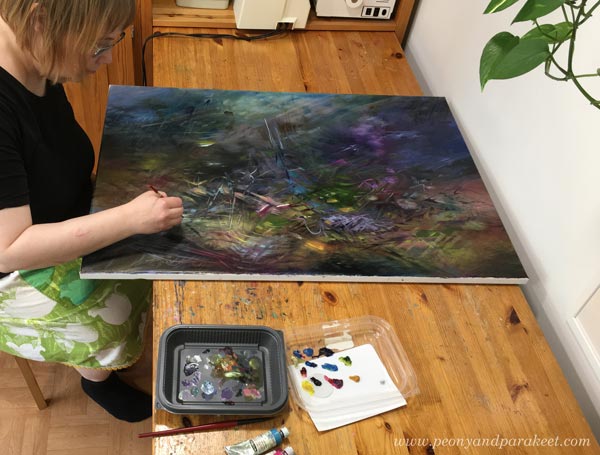
My paintings seem to know how they want to grow, and my ego disappears.
One Mystical Morning
One morning, when I was walking the dog, I saw a miraculous view. It was meant to be just an experiment. I asked myself to look at nature like I would look at a painting in progress. And suddenly, I saw everything in a new order – not organized by a hierarchy or by their aesthetic value. Gravel, weed, grass, dandelions, trees – all were equal and formed one mysterious mesh.
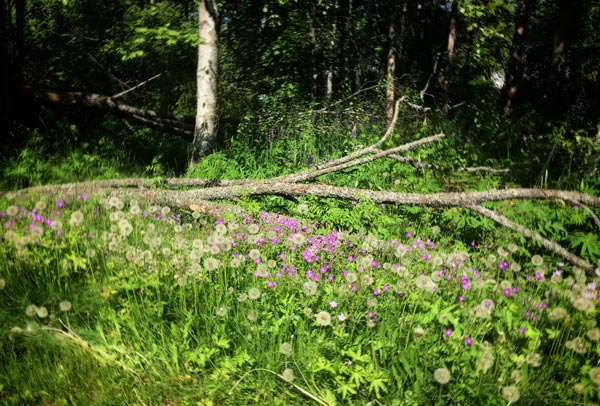
I was part of that mesh too. Not any more valuable than a crooked stem of a dandelion, but still tremendously happy and free.
Every Stroke is a Weed – For How Long Can It Grow?
We art instructors talk often about visual hierarchy – there’s a lot of that in my classes too! The image needs a focal point, and there needs to be a visual flow in a composition. Otherwise, the image looks stiff and the viewer is left puzzled. But the more I have painted, the more I have postponed all that visual organization. That’s why you see me working on the table mostly, focusing on the details.
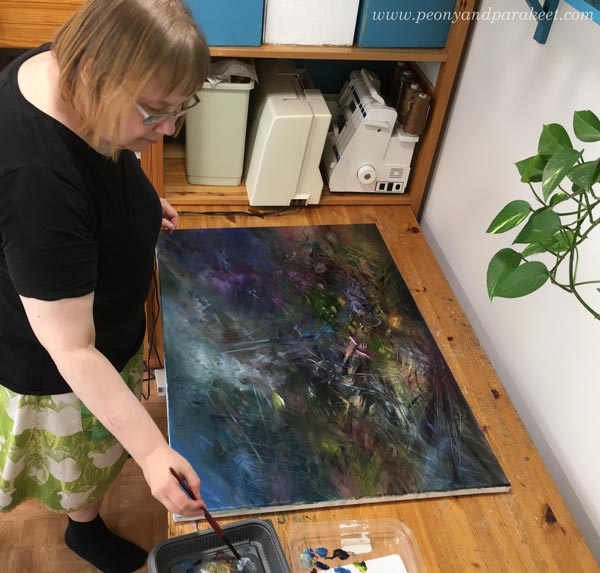
When the painting is in progress, it grows all kinds of weeds, and it’s ok. Then, when I am close to an end, I will put the painting on the easel and improve the visual hierarchy and flow.
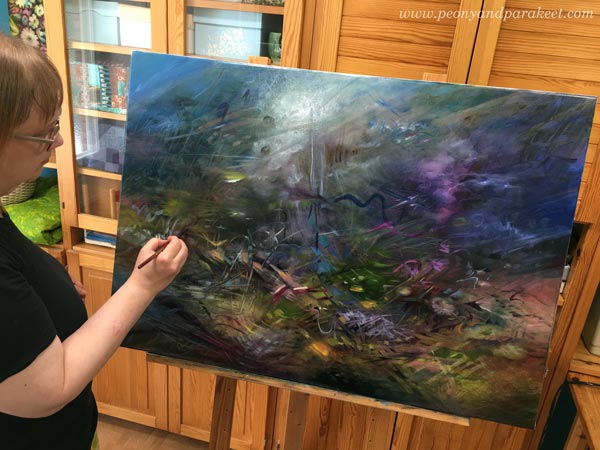
So, I let the child play freely first before teaching it to greet, bend the knees a bit, and make the viewer feel welcome. Before the last part, I can just enjoy the mesh and let the artist be one with the child.
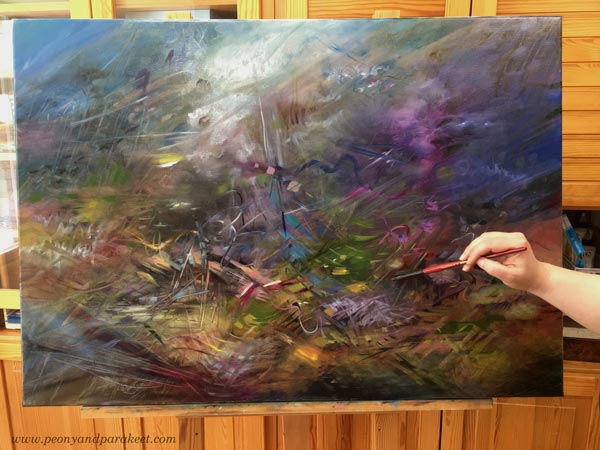
What do you think? Does this make sense to you? Have you had mystical experiences?