
Beautiful Blog Post
This week is about creating beauty, and I have a beautiful blog post for you.
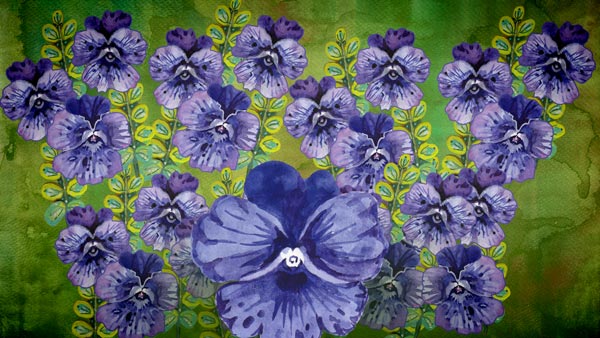
Violets on an Adventure
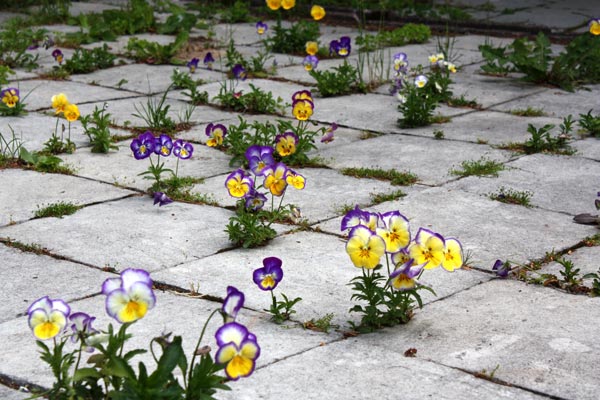
Ten years ago, an old yard tiling gave us a surprise. Renovating it had been on our to-do list, but there had been other things to do in the house. But we were lucky.
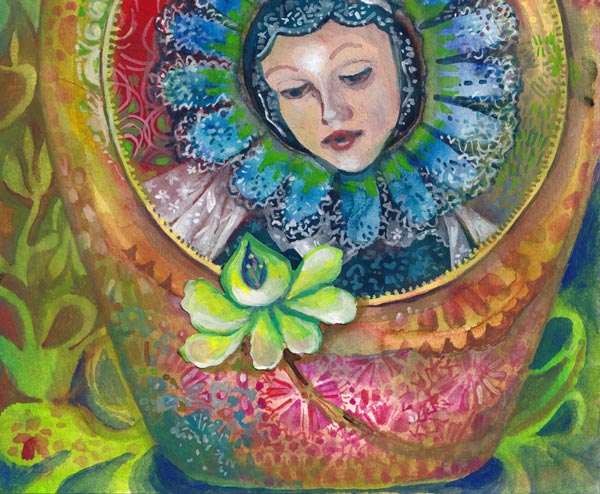
The violets planted in the pot had looked at the tiling and its gaps with completely different eyes. What an opportunity for seeds! So, the following year, we were able to enjoy the glory of flowers in the surprising place.
Creativity is a flower that wants to break free from its pot and get on an adventure. Abundance is allowed and ugliness can enable beauty.
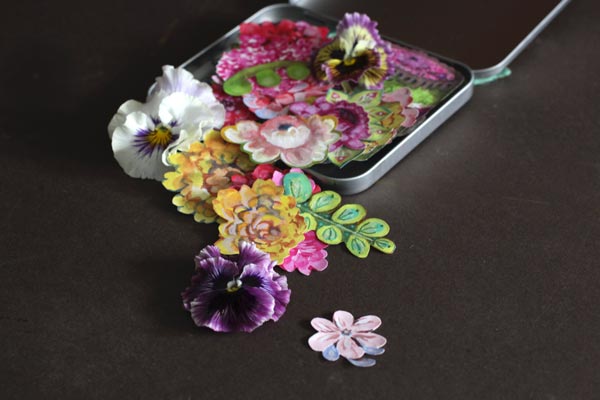
A painting that starts with a few ugly brushstrokes can be decorated
to rich and beautiful.
Beautiful Decodashery
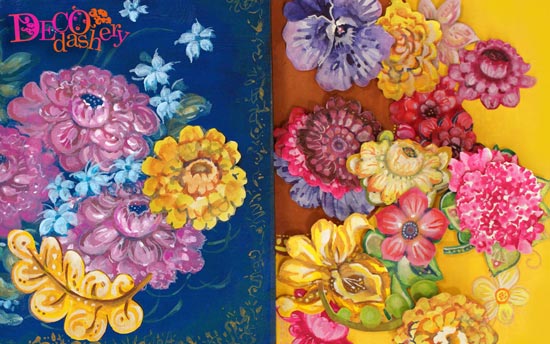
My online class Decodashery is about creating beauty that easily finds its purpose. This kind of art is not just fun to make but perfect for cards and gifts.
Decodashery is one of my personal favorites. The videos are inspiringly colorful and uplifting. You play with the tradition of decorative art and create beauty that people have always found attractive. >> Buy here!
Paint Beautiful Decorative Flowers!
This week, we create stylized beauty. You will see how I painted these beautiful decorative flowers.
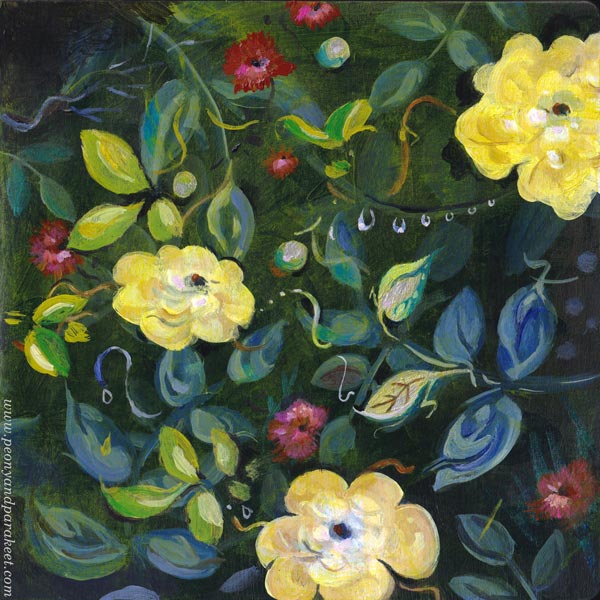
Time for Some Happy Art!
At least here in Finland, May-June is a time for parties. There are school graduations and then Midsummer at the end of June, which is celebrated not only by people but by Finnish nature too. Days are long and the deep sleeps during the dark winter are now coming into use. If different art forms had seasons, this uplifting time would be dedicated to decorative painting. Beautiful decorative flowers and other curvy motifs go well with the celebrations.
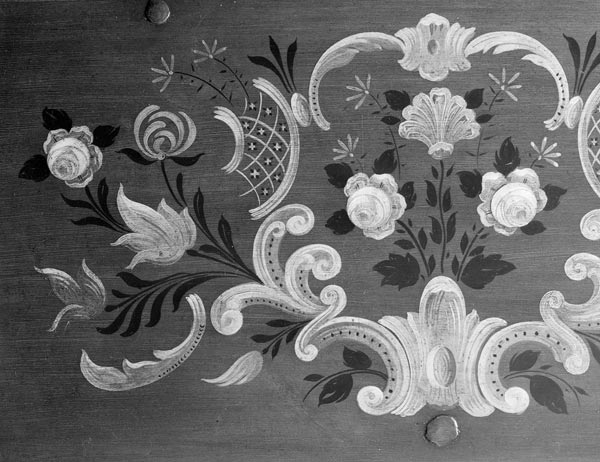
Decorative art is happy art for most people. Its tradition extends all over the world and it only requires a little sensitivity to beauty from the viewer.
Uplifting Art-Making
Three years ago, when the Corona lockdowns started, I buried myself in decorative painting. I made decorative collages from hand-painted papers and practiced decorative painting techniques.
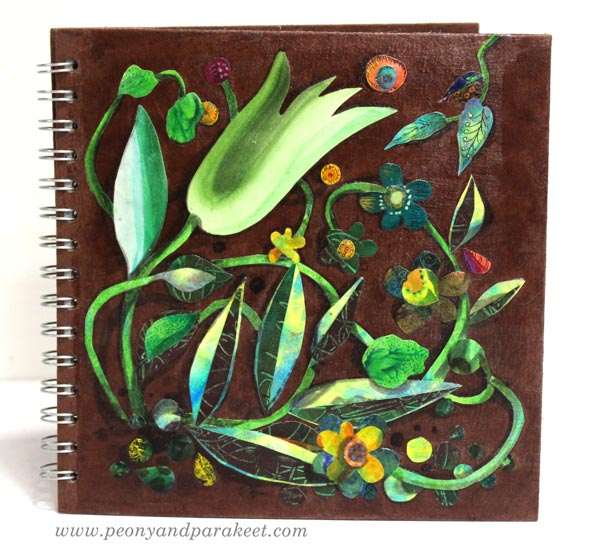
These curvy forms and lines are still present in my paintings, where decorativeness is mixed with a more dynamic and abstract expression.
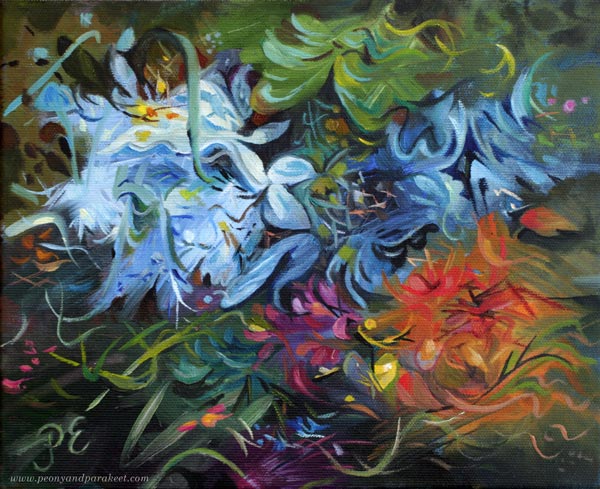
Painting in a decorative style is fun. A few thoughtful brushstrokes create beauty, and even a beginner’s work looks great when viewed from a far enough distance. Over time, the brush mark improves and has an effect on all drawing and painting, even handwriting. And it’s the perfect style for cards and gifts!
Starting a Decorative Painting
As I watched the blossoms in apple trees, I felt like painting something small and nice to celebrate the beginning of the blooming season.
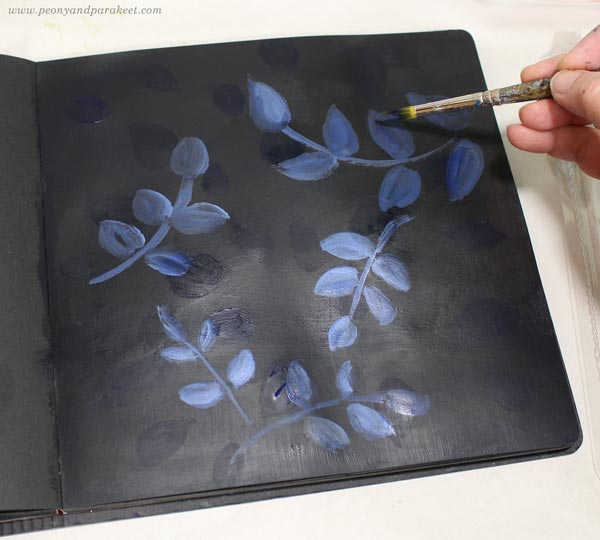
I took out my black Dylusions Creative Journal and acrylic paints and painted the background very dark blue. Then I made leaves on top of each other, and so that they get lighter layer by layer.
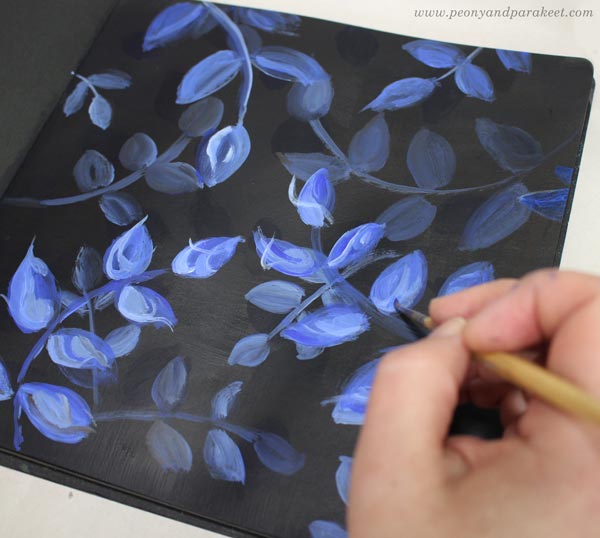
At the same time, I watched the videos of my course Decodashery.
Decodashery – Painting Techniques for Vintage Flowers and More
I still like this course a lot. Decodashery is beautiful, inspiring, and detailed in its instructions. It is also full of ideas. When the Corona lockdown was on, I had plenty of time to experiment with decorative painting and make more examples than usual. This course is for watercolors, gouache, and acrylic paints. You can choose what you want – most of the decorative techniques suit all of them.
Beautiful Decorative Flowers in Two Parts
At first, I thought about making two separate paintings for this post but then decided to make one work in two parts. The first part is simple and stylized and the second part is more creative. In this first part, I used quite raw colors: mainly ultramarine blue and white. I also mixed some brown umber with them.
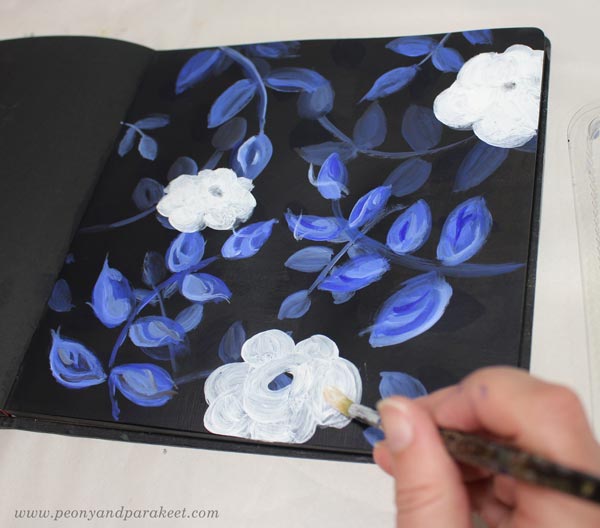
To highlight the decorative theme, I painted some parts with silver acrylic paint.
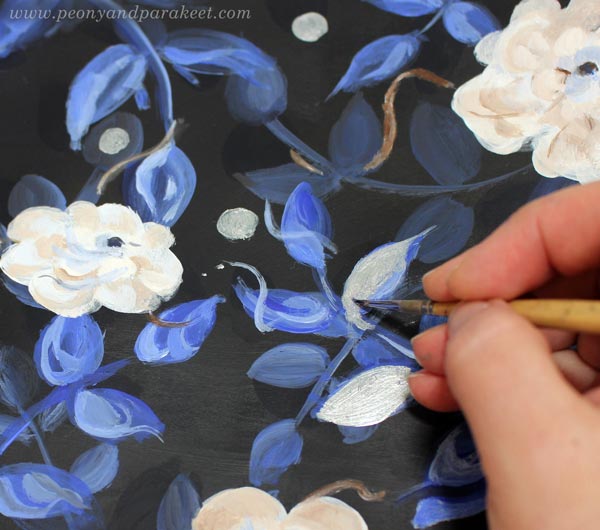
Finally, I added some Sienna brown and turquoise (manganese blue hue) to bring warmth to the details.
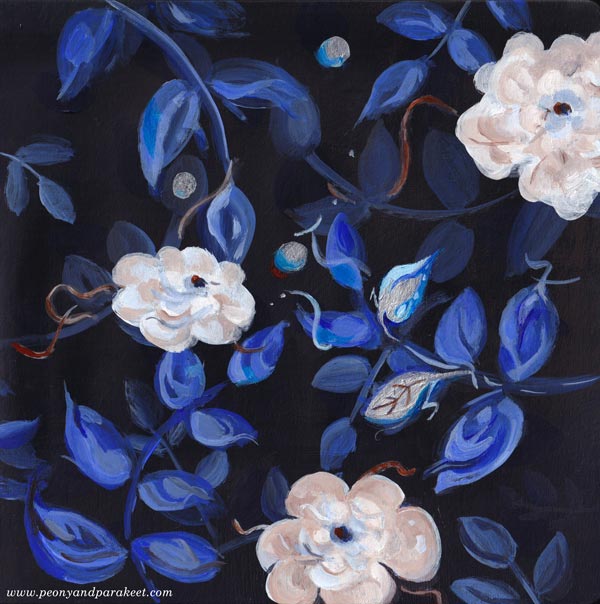
Now the first part is finished. The flowers that are only partly visible give the impression of continuous space.
Beautiful Decorative Flowers – The Second Part
In the second part, I wanted to bring more depth and warmth to the work. So I spread a thin layer of yellow-green color over the painting.
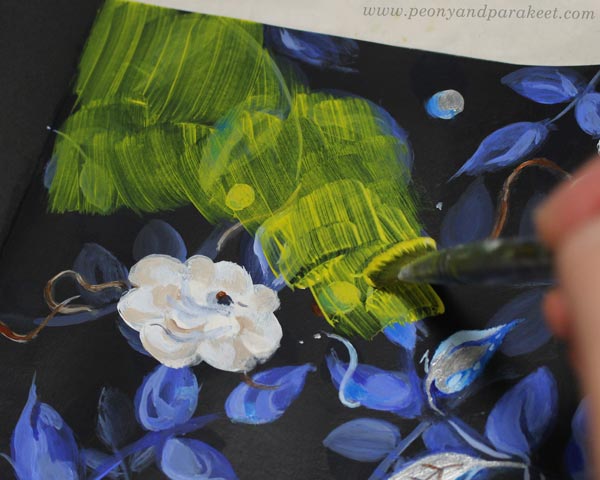
I used glazing gloss as a thinner here, but you can also try to thin the paint with water.
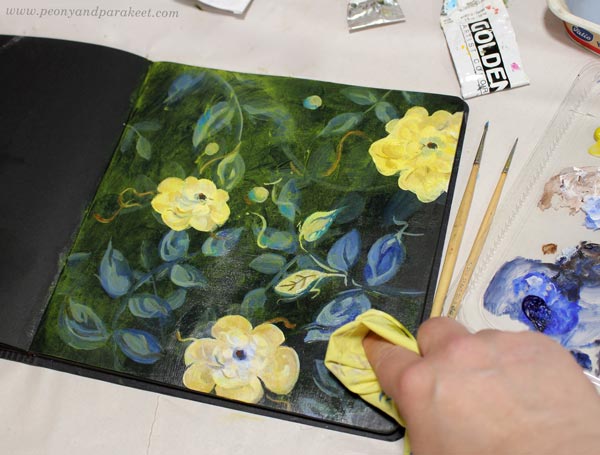
Immediately after application, I removed the excess paint by rubbing the surface with a cotton cloth. The thin color wash warms the tones of the whole painting.
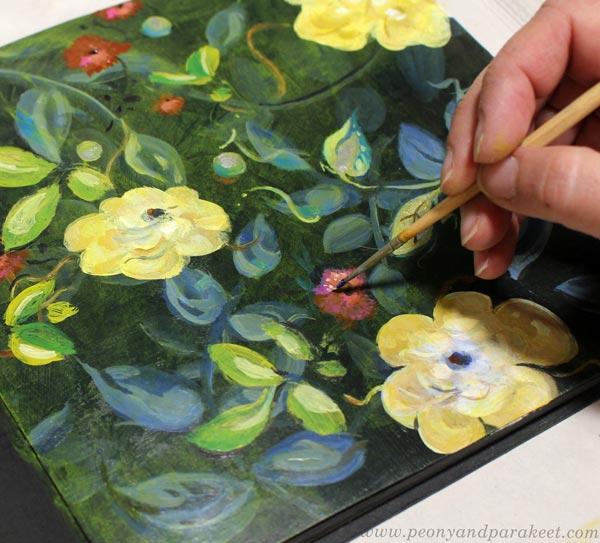
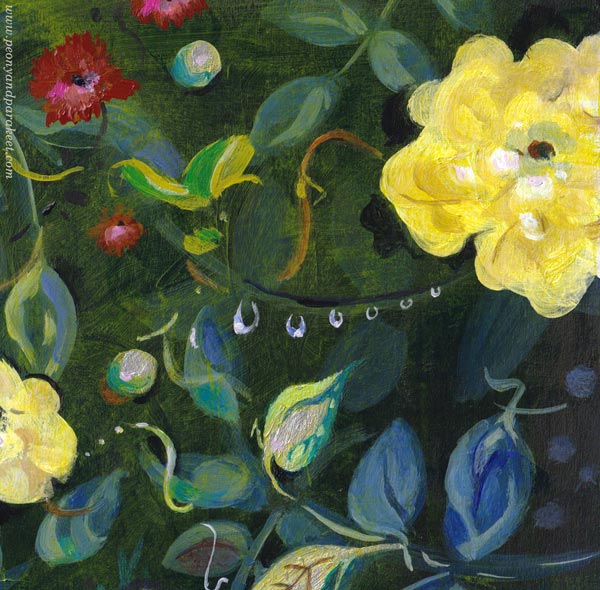
After the color wash, the painting is a bit hazy. Next, I added more details and brought some of them back up from the lower layers. This sharpens the best parts.
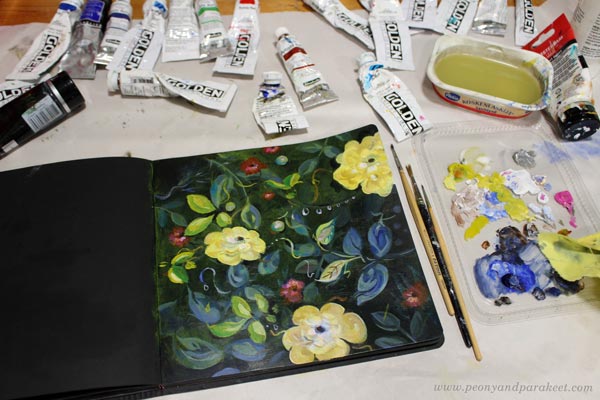
I had lots of tubes on the table but only used a few. Decorative painting encourages making a variety of tones by adjusting the lightness and darkness of color instead of always changing the actual color.
Happy for the Artist, Happy for the Viewer
There were moments of joy that only decorative painting can give me while making the page. This style feeds gentleness and peace. And even if the pleasures of the decorative painting process are only experienced by the painter, the decorative painting leads to results that are extrovertedly joyous, ready to brighten up anyone’s day.
Decodashery online course – Paint vintage beauty – Buy Now!
Get Creative in Drawing Ornaments!
This month, the focus is on art history. Art history is often talked about in a very serious tone, but let’s examine it through imagination and start by drawing ornaments!
Ornament Tells a Story from Childhood
It’s fascinating that even if the ornaments are stiff and organized compositions, one can express a whole story.
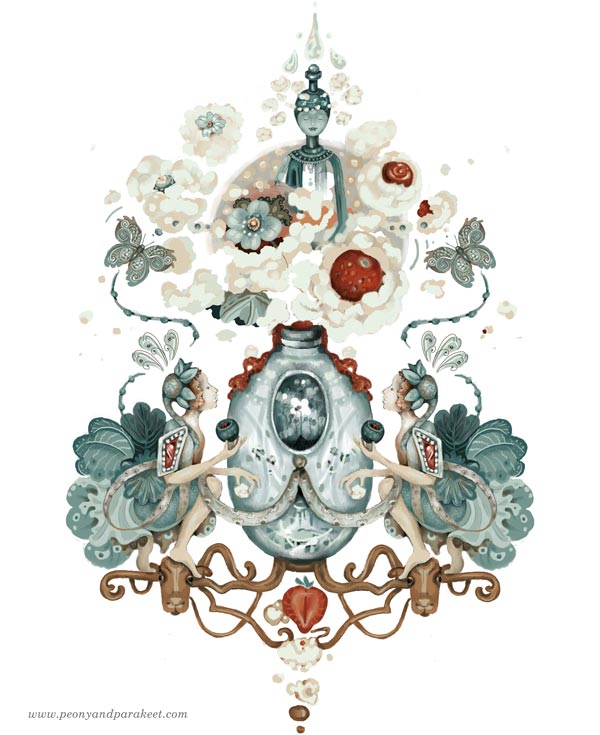
The background of this drawing is a funny story from my childhood. When the school asked each student’s favorite food, I answered “Mansikoita ja kermavaahtoa!” – Strawberries and whipped cream” while the others listed macaroni dishes or meatballs. Both the teacher and the students were quite shocked by the answer, but I wondered how anyone would prefer to eat something so modest and usual.
This story tells a lot about how I’ve always wanted to get away from the mundane. I still want to draw things so that they look like a luxurious celebration rather than a gray everyday life. I like drawing jewels, lace, floral motifs, and swirls, and you can have a lot of those on the ornaments.
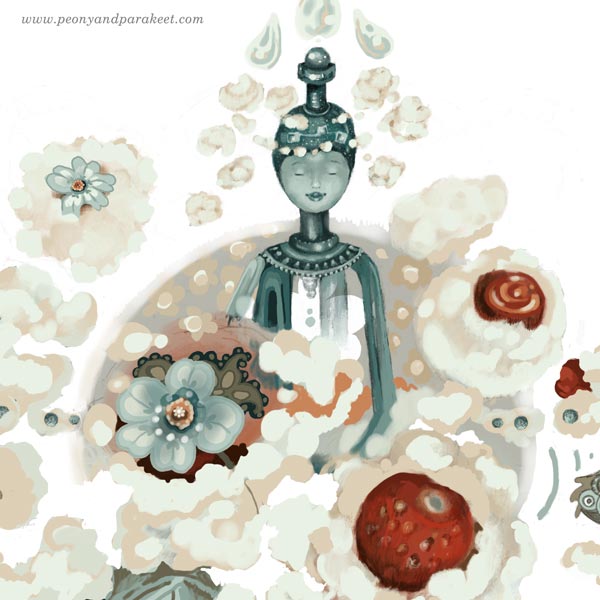
I often want to include people or animals too. For example here, I wanted to make the whisk half-human, and draw two fairies that enjoy the dessert.
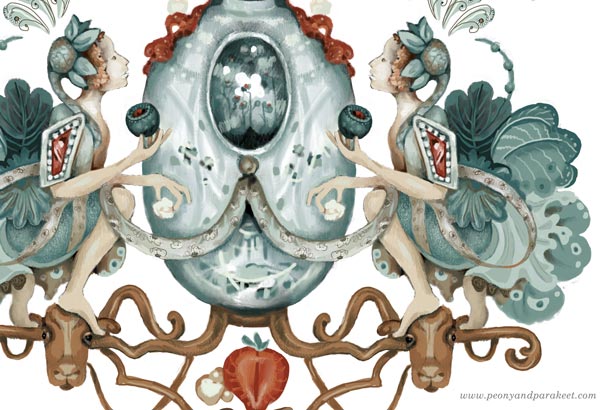
The method that I teach for human poses in the course Doll World was very helpful here.
Inspiration from Antiques, Old Buildings, and Paintings
There are plenty of ornaments in my photo archive. When I visit old buildings, I go through doors, ceilings, wall panels, and floors, looking for nice ornaments.
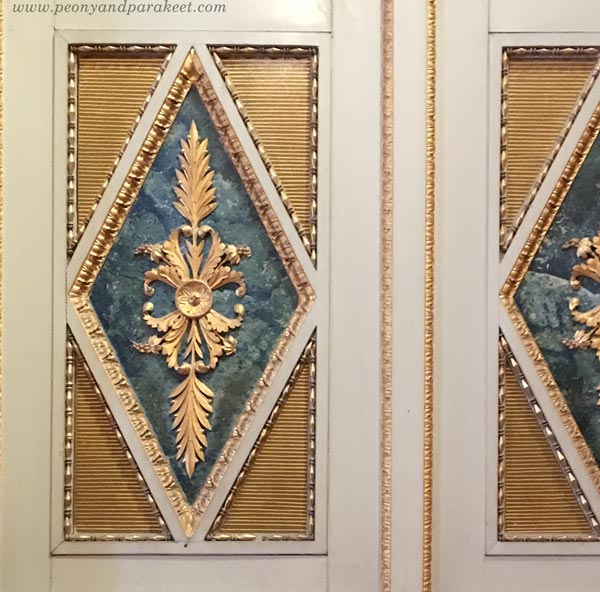
I also love to examine antiques closely.
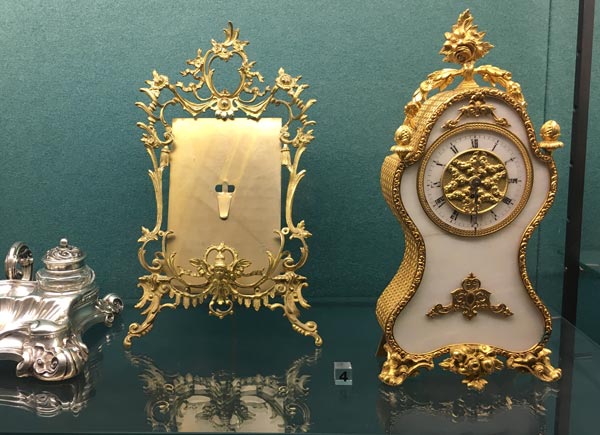
Old paintings often have lovely frames. Whenever I photograph one, I always try to include the frame in the picture.
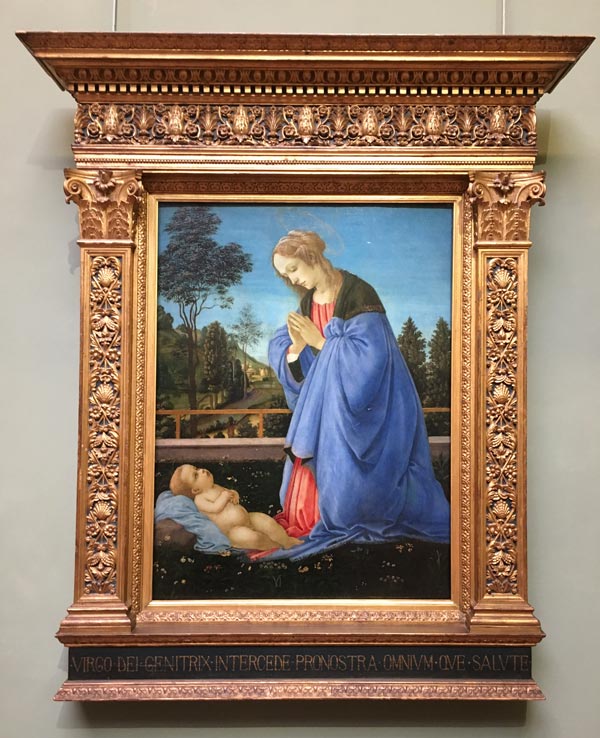
This frame is like an ornament representing a palace!
Lots of Simple Shapes
The decorative appearance of the ornaments can mislead you into overestimating their complexity. When an ornament is taken apart, the shapes can be quite simple.
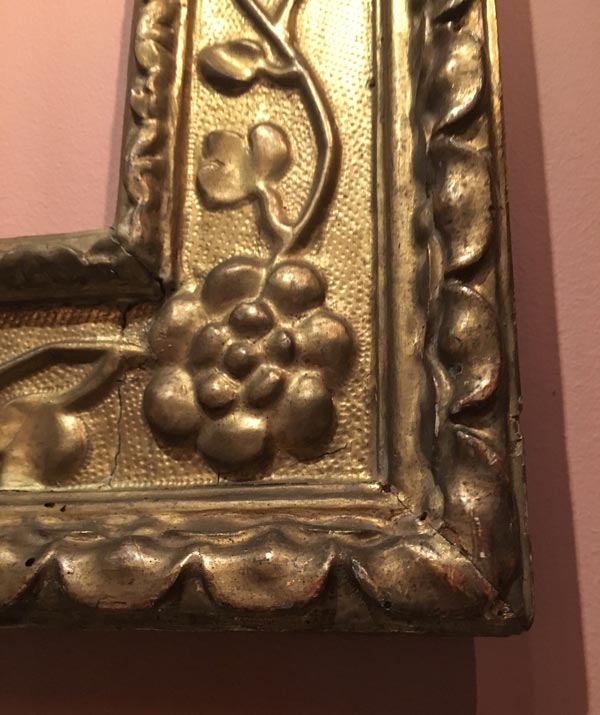
I love this kind of sophistication based on quantity and repetition, with which you can express anything – humorous subjects …
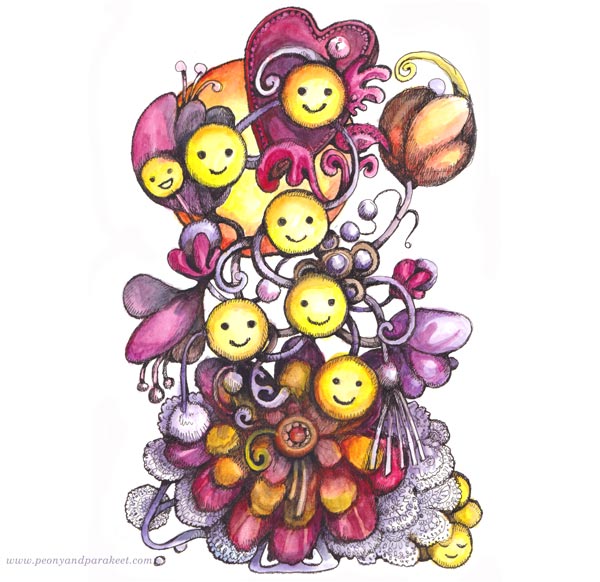
… or more serious.
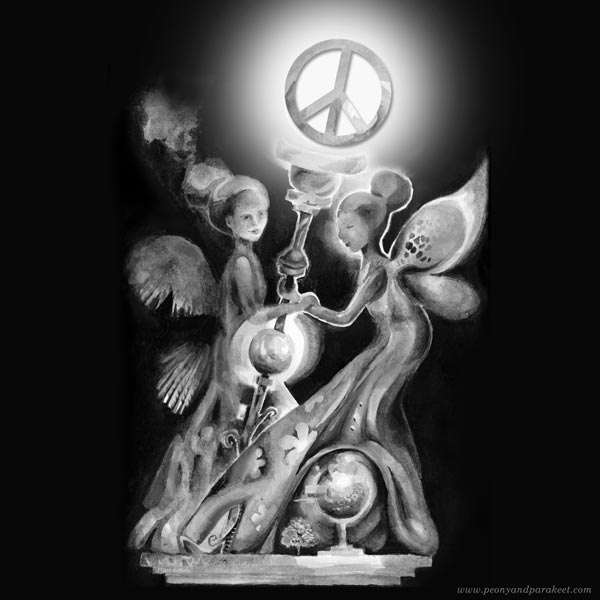
This example shows well that you can also express light when drawing ornaments.
Ornaments Can Both Hide and Reveal
I am fascinated by the fact that although the subject can be drowned in decorative forms, it can also be brought out more directly and more concisely than in a regular drawing. Time travel to the past can become surreal when the horizon disappears and the items are arranged as part of a floating structure.
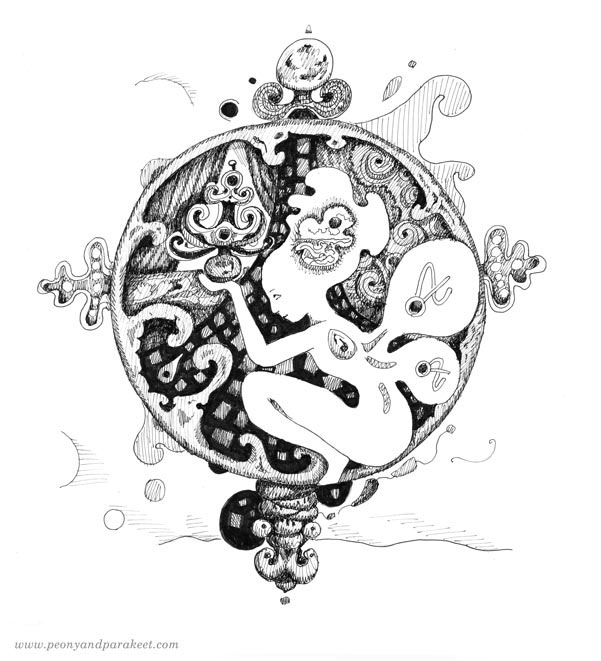
Ornaments as Collage Art
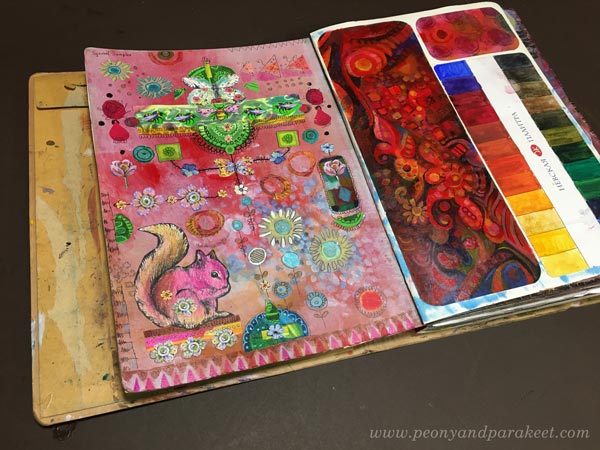
If drawing the whole ornament in one go feels too demanding, remember that the ornaments can also be collage art. You can glue individual elements so that they form a decorative tree or medallion. I have put together many kinds of ornaments from hand-drawn animals and hand-decorated papers.
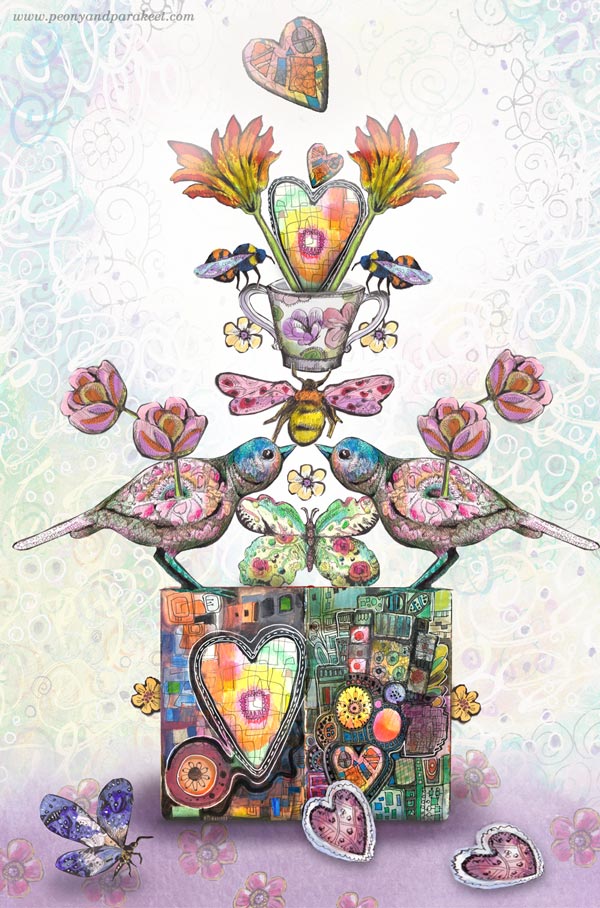
You can also scan or photograph the drawings and assemble the ornament digitally with an image processing program. Here are animal figures and flowers from the course Animal Inkdom and a teacup from the course Magical Inkdom.
Drawing Ornaments is Expressing the World
After working with ornaments for a while, you begin to realize that the world is largely based on them. Surface patterns are everywhere. The beauty of organic forms can be found in all living things.
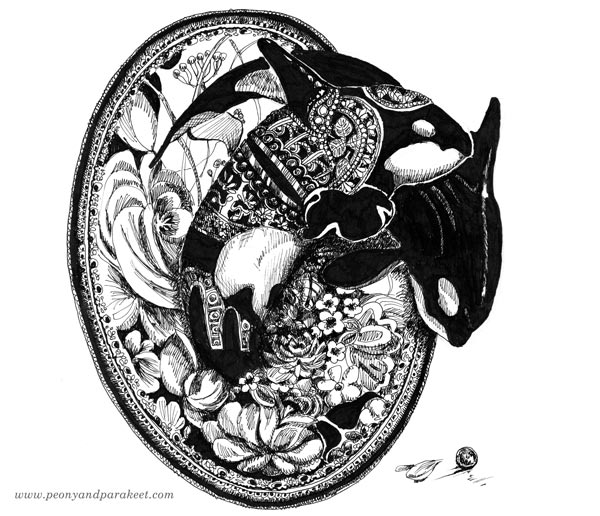
Ornaments build a bridge between the living and the non-living. They make the living an object and the object alive.
Hidden Love for Ornaments and How it Shows
I think that many of us have an innate need to design ornaments. Maybe you dream about designing fabrics or have a huge stash of them. Maybe you collect jewelry or save photos of them. Maybe you feel that something is lacking if you only draw or paint complete images and are not able to rearrange the composition so that it’s something more stylish and less representational.
I only realized this tendency of mine when I made ornaments as part of the illustration for a children’s book. Back then, I used transparent marker paper to design the symmetry, and my desk was full of different versions.
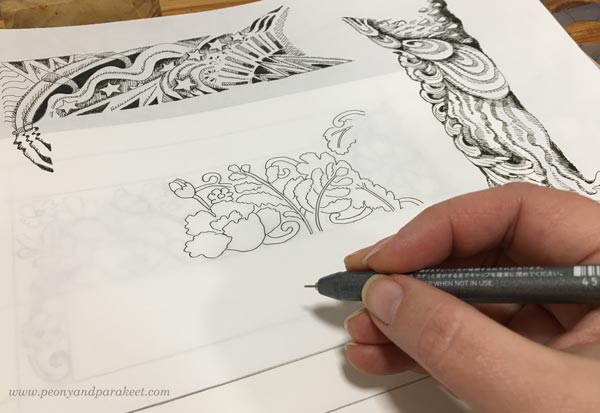
One day when picking the pen, I suddenly felt happy and meaningful: “I should do this more!” Since then, I have not underestimated even the smallest encounters with ornaments.
Drawing Ornaments Inspired by Embroidery
I relax from my work as an artist by doing cross-stitch and those projects also inspired me to draw ornaments.
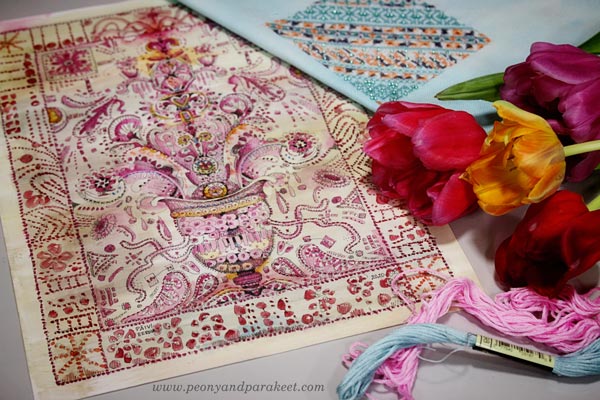
See here how to draw and color an embroidery-inspired ornament – Doodler’s Sampler Step by Step!
Drawing Ornaments without Perfect Symmetry
I drew the last ornament with the ProCreate app. The good things about it are that the background can be kept separate so that the background colors can be varied and it is easy to create symmetry. However, I think completely symmetrical ornaments are a bit too stiff and boring, so I also made quite a lot of asymmetry for this ornament.
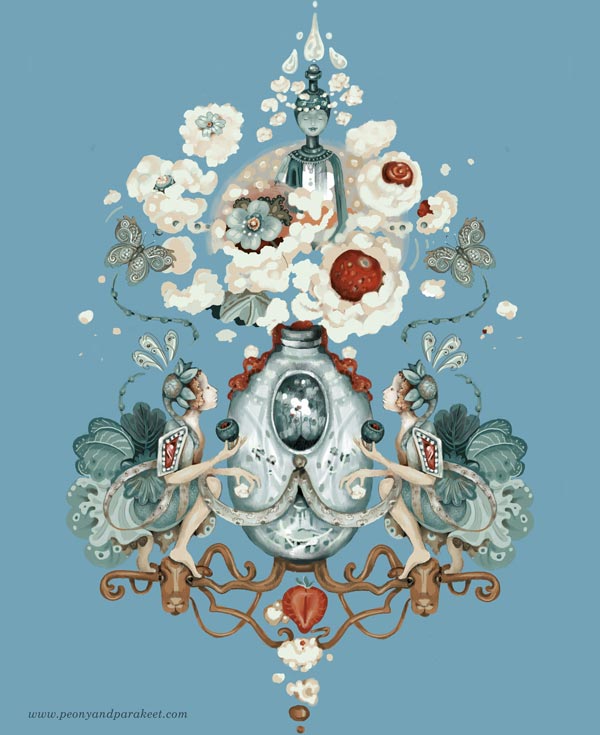
I hope you will start drawing ornaments right away whatever technique you choose!
Related Courses
- Doll World – drawing human poses – Buy here!
- Animal Inkdom – drawing animals – Buy here!
- Magical Inkdom – drawing fantasy – Buy here!
- Collageland – inspired by embroidery – Buy here!
Why Draw in Black and White?
I have often asked myself: “Why draw when you can paint?” And as someone who loves colors, it hasn’t always felt appealing to omit them. Still, one of the biggest things in my artistic development has been to find a connection to my childhood through black-and-white drawings.
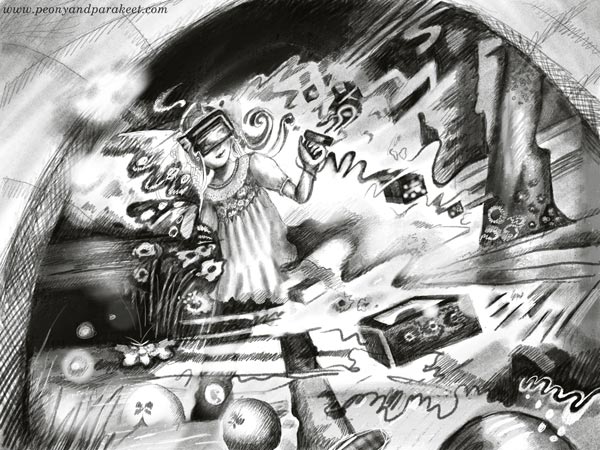
In this week’s blog post, I want to inspire you to draw things you love in black and white. If you want to practice ink drawing with me, see these courses: Animal Inkdom and Magical Inkdom!
My Way to Drawing in Black and White
It’s been over thirty years since my father’s death. He was quite distant, but I still vividly remember when he drew horses when I was a child. The horses were not noble and streamlined like in the picture books, but furry sympathetic characters. It was as if my dad really knew these animals.
So it was no wonder that when I participated in the Inktober drawing challenge in 2018, my drawing style borrowed a short hair-like line from my father. You can say that at that time, I fell in love with drawing. Nowadays, I still draw in black and white every time I want to visualize something through my thoughts. I now have an Apple Pen and Procreate, but I sometimes draw on paper as well.
See a quick 4-minute flip-through video about one of my sketchbooks!
See more pictures of the children’s book illustrations: The Beauty of Science – Illustrating a Children’s Book
Why Draw? – Move from One Idea to Many!
Drawing visualizes the invisible and makes us think deeper. First, the idea is wavering and could take any direction. But as the details increase, the big picture also grows. Therefore, it’s important for me to let the pen linger in small areas. I find pleasure in putting tiny pieces in place so that they are part of a bigger story.
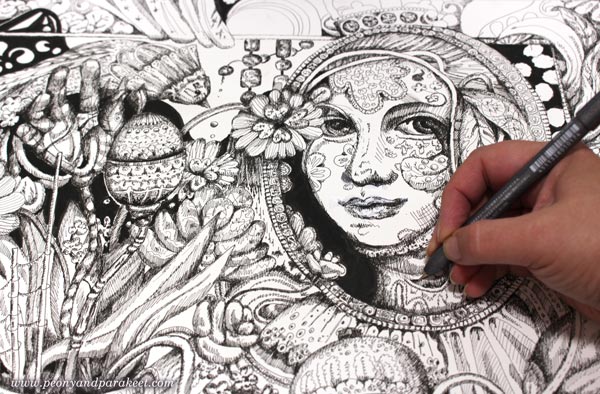
There are two good things about drawing with a thin black marker pen. First of all, the pen mark cannot be erased. You have to figure out how to make the wrong stroke a part of the drawing. It has often happened to me that the core of the picture was created while correcting a mistake. Another advantage is that when you don’t have to worry about colors, you can focus on shapes and patterns in peace. And of course, you can always color the drawing afterward, for example with colored pencils or watercolors.
Why Draw? – Connect Your Art with Your Origin!
I believe that anyone who has drawn for a while will develop an understanding of why they draw. I have a feeling that I was created to express things through ornaments. For me, an ornament is not just a picture, but a whole language. When drawing ornaments, I’m on the border between writing and illustrating, and feel that I am doing something important. As if I belong to those authors to whom poetry appears as pictures.
It’s confusing, but this connection between drawing and writing seems to have arisen in me when my father drew a horse. Of course, I didn’t know how to break it down like that as a child, but I now think of my father’s horses as ornaments that summarized the origin of our family. It wasn’t the most elegant possible, but I still wanted to give it wings. Nowadays, every time I draw, I feel close to where I am coming from. I hope that by drawing you too will find wings for your origin!
What would you like to draw? Leave a comment!