
Artist’s Life – Starting New Media Art
This week, I share my latest new media art and thoughts about my career as an artist. This is a sequel to the blog post called Beginner’s Video Art that was published last month.
Unstill Still Life – Video Art
The video above is my latest artwork “Unstill Still Life.” I have done this largely by programming. I have developed generative algorithms that create and alter shapes. I have designed the individual shapes with a 3D modeling program called Blender. The models and the code are put together with the Unity Engine which is a software environment for developing games.
Inspiration from an Old Painting
With the artwork, I participated in the Finnish National Gallery’s Web3 community Alusta challenge called “Nature and Nourishment.” The Finnish National Gallery has many copyright-free images and the organization encourages artists to use them for creating new media art.
I have taken inspiration for the colors and surfaces, as well as the concept itself, from Fanny Churberg’s 1876 painting “Still Life with Vegetables and Fish.”
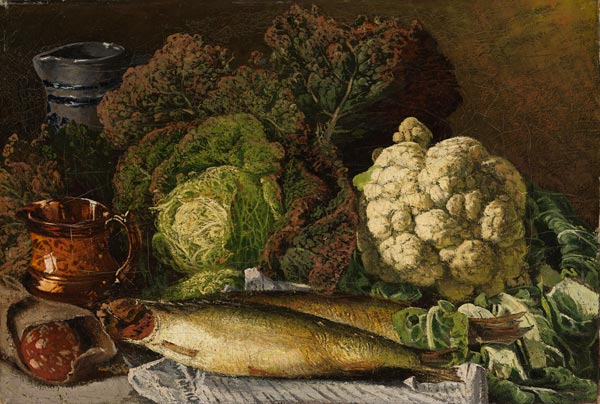
I love old paintings, so this challenge was made for me. It’s so interesting to examine the brush strokes and think about the 3-dimensional shapes that they are related to. And I have so much to learn in making generative art, that I need small challenges to keep heading forward.
I Will Continue Painting, But …
I am still going to continue painting traditionally but I also want to start a career in new media art. I want to bring back my skills in programming from the years when I was a software engineer and use those for creating art. I also have a degree in Industrial Design that helps a lot with 3D modeling. The grant that I received from The Finnish Cultural Foundation has enabled me to develop my style in new media.
But all this is not only exciting but hard too. Do you know that feeling that comes when you have to start life over again? There is enthusiasm in the air, but also some “oh no”.
Building a CV
For a full-time artist, most opportunities are based on a CV.
That was not a problem when I graduated in software design in 1996. I thought: “I have plenty of time to grow my CV.” Then, when I graduated as an industrial designer in 2009, life seemed to be halfway over, but I was able to get quite a decent CV by combining some old and new projects.
When I started working as a full-time visual artist in 2014, I didn’t think about CVs at all at first.
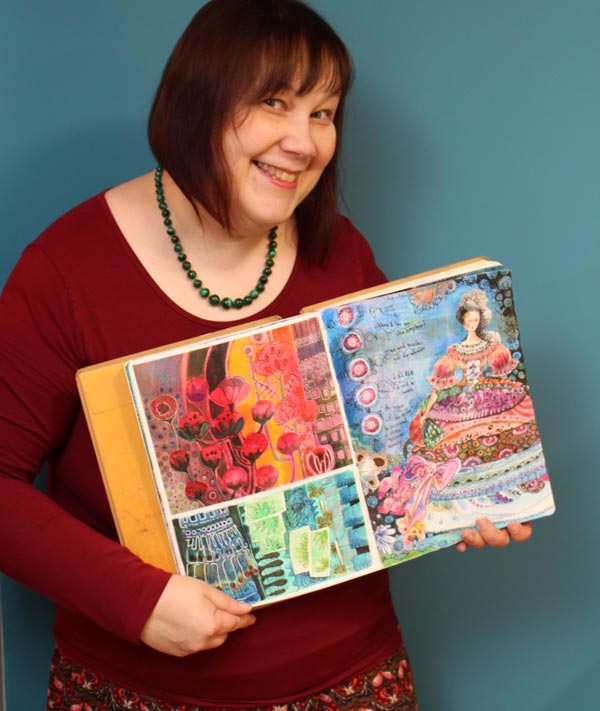
The picture above is from 2015 when most of my art was in art journal pages.
But when I moved forward in painting, the reality hit me – it was very hard to get accepted to exhibitions and organizations without a CV. Mine was practically blank at first, and it has taken a lot of time and effort to add rows to it.
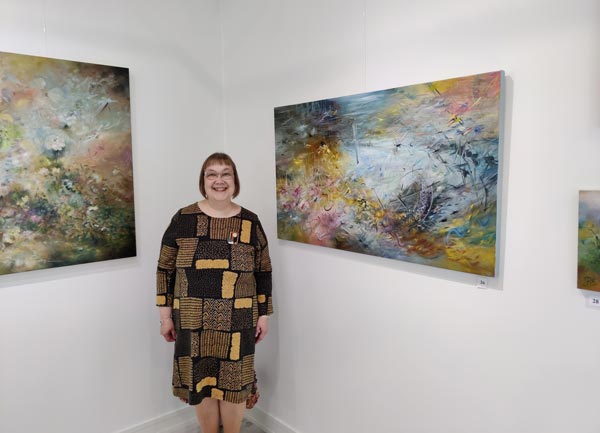
The picture above is from last summer at the exhibition organized by The Albert Edelefelt Foundation. See more pics in this blog post!
New Media Art – New Career?
And just when I thought that life was almost over at the age of 55, this new media digital art came into my life and it hit me – I’m a beginner again with an empty CV. So, I need and want to participate in challenges, competitions, and exhibitions, to get accepted again. And I want to believe that I still have time to create this new kind of art, not only paintings.
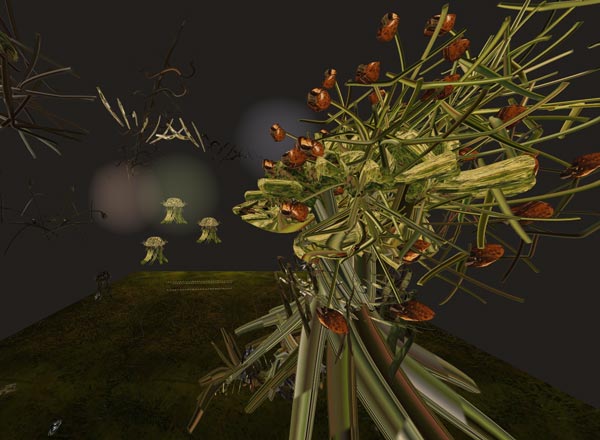
Some leaves of the big plant are connected to an invisible virtual camera that moves around and sends a mirror image to them.
I learn new things about generative art every day and I am amazed that I have been given this long life to experience it. Gratitude is the overriding emotion that emerges from this new beginning. I am lucky in what I have seen in the development of information technology and what I have been able to develop and be involved in developing in the past. I want my future CV to tell the story of a girl who wanted to become an artist as a child, who fell in love with computers as a teenager, and who finally has the artistic vision and the technical tools to combine the two.
Looking Back Enables Seeing Forward
If you have been following my blog for a while, you must have noticed that my blog posts are often self-reflective like this one. Visual art-making needs self-reflection too. It’s useful to go back and see how things have changed to make future changes and take steps forward.
With the newest course Liberated Artist Revisited, I invite you to paint with me – to follow directions from Paivi many years ago, and then create more with the current Paivi. At the same time, you can ponder, how your art-making has changed and will change.
Liberated Artist Revisited is a limited edition – only available for purchase until the end of March 2024! >> Buy Now!
Now and Then – Development of Style
I started a grant project in October. The project lasts a year and covers half of my working time. I am making a digital artwork that can be experienced with virtual glasses. This will definitely give a boost for my artistic development, including the style as well.
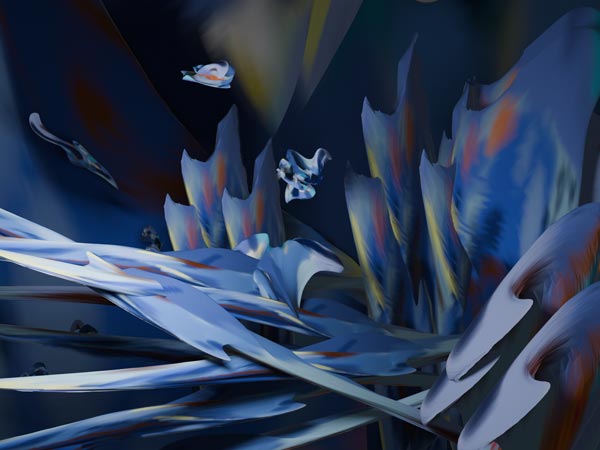
I used a fun sculpting app called Nomad and a 3D modeling software called Blender.
This image is based on replicating one shape only.
One of the recent practical changes is that I have given up using a Mac computer and bought a new Windows gaming laptop, which I call Turandot. I am now writing this blog post with her. She must have imagined that she would be owned by a young man, but no – she has a woman in her fifties. Turandot must have sounded like a great name to her, but after googling it, she might have been upset: Puccini’s opera! Well, she just has to adjust and learn my style.
Style Development – Looking Back
The new big project has made me think back and explain it all to Turandot. Ten years ago, I wanted to learn to paint so well that I would be satisfied with my paintings: “I could then die happy!” I thought that as an artist I had to abandon what I have been until then and build a new vision and a new world of my own.
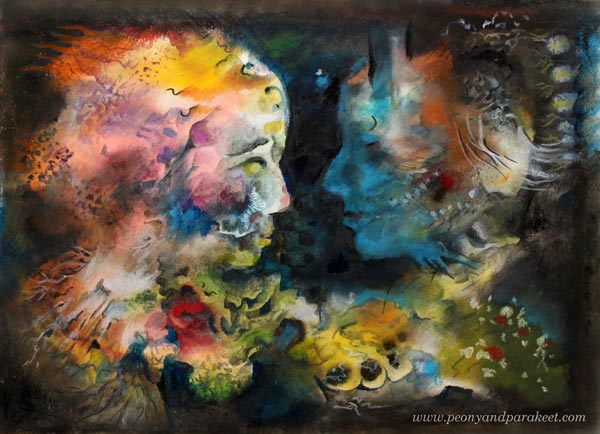
When my paintings started to reach the level I had hoped for, I felt first grateful and then empty. I couldn’t see forward anymore.
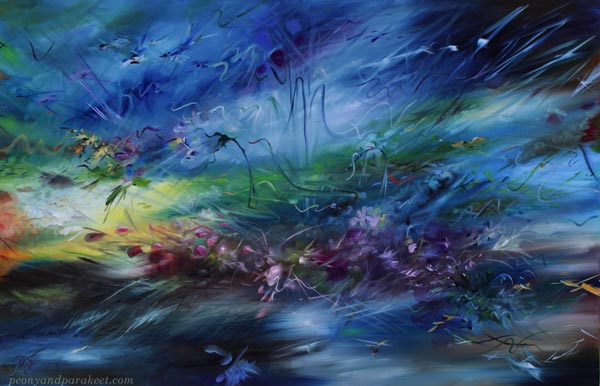
See the gallery of my oil paintings!
Now, however, I’m on the brink of something new again and the crises of the past seem strange: how was I so hopeless? Why didn’t I realize that everything meaningful that I’ve done in my life will tie into my art over time?
Always a Beginner
My artist friend said that I have developed quickly as an artist. However, it doesn’t always feel that way. I always have self-criticism and always notice things to improve. That’s why it feels frustrating now when I’m starting over again and building a three-dimensional digital expression. At the same time, I remind myself that the beginning of today is much further than the beginning 10 years ago – there is a lot that I already know and what I can already see, not only style-wise but in a more general level as well.
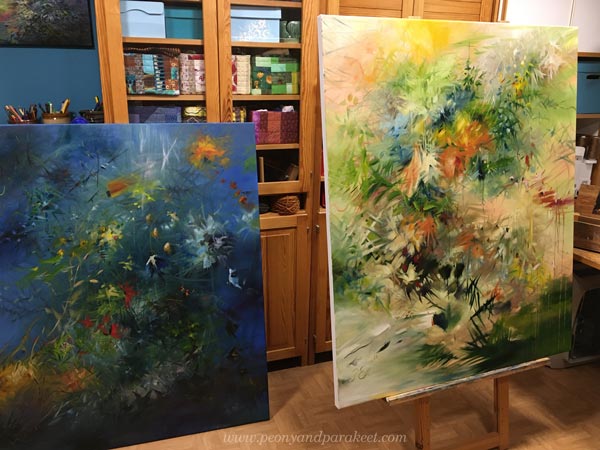
The balance between encouraging yourself and criticizing yourself is essential when making art. You have to be able to observe your pictures as if they were created by someone else and at the same time, you have to see forward – what all this could be and where it could lead when I will learn more skill and imagination.
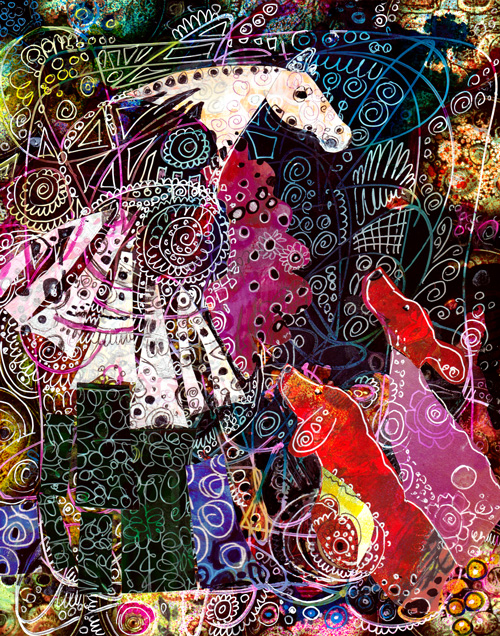
Fortunately, I haven’t listened to those who say that everything you do must be in the same style and form a unified experience. When you’re a beginner, forcing a certain style only leads to getting stuck at a level where you really don’t want to stay. When you’ve done enough, your own style pushes out naturally.
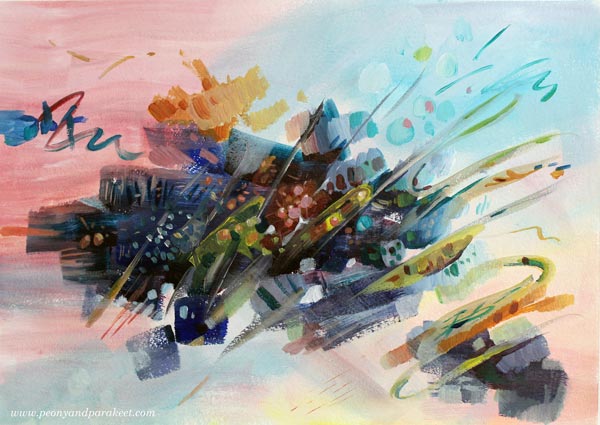
Yarn, Thread, Line, and a Telescope!
10 years ago, my line was clumsy and closed, while now it’s elegant and curious, like a telescope that lets me see beyond what I’m currently aware of.
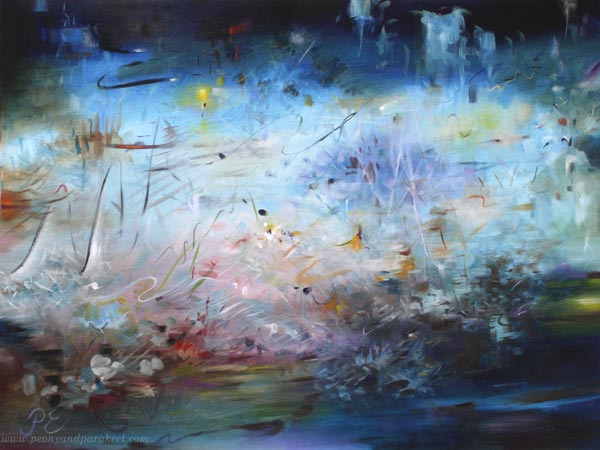
I’ve always liked knitting and embroidery. Thread and line have a lot in common. That’s where my style started.
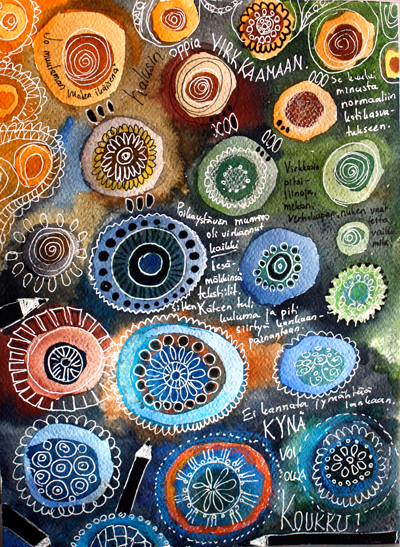
Collageland teaches this style!
Now my task is to continue developing my style and step into the world of digital art. However, I will still be drawing and painting next year, so there is no need to worry that this blog will change too much!
Kaunosielu – Painting and Drawing Sensitivity
Kaunosielu is a Finnish word for which I don’t know an English equivalent. It means a dreamer who loves beauty, but the word has an ironic undertone. This romantic soul, alienated from everyday life, cares little about taking care of practical matters and frequently stops to admire the beauty around her.
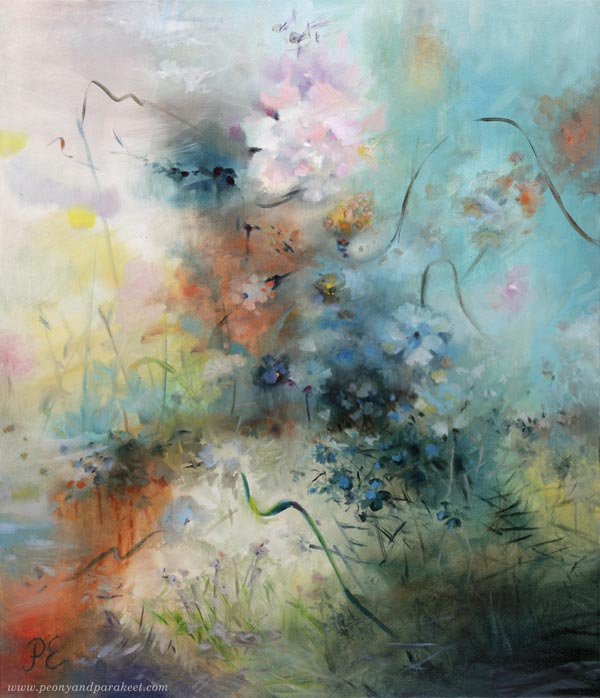
I’ve been thinking about people’s yards in my neighborhood a lot lately. The new houses have a small lawn area, a wooden patio, and a row of white cedars. These homes are advertised as “easy-to-maintain yards” in real estate ads. And yet, it often happens that when time passes, a few violets or a peony bush appear. It makes me believe that we all are “kaunosielu people” who have a sensitive heart and eye for beauty.
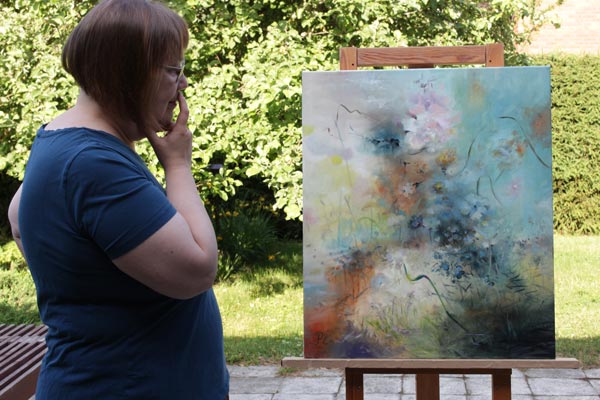
So my Kaunosielu painting is dedicated to that part of you who stops after seeing something beautiful. This topic was challenging for me because I usually express movement. Here, however, it’s all about staying rather than leaving and looking rather than running away.
Inspiration from Pastel Drawings
I am making a series of paintings for an exhibition called “In the Mood of Albert Edelfelt” and I have browsed a lot of Albert Edelfelt’s (1854-1905) works. Surprisingly, his pastel drawings fascinate me the most. Look at this woman, for example – or rather – her dress!
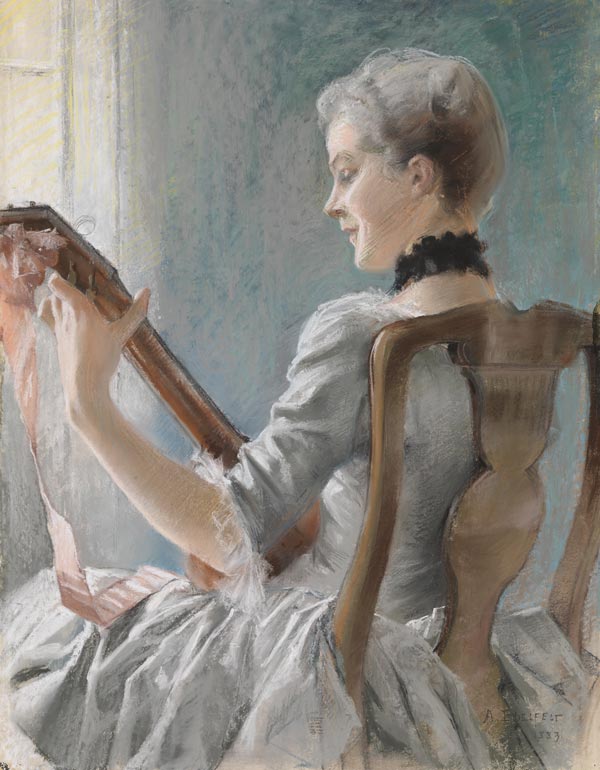
I see a similarity with flowers in old portraits. The outfits are pleated like the petals of flowers and the lines form interesting patterns.
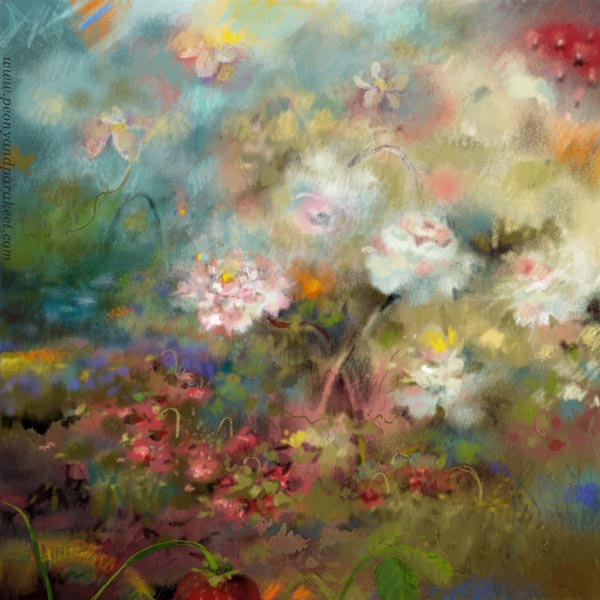
I also started using chalk brushes in the ProCreate app. Here is a digital pastel drawing: peonies and strawberries.
I have done oil pastel work for the course Innovative Portraits, but now I dug out the soft pastels.
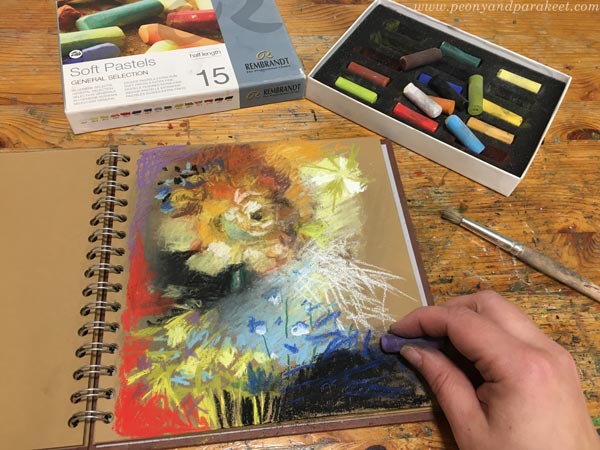
Soft pastels are more chalky than oil pastels and maybe a bit more difficult too because, unlike oil pastels, soft pastels also need fixative.
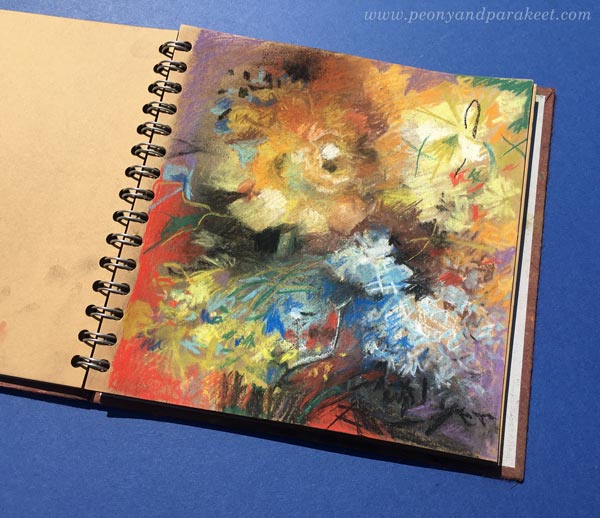
This is just a small notebook and a small piece but I like to practice between bigger paintings.
Kaunosielu on Canvas
My painting Kaunosielu is painted in oil, but it is close to pastel artworks in terms of color scheme and the use of lines.
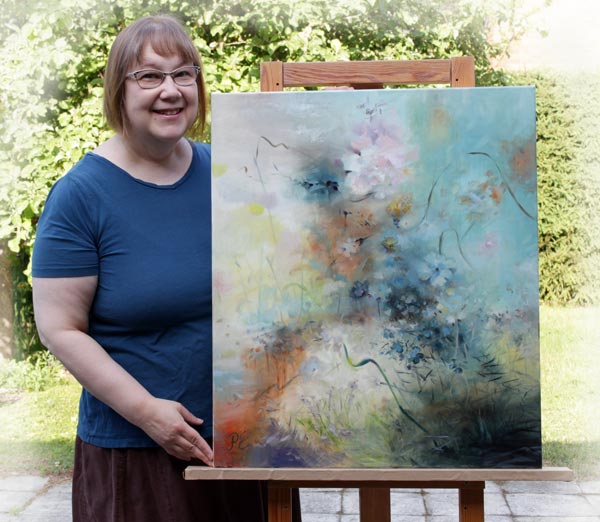
The painting is inspired by a lovely pastel drawing by Albert Edelfelt called “At the Window.” I was lucky enough to see this work authentically in the Albert Edelt exhibition of the Ateneum Art Museum. This piece is 68 x 62 cm, so it’s quite large for a work drawn on paper. And look at that frame!
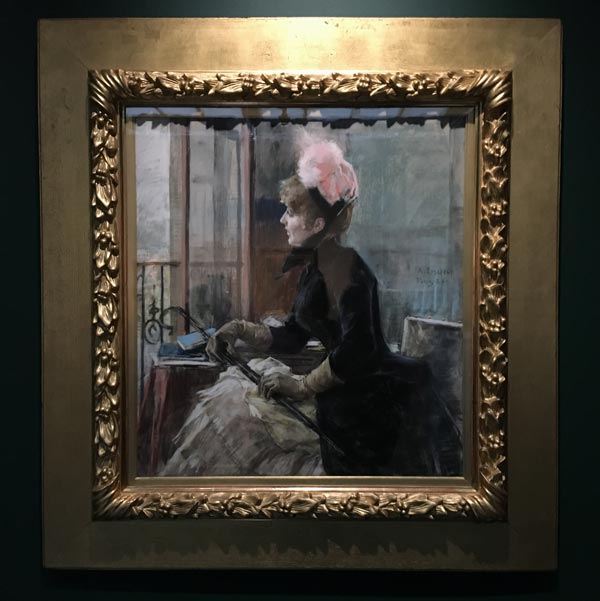
I was especially fascinated by the composition, and as soon as I started my painting, I felt that now it was coming: Kaunosielu! I had been planning to do a piece called that for a long time.
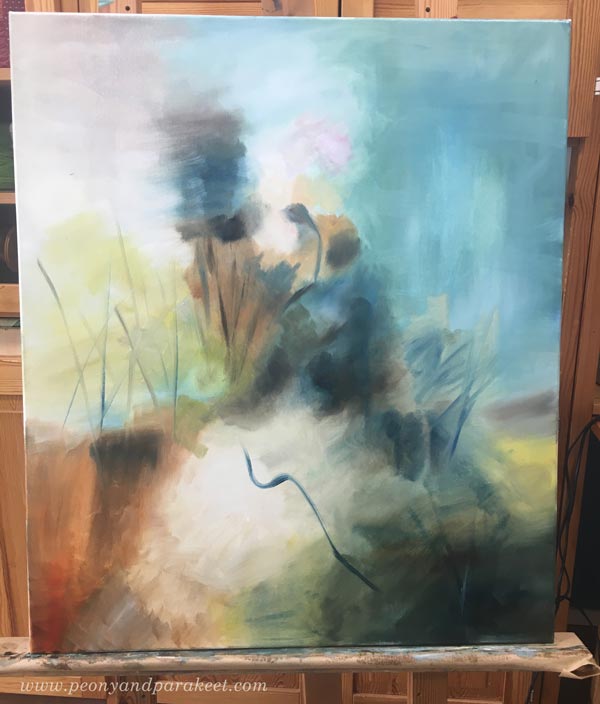
I wanted to incorporate haziness and vagueness into this painting, but at the same time use strong variations in darkness. With the big differences in color value, I wanted to create a sense of presence similar to Albert Edelfelt’s paintings.
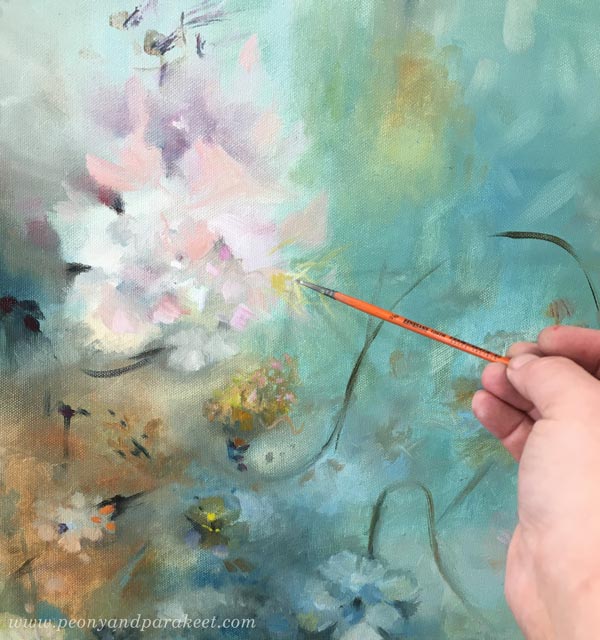
When I took this photo in the morning sun, it felt like the moment stopped and two Kaunosielus came into the picture.
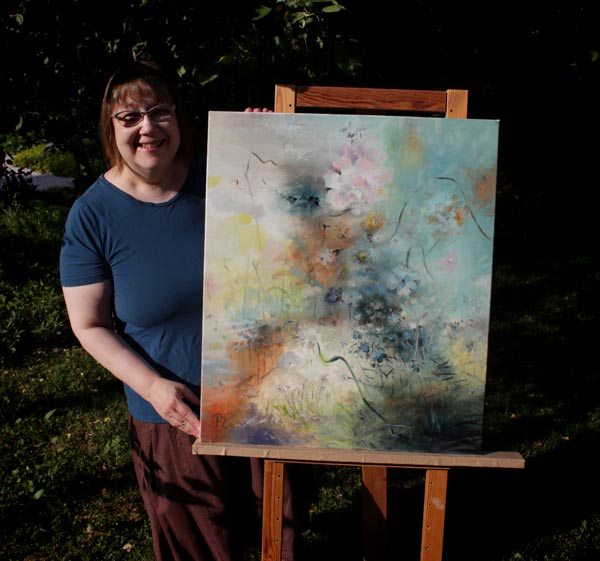
This photo shows so well how darkness and light go hand in hand.
This Week’s Challenges for Your Art-Making
- Empathize with the kaunosielu personality: Examine what it means to be an impractical but sensitive sielu – soul!
- Examine old portrait paintings. Dind the similarities between flowers and luxurious dresses.
- Be bolder with contrasts. Enhance your expression by combining pastel colors with really dark blues and browns.
- Experiment with soft pastels or oil pastels or mimic their effects with other art supplies.
I hope all these tips inspire you to start creating!
Get Creative in Drawing Ornaments!
This month, the focus is on art history. Art history is often talked about in a very serious tone, but let’s examine it through imagination and start by drawing ornaments!
Ornament Tells a Story from Childhood
It’s fascinating that even if the ornaments are stiff and organized compositions, one can express a whole story.
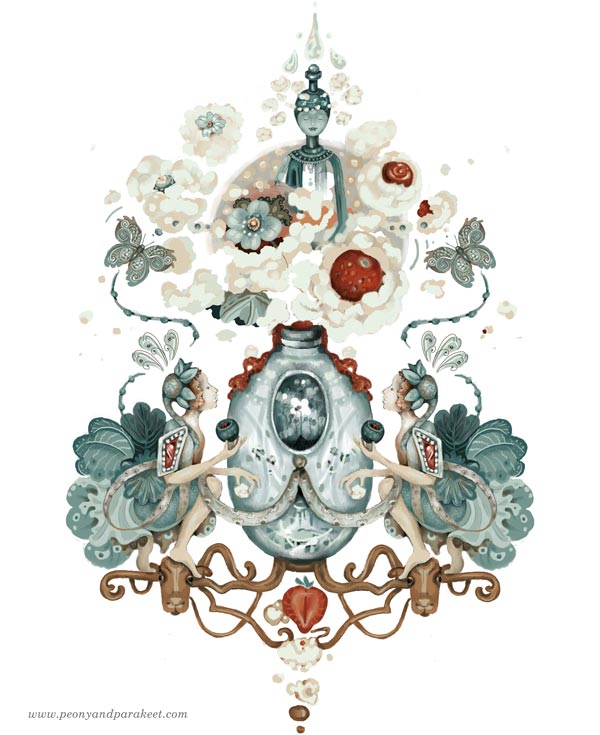
The background of this drawing is a funny story from my childhood. When the school asked each student’s favorite food, I answered “Mansikoita ja kermavaahtoa!” – Strawberries and whipped cream” while the others listed macaroni dishes or meatballs. Both the teacher and the students were quite shocked by the answer, but I wondered how anyone would prefer to eat something so modest and usual.
This story tells a lot about how I’ve always wanted to get away from the mundane. I still want to draw things so that they look like a luxurious celebration rather than a gray everyday life. I like drawing jewels, lace, floral motifs, and swirls, and you can have a lot of those on the ornaments.
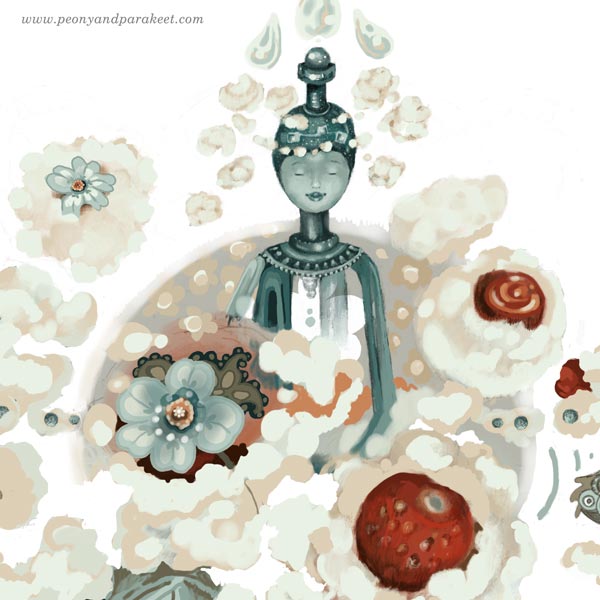
I often want to include people or animals too. For example here, I wanted to make the whisk half-human, and draw two fairies that enjoy the dessert.
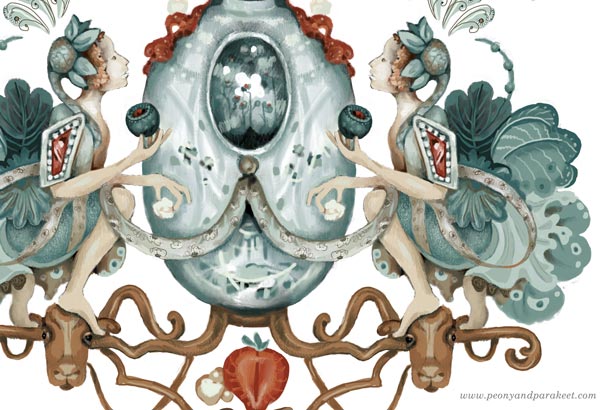
The method that I teach for human poses in the course Doll World was very helpful here.
Inspiration from Antiques, Old Buildings, and Paintings
There are plenty of ornaments in my photo archive. When I visit old buildings, I go through doors, ceilings, wall panels, and floors, looking for nice ornaments.
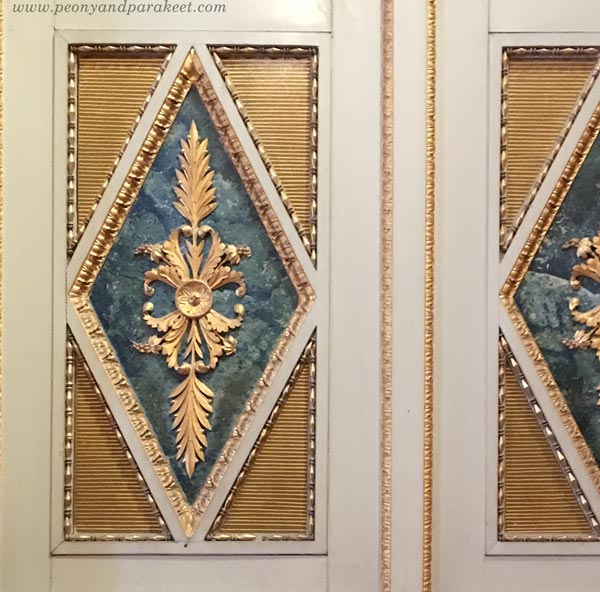
I also love to examine antiques closely.
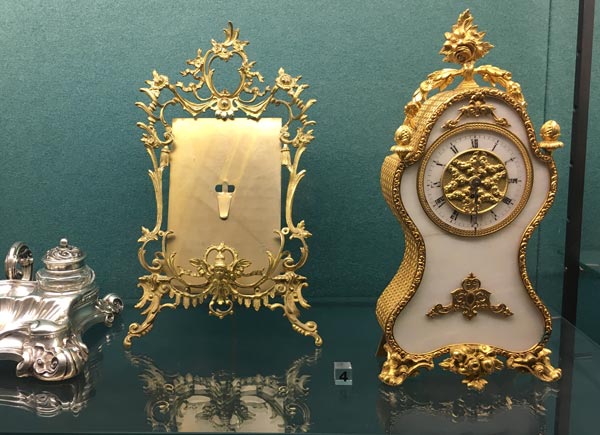
Old paintings often have lovely frames. Whenever I photograph one, I always try to include the frame in the picture.
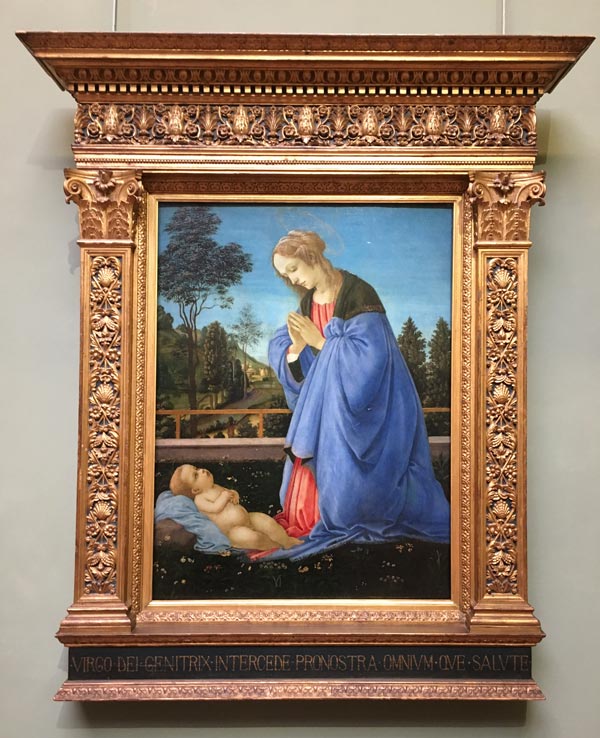
This frame is like an ornament representing a palace!
Lots of Simple Shapes
The decorative appearance of the ornaments can mislead you into overestimating their complexity. When an ornament is taken apart, the shapes can be quite simple.
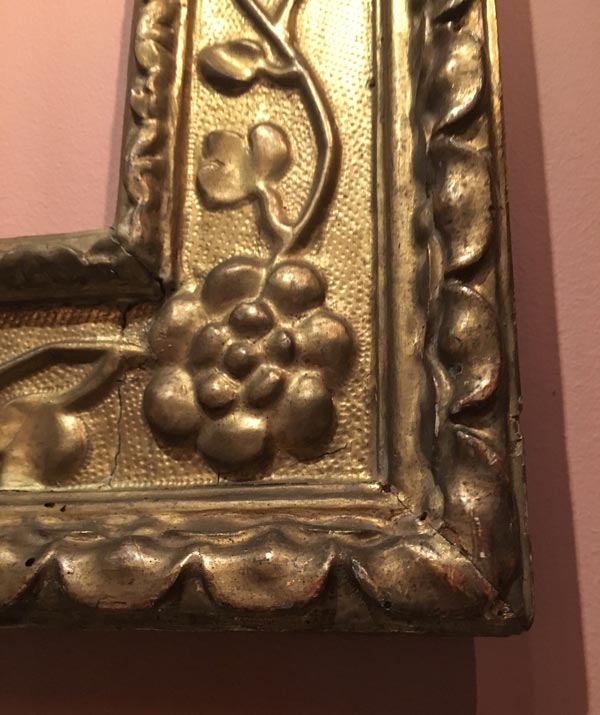
I love this kind of sophistication based on quantity and repetition, with which you can express anything – humorous subjects …
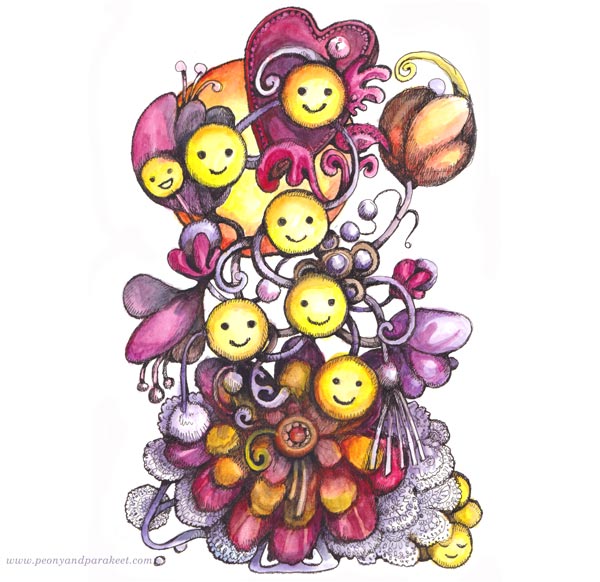
… or more serious.
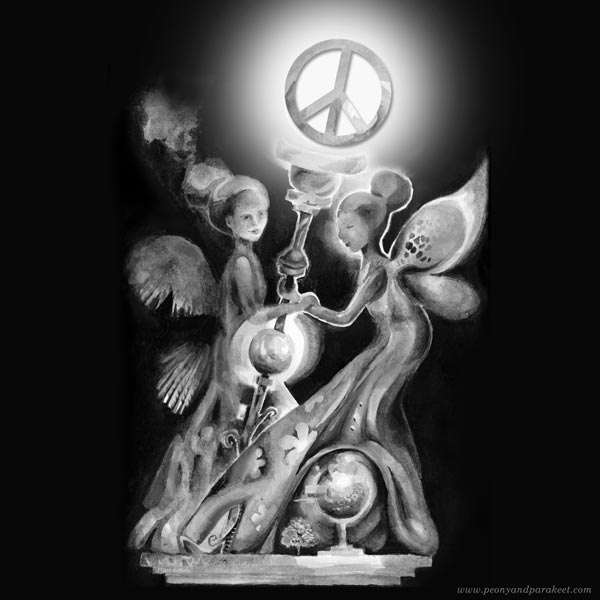
This example shows well that you can also express light when drawing ornaments.
Ornaments Can Both Hide and Reveal
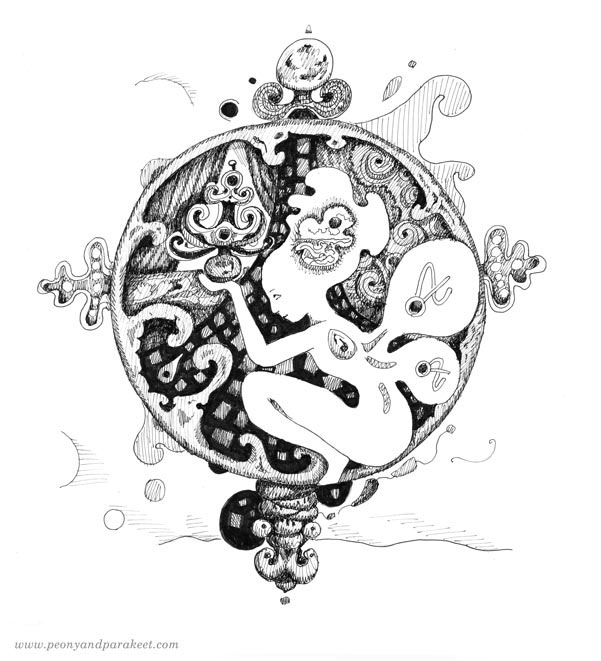
I am fascinated by the fact that although the subject can be drowned in decorative forms, it can also be brought out more directly and more concisely than in a regular drawing. Time travel to the past can become surreal when the horizon disappears and the items are arranged as part of a floating structure.
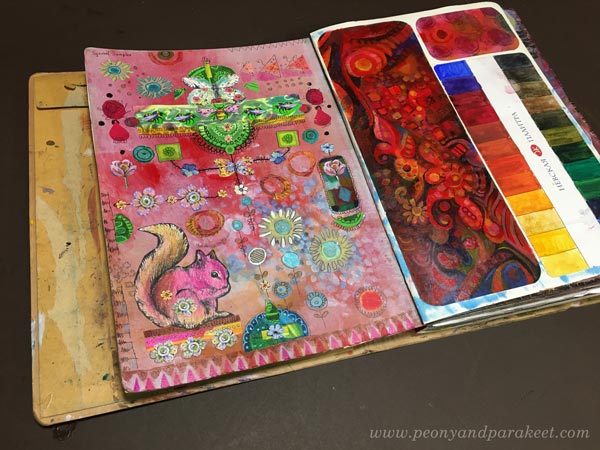
Ornaments as Collage Art
If drawing the whole ornament in one go feels too demanding, remember that the ornaments can also be collage art. You can glue individual elements so that they form a decorative tree or medallion. I have put together many kinds of ornaments from hand-drawn animals and hand-decorated papers.
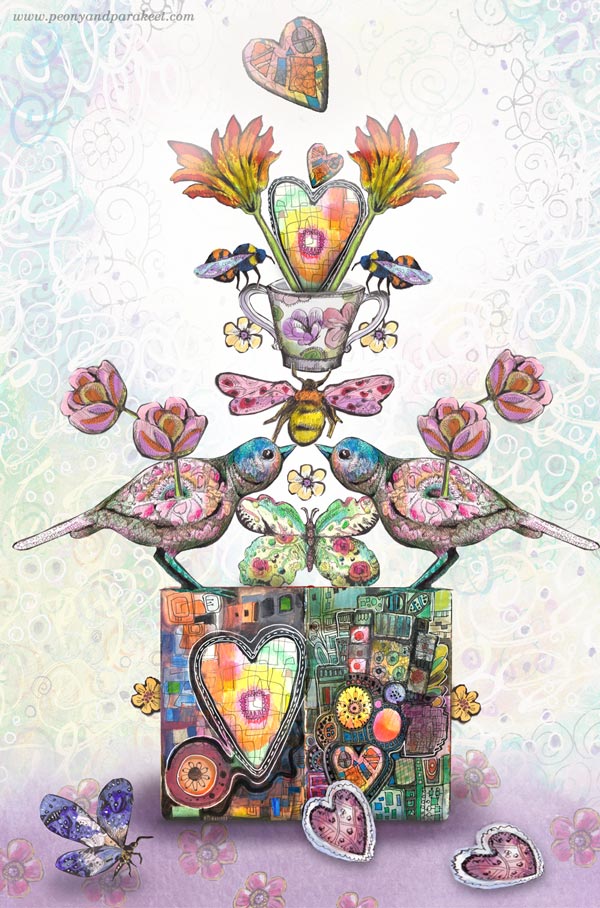
You can also scan or photograph the drawings and assemble the ornament digitally with an image processing program. Here are animal figures and flowers from the course Animal Inkdom and a teacup from the course Magical Inkdom.
Drawing Ornaments is Expressing the World
After working with ornaments for a while, you begin to realize that the world is largely based on them. Surface patterns are everywhere. The beauty of organic forms can be found in all living things.
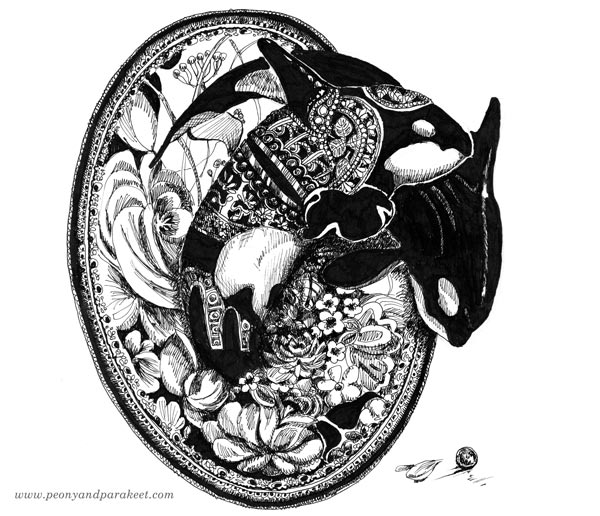
Ornaments build a bridge between the living and the non-living. They make the living an object and the object alive.
Hidden Love for Ornaments and How it Shows
I think that many of us have an innate need to design ornaments. Maybe you dream about designing fabrics or have a huge stash of them. Maybe you collect jewelry or save photos of them. Maybe you feel that something is lacking if you only draw or paint complete images and are not able to rearrange the composition so that it’s something more stylish and less representational.
I only realized this tendency of mine when I made ornaments as part of the illustration for a children’s book. Back then, I used transparent marker paper to design the symmetry, and my desk was full of different versions.
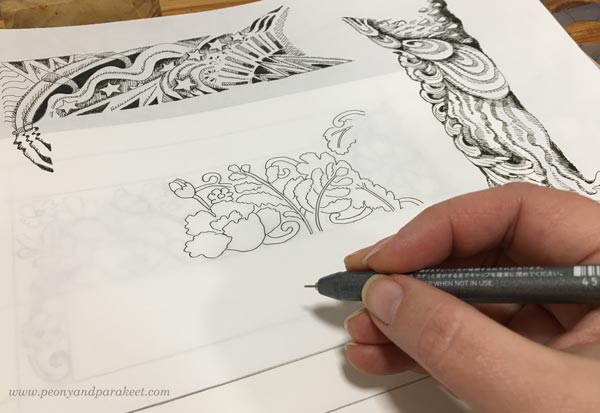
One day when picking the pen, I suddenly felt happy and meaningful: “I should do this more!” Since then, I have not underestimated even the smallest encounters with ornaments.
Drawing Ornaments Inspired by Embroidery
I relax from my work as an artist by doing cross-stitch and those projects also inspired me to draw ornaments.
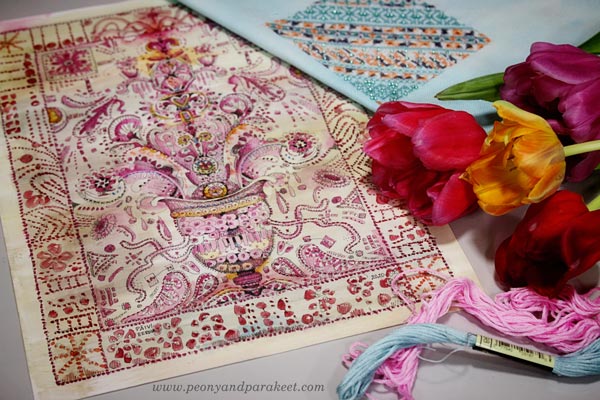
See here how to draw and color an embroidery-inspired ornament – Doodler’s Sampler Step by Step!
Drawing Ornaments without Perfect Symmetry
I drew the last ornament with the ProCreate app. The good things about it are that the background can be kept separate so that the background colors can be varied and it is easy to create symmetry. However, I think completely symmetrical ornaments are a bit too stiff and boring, so I also made quite a lot of asymmetry for this ornament.
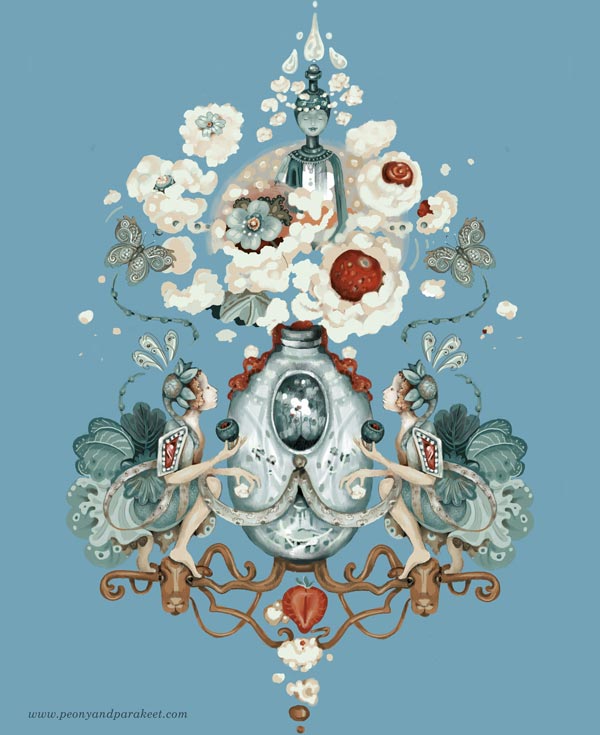
I hope you will start drawing ornaments right away whatever technique you choose!
Related Courses
- Doll World – drawing human poses – Buy here!
- Animal Inkdom – drawing animals – Buy here!
- Magical Inkdom – drawing fantasy – Buy here!
- Collageland – inspired by embroidery – Buy here!