
Joy of Nature in Colored Pencil
This week, we learn from nature and bring its joy to our colored pencil art.

It makes me sad how colored pencils are used only for replicating photos, and how little there is room for free expression. Nature grows freely, so why not give our art the same opportunity? I hope this post inspires you to do more intuitive coloring!
Joy of Nature: Patchwork
Think about nature sceneries as crazy quilts that have fabrics and seams! The fabrics are larger areas and the seams are lines. Patchwork has short seams, so keep your lines quite short too.

When you walk in nature, stop, and see the quilt by searching for the mesh of trees and bushes. Observe how twigs cross over each other and form nature’s patchwork.
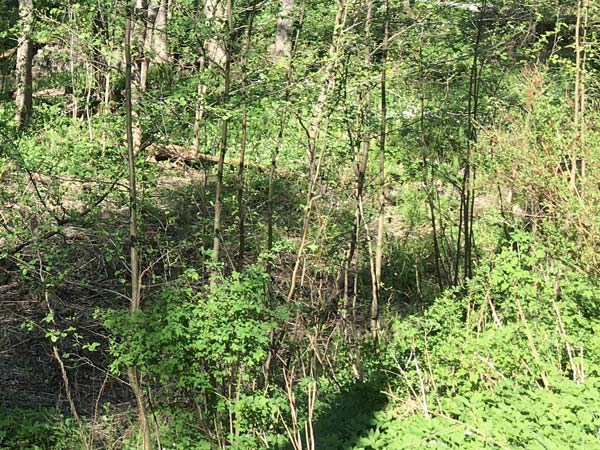
Then when you start coloring a blank paper, focus on building the asymmetric and abstract style quilt, rather than thinking about trees and such.

I find this kind of “patchwork coloring” a lot of fun. Many call this mark-making, but I like to think about creating a patchwork instead. Marks are a more abstract term but textiles connect me to the creative world that is full of ideas.
Joy of Nature: Harmony
Despite its patchy structure, nature sceneries have harmony that our art often lacks. When you walk in nature, step back to admire the big picture and point out the areas by their dominating colors. You could think that the sky and earth both have a few quilts: patchwork areas that mostly have similar colors.
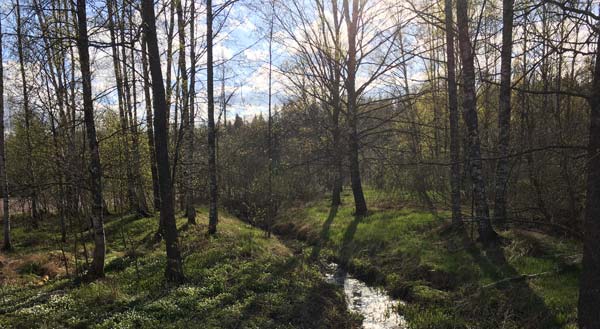
So, when your paper has all kinds of patchwork, compose larger areas by coloring over them so that they get a stronger identity in color. For example, you can have a couple of green areas, a dark area, a more neutral brown area, and one with very light colors.

So, first, you start coloring gently with a wider color scheme and then add larger unified layers over the colorful patchwork.
Joy of Nature: Spirit
I like to think that light is nature’s spirit. When you walk in nature, seek for this spirit. You miss the spirit, if you only point out the big concrete things in the scenery like bushes, trees, water, and sky. To see the spirit, you have to step into the abstract world and look for the light: odd shapes on the trunks of the trees, pattern play on the leaves, and in general, all kinds of small reflections.
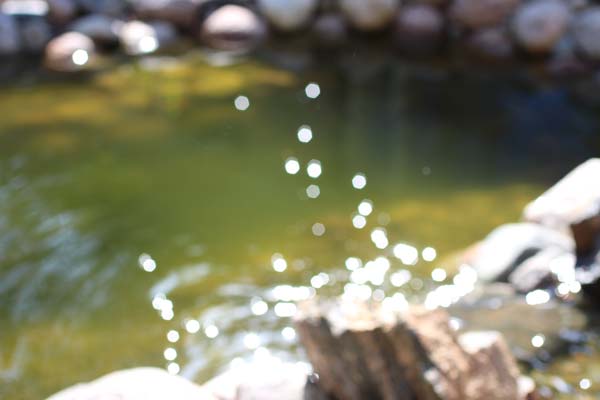
For me, it’s helpful to think that the spirit has twins. One is the light and the other is the shadow. When you want more light, you will also get stronger shadows.
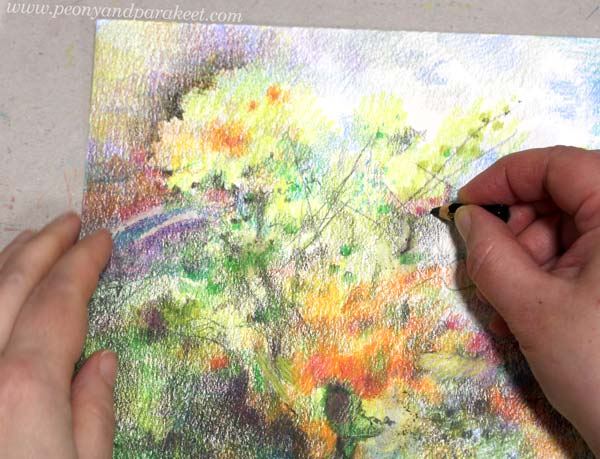
Light and shadows add contrast and scatter. When you add them to your piece, it becomes less harmonic, but also less boring.
Joy of Coloring Small
Recently, my colored pencil pieces have been quite small, and the paper has been divided into smaller pieces.
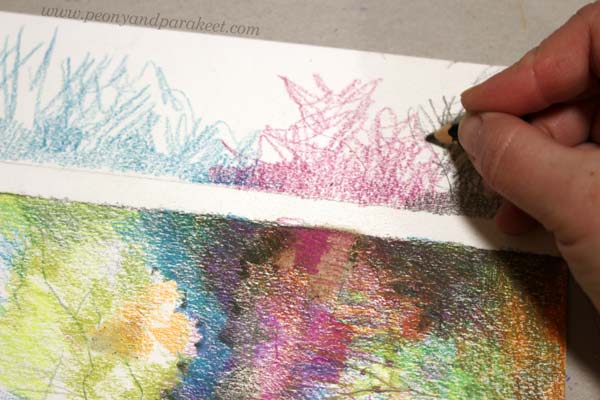
Coloring can be a bit like weeding: you can do it little by little.
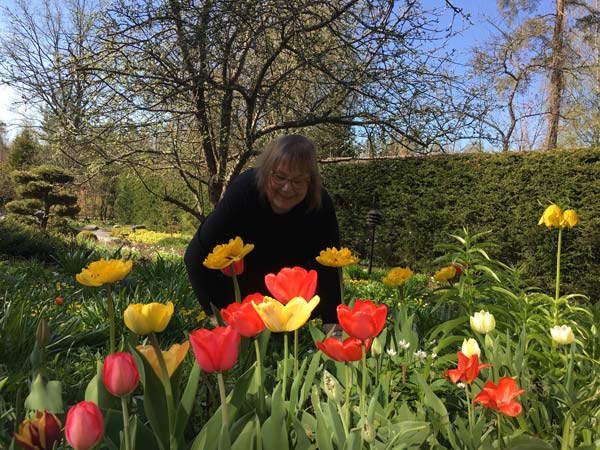
First, the result is nothing, but it will bloom over time.

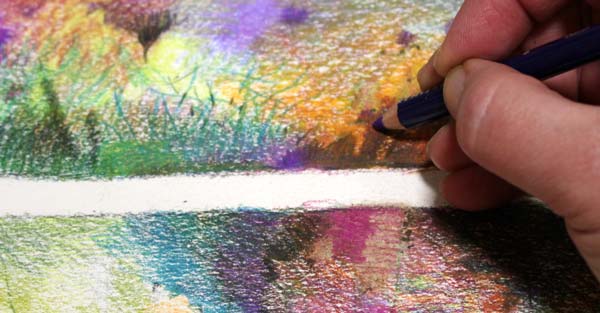
Colored pencils beat other supplies when we are creating this kind of small joyful art.
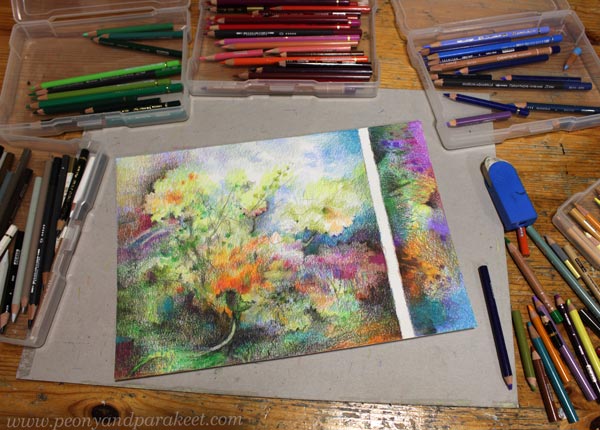
Here one A4-sized paper has two pieces of colored pencil art. So, you can take short walks or long walks to express the joy of nature in colored pencil.
Mother Nature is the best art teacher. That’s why most of my classes are about what I have learned from her.
12 Spring Art Ideas from Over the Years
This week, I share spring-themed art from the past 10 years and give ideas for creating spring art.
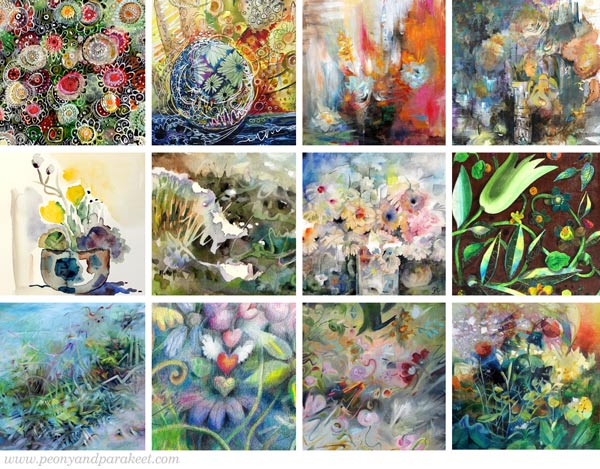
There’s a variety of ideas and I hope everyone can find some that inspire to get creating!
#1 – For Beginners and Dull Moments
Doodle spring flowers with the mindset “more is more”!
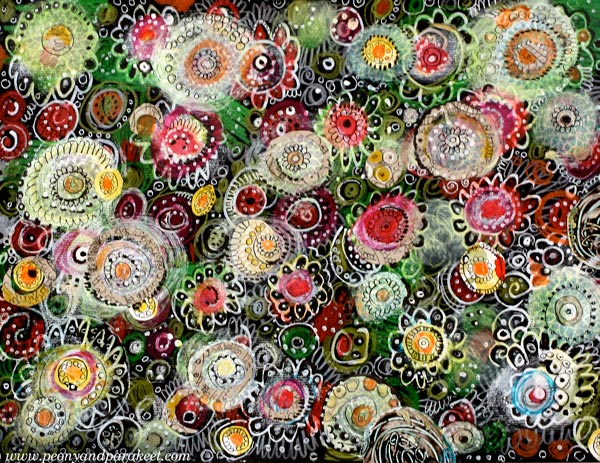
See the blog post: Subconscious Art
Course recommendation: Collageland
#2 – For Self-Explorers
Express your spring energy by following this step-by-step exercise: Bursting Circle
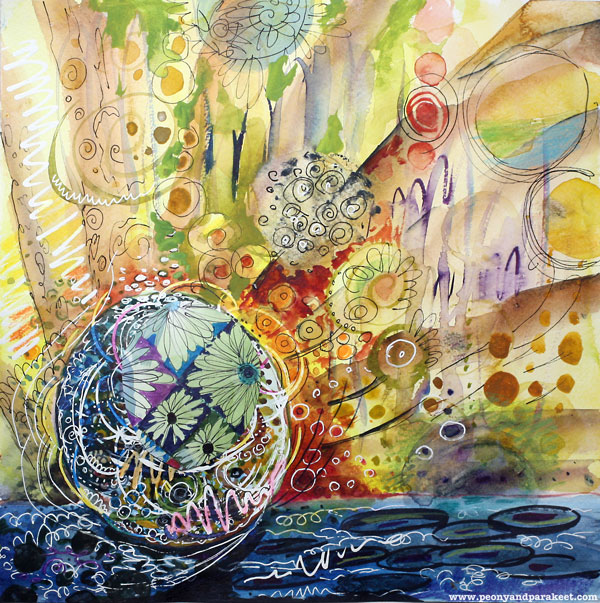
See the blog post: Bursting Circle
Course recommendation: Inspirational Drawing
#3 – For Free Spirits
Splash color and let everything grow from there!
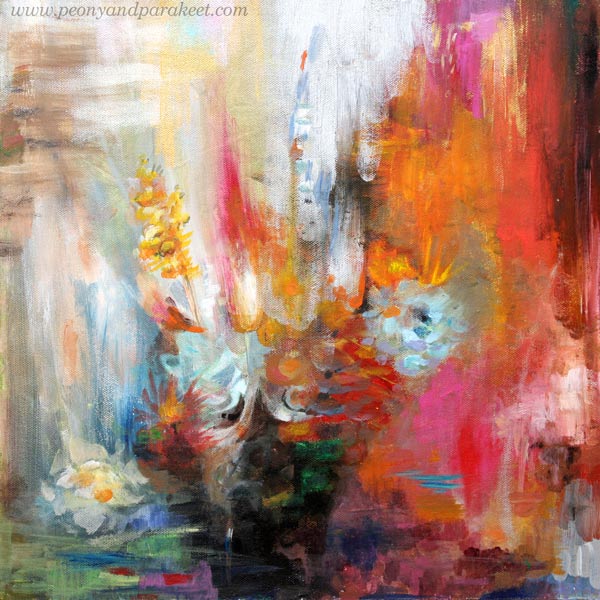
See the blog post: Art is Freedom
#4 – For Those Who Want to be Freer
When you want to be freer, the art of seeing is as important as the art of creating.
See the video of making “March Still Life”: Painting in Liberated Style
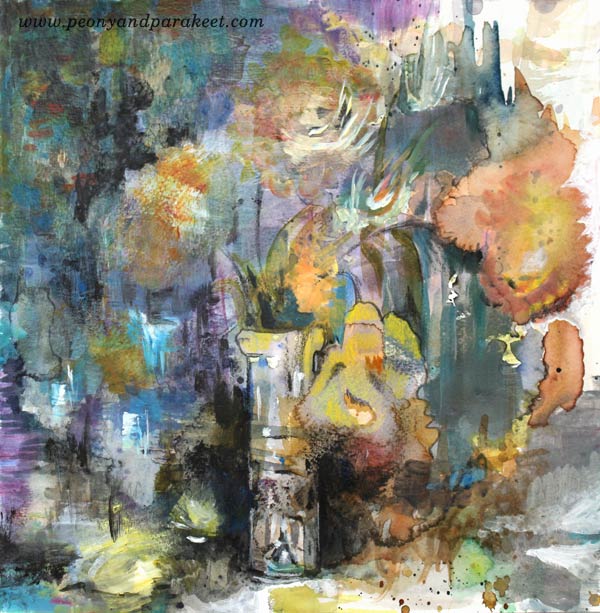
See the blog post: Painting in Liberated Style
Course recommendations: Liberated Artist Revisited and Freely Grown
#5 – For Minimalists
Pick a small piece of watercolor paper, moisten your watercolor pans, and let water do the trick.
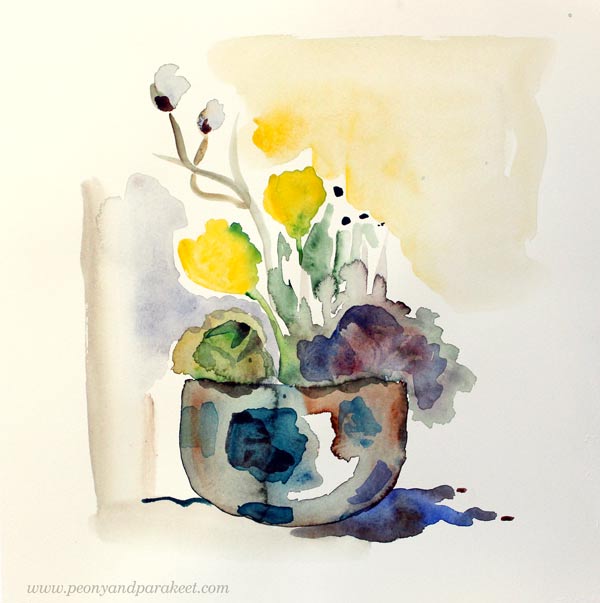
See the blog post: Easter Still Lifes in Watercolor – Video Included!
#6 – For Travelers
Paint a spring panorama. More examples: Watercolor Panoramas to Express Travel Memories
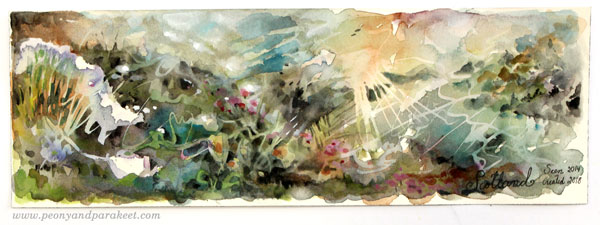
See the blog post: Watercolor panoramas to Express Travel Memories
Course recommendation: Watercolor Journey
#7 – For Beautiful Mess-Makers
Beautify the mess by adjusting the details: paint frilly edges and draw fine lines!
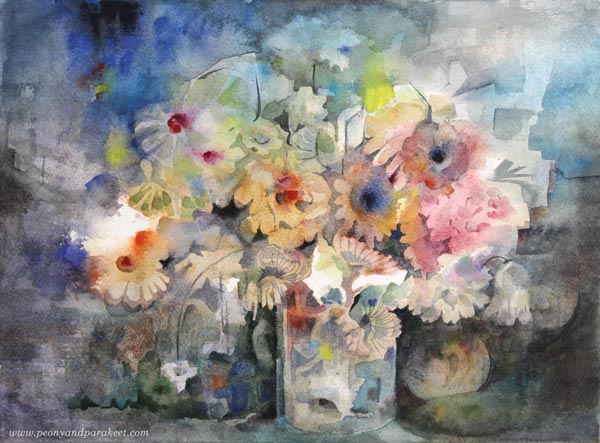
See the blog post: Freely Born Watercolor Florals
Course recommendations: Floral Fantasies and Freely Grown
#8 – For Journalers
Decorate a journal cover with your original art! See more instructions in this blog post: Painted Paper Collage
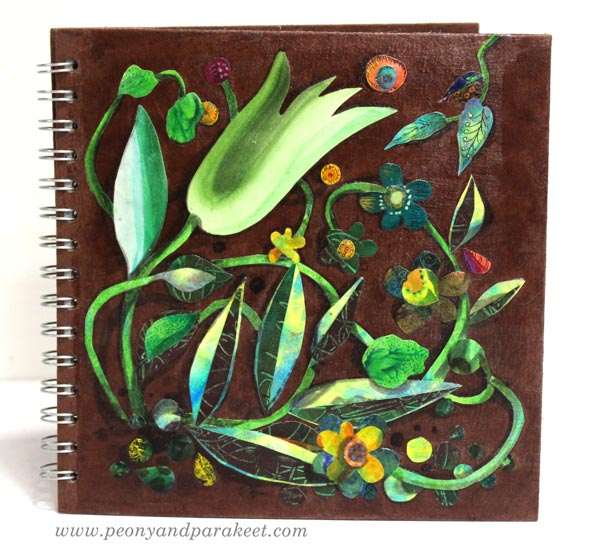
See the blog post: Painted Paper Collage – 6 Tips for Intricate and Fun Art
Course recommendations: Collageland and Decodashery
#9 – For Bird Watchers
Take this challenge to move from illustration to fine art:
Step out of your comfort zone and think about a bird shape as a canvas for expressing its surroundings.
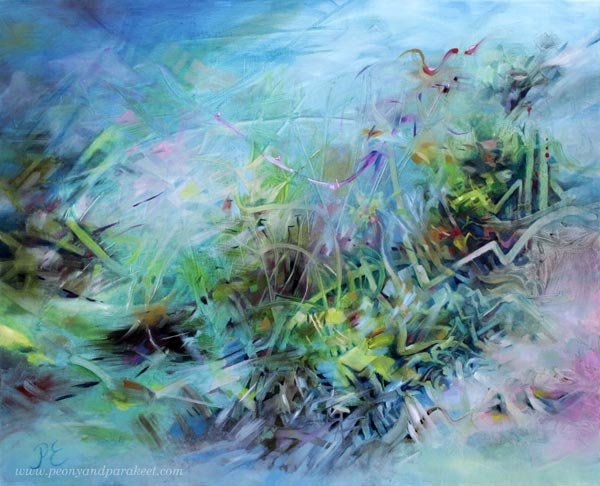
See the blog post: Pros and Cons of Becoming an Artist
Course recommendation: Floral Freedom
#10 – For Art Lovers Who Procrastinate
Reduce watching those photo-realistic colored pencil videos and start coloring freely. One heart shape can lead to many and start your flight to the world of imagination!
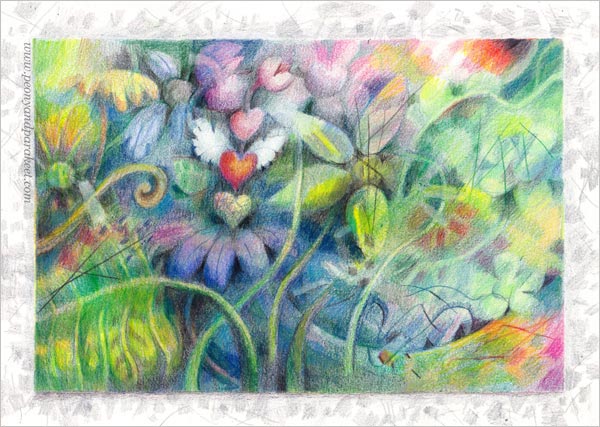
See the blog post: 5 Reasons Why I Love Colored Pencils
Course recommendations: Intuitive Coloring and Fun Botanicum
#11 – For Wannabe Fantasy Artists
Find the story first, then its surroundings! A character is not only described by his face.
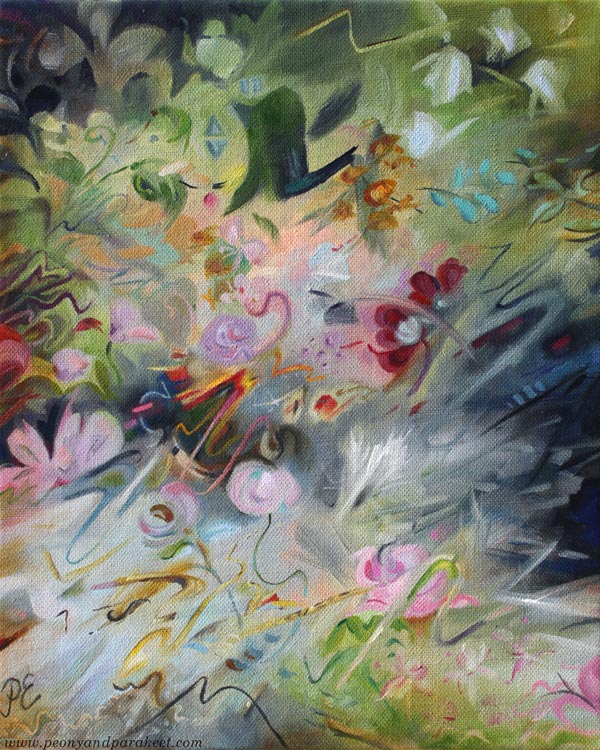
See the blog post: Wonderland Art – Inspiration from Alice in Wonderland
Course recommendations: Magical Forest and Magical Inkdom
#12 For Artists at Heart
Our creativity has winter and spring too. We need each other to keep the inspiration going – to turn the winter into spring.
A challenge for you: How can you make a new start – create a new spring for your art?
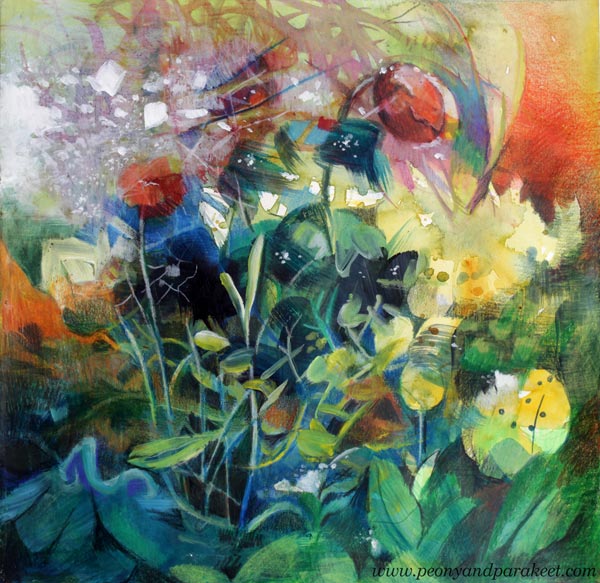
See the blog post: New Beginnings in Art-Making
Course recommendations: Liberated Artist Revisited
Bonus Idea #1: Spring Art Display
Gather your art on a side table for display! Make a collection of all kinds of pieces – even the smallest drawings and collage pieces can look fun this way.
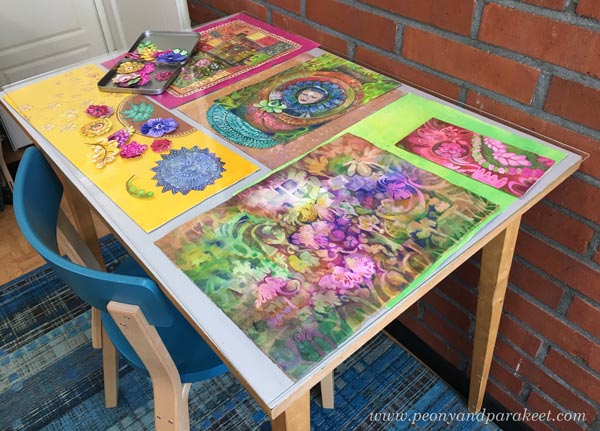
I have a plastic plate that is the same size as my table.
It protects my art, and it also protects the tabletop when painting in watercolor.
Bonus Idea #2: Listen to This!
I also have a music recommendation: “Kevät”
Kevät is spring in Finnish and the song was presented by a Finnish girl band Tavaramarkkinat in 1985. Here’s an English translation of the lyrics. The tone of the song is melancholic. This kind of controversy between melancholy and joy is one of the most inspiring things in spring, I think!
P.S. PostScript for Spring Art Ideas
We still have a lot of snow in Finland, and I miss spring so much! In these spring art ideas, I wanted to combine my yearning for spring and the celebration of being a full-time artist for ten years. The actual anniversary is in September, but I want to celebrate this life span the whole year of 2024.
One part of the celebration has been making the course Liberated Artist Revisited where I invite you to paint with me – to follow directions from Paivi many years ago, and then create more with the current Paivi. At the same time, you can ponder, how your art-making has changed and will change.
Because of the 10-year celebration and the nature of personal stories, Liberated Artist Revisited is a limited edition – only available for purchase until the end of March 2024! >> Buy Now!
Beginner’s Video Art – Paintings Come Alive
This week, I have a video, but it’s different than what I have ever made so far.
A lot has happened in the last few months, and it has also changed my attitude towards life. I have come to believe in destiny. Usually, when I’ve looked back, I’ve seen my life as loose threads. I remember the words of a professor of control engineering from decades ago: “Miss Eerola, what are you aiming for with your studies?”
I finally have an answer for him, maybe he will read my blog from the afterlife and be pleasantly surprised.
Now I know why I have studied programming, vehicle navigation, robotics, control engineering, and industrial design with 3D modeling. Now I know why the boys playing computer games feel my tribe even though I don’t play at all. Now I know why the nerd in me didn’t die even when I was painting oil paintings day after day.
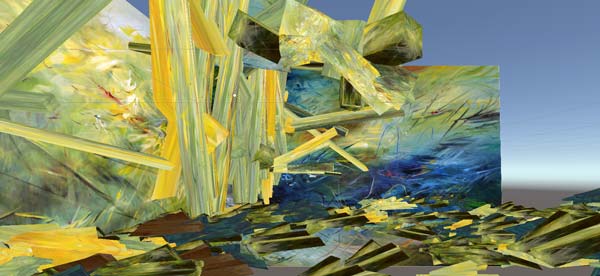
I have programmed this digital work using the Unity game engine. The video has two of my oil paintings in the background: Runaway Sun and Happy Earth.
Beginner’s Video Art
I’m still quite clumsy in this sport. so this is more of a practice piece than a fine video artwork. But I have learned from all art-making that it’s ok to be a beginner. And it’s ok to share pieces that are not the best of you, at least when you look at them after a while!
When my husband saw the video, he wasn’t very satisfied with the outcome. But I told him that it doesn’t really matter if you’re going on a long hike if the first gas station serves a modest meat pie. The journey is long and there will be plenty of experiences – at least if fate works as it has so far!
Thank you to the Finnish Cultural Foundation for the grant, which allows me to make digital art for many more months.
Fantastic Watercolor Sceneries
This week, we explore watercolor sceneries. Landscapes have always been an uncomfortable theme for me, but despite that, I consider myself to be some kind of landscape painter. Even this digital watercolor painting is a landscape.
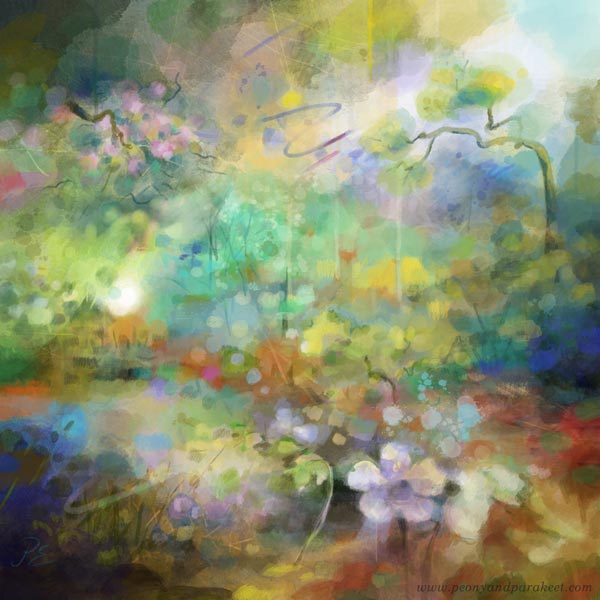
Here I mixed the memories of the sunny days of the last fall with the eager wait for the upcoming blooming season.
What Do Landscapes Mean to You?
I think that landscapes are relevant to any growing artist. It is important to look at your relationship with basic themes such as:
- human or animal – portrait
- inanimate object – still-life
- nature – landscape
Of these, I have the closest relationship with the landscape, and through that, I also have a special relationship with places.
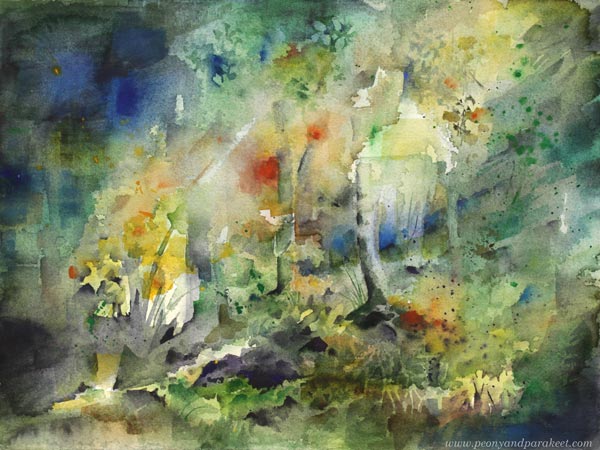
Even if I take photos of interesting sceneries, I am not at all enthusiastic about copying the landscape as it is. I’m a romantic who sees even the ugliest grass field as an exciting jungle. I often crouch down to explore the world from the perspective of a modest plant, where everything looks big and grand.
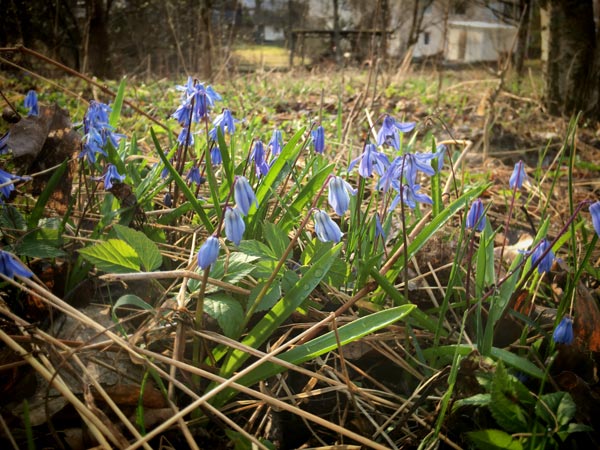
The landscape can also be a stage for an event. When I looked out the window of my room as a child, I was saddened by the fact that nothing was happening in the small area of detached houses. However, I paid attention to the house visible on the hill and how its roof seemed to change color in different lighting and in different seasons.
This kind of slow dynamics characteristic of the landscape is fascinating because when we paint we are not prisoners of time. We can fill the view with all kinds of activity. Various colors and states of one object can be gathered and everything can be lifted into flight and movement.

By thinking about what a landscape means to me, I have built a bridge to my childhood and enabled creative play.
From Traditional Landscapes to Expanded Sceneries
Even if I now see playfulness in landscapes, it took me a long time to realize that traditional landscape painting can be expanded. You can choose to express a real place, but make a completely own interpretation of it.
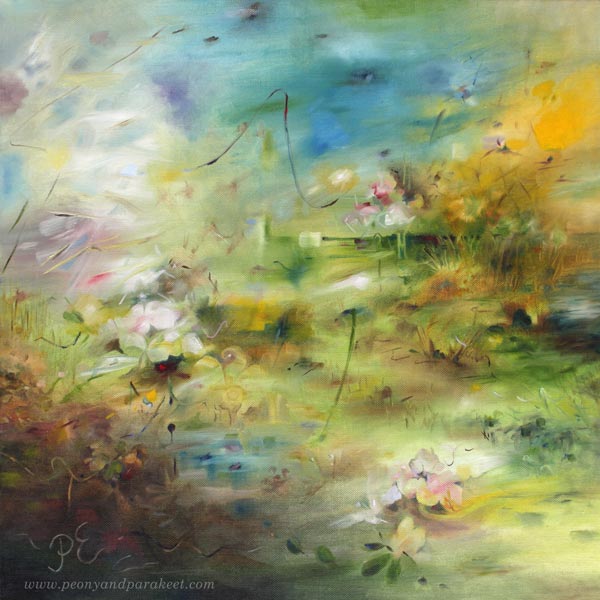
For me, watercolors have played a key role in this realization. In 2018, I started making small panorama paintings, in which I painted holiday travel memories, picking up details here and there from the photos as if reconstructing the place.
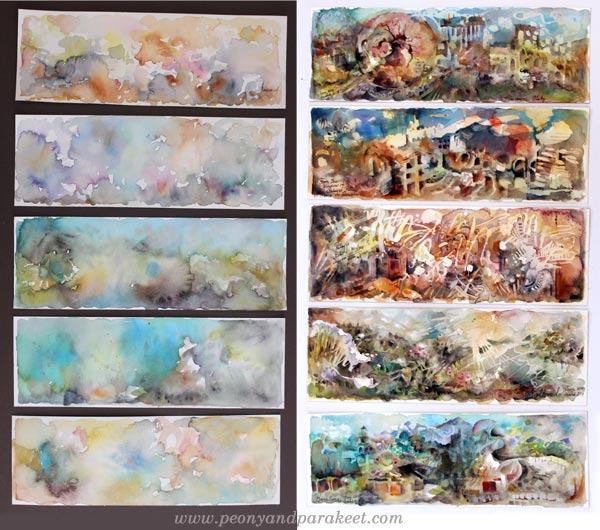
See this post to read more about these watercolor panoramas!
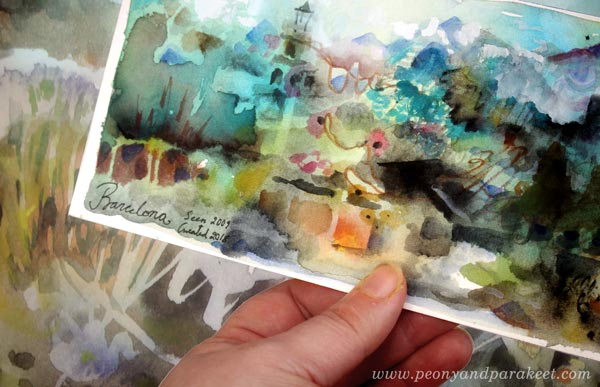
I also had a small sketchbook where I made watercolor sceneries, some realistic, some fantasy. See this post to watch a video about keeping a watercolor diary!
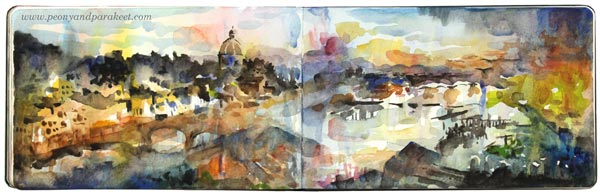
And of course, I also made the course Watercolor Journey from my insights.
In this course, you travel between imagination, memories, and reality. >> Buy here!
The Journey Continues
At the moment I am painting a small ditch, from which I have grown a beautiful landscape on a large canvas.
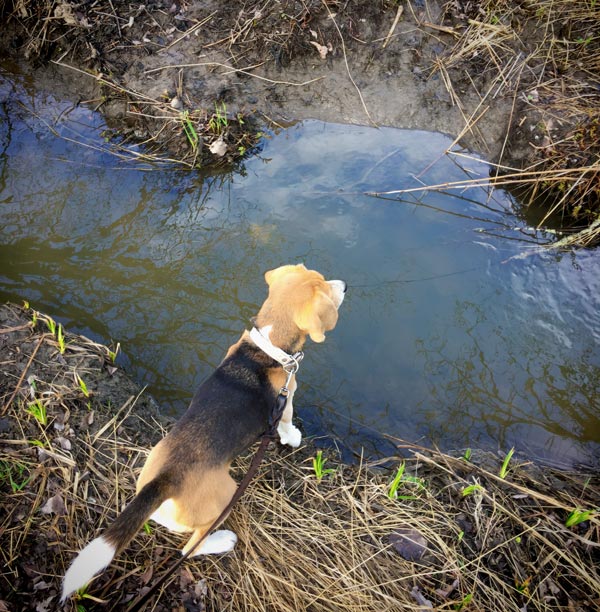
In the painting, a lot is happening and nothing is static or insignificant.
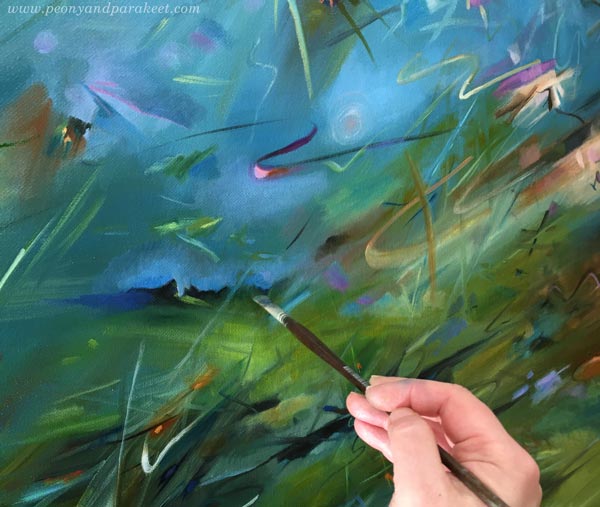
In art, the only limit is our imagination. It doesn’t matter where we live, in our paintings we can make it the place we want to travel to next!